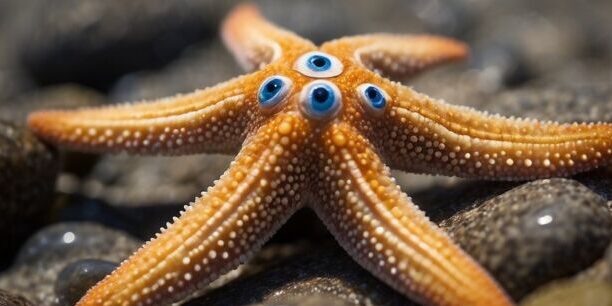
Animals with more than 2 eyes include iguanas and tuataras with a light-sensitive third eye; lampreys with two lateral eyes plus pineal and parapineal photoreceptors; five-eyed honey bees and praying mantises; eight-eyed spiders; multi-eyed scorpions and horseshoe crabs; sea stars with an eye at each arm tip; three-eyed Triops; five-eyed Opabinia; and certain chitons with hundreds of shell-embedded eyes.
Those structures do not all work like human eyes. Some form detailed images, while others mainly register motion, brightness, ultraviolet light, or the direction of a light source. Eye count also does not equal visual sharpness: a jumping spider can extract fine detail with two principal eyes, while a chiton uses hundreds of much smaller eyes to monitor the space above its shell.
This fact-checked list compares the number, type, and function of each visual organ. For another angle on animal vision, see our guide to animals with the best eyesight.
Key takeaways
- Extra eyes often divide the work. One pair may resolve detail while smaller eyes monitor motion, light level, or orientation.
- A compound eye still counts as one eye. Its many ommatidia are repeating visual units inside a single organ, not thousands of separate eyes.
- Counts can vary. Scorpion species have different numbers of lateral eyes, and a sea star usually has one eye per arm.
- The four-eyed fish is a naming trap. Anableps has two eyes, each divided into aerial and aquatic optical regions.
- Some “third eyes” are photoreceptive organs. The parietal eyes of iguanas and tuataras detect light but do not provide the detailed scene vision produced by their main eyes.
What counts as an eye?
The word eye covers several kinds of light-sensing structures. That distinction matters when comparing animals from very different branches of the animal kingdom, especially invertebrates.
- Camera-type eye: Uses a lens to focus light onto a retina. Human eyes, the main eyes of reptiles, and a jumping spider’s principal eyes follow this broad plan.
- Compound eye: Contains many repeated units called ommatidia. Each compound eye is one organ, even when it contains thousands of facets.
- Ocellus: A simple eye, often used to measure brightness, horizon position, or rapid changes in illumination.
- Parietal, pineal, or parapineal photoreceptor: A median light-sensitive organ linked to the vertebrate brain and biological timing systems.
- Arm-tip or shell eye: A visual organ built into an unusual body structure, such as a sea star’s arm or a chiton’s shell plate.
The table below uses the count most commonly applied to each animal, with a note where anatomy or species variation makes a single number misleading.
13 animals with more than two eyes at a glance
| Animal | Typical eye count | Main eye types | What the extra eyes do |
|---|---|---|---|
| Iguana | 3 | Two lateral eyes and one parietal eye | Detects light and supports biological timing |
| Tuatara | 3 | Two lateral eyes and one parietal eye | Registers light and seasonal or daily cues |
| Lamprey | 4 eye-like photoreceptors | Two lateral eyes plus pineal and parapineal organs | Combines image vision with light-cycle sensing |
| Praying mantis | 5 | Two compound eyes and three ocelli | Judges prey distance and monitors illumination |
| Honey bee | 5 | Two compound eyes and three ocelli | Detects color, ultraviolet patterns, motion, and brightness |
| Ogre-faced spider | 8 | Eight simple eyes, including two greatly enlarged eyes | Supports nocturnal prey detection |
| Jumping spider | 8 | Two principal eyes and six secondary eyes | Separates detailed inspection from wide-field motion detection |
| Scorpion | Usually 6–12 | Two median eyes and two to five pairs of lateral eyes | Measures light and movement; touch remains more important |
| Chiton | Hundreds in certain species | Mineral-lens eyes embedded in shell plates | Forms coarse images of objects above the shell |
| Sea star | One per arm, often 5 | Compound eye at each arm tip | Supports low-resolution navigation |
| Horseshoe crab | Commonly counted as 10 | Compound, median, simple, and ventral eyes | Combines image formation with visible- and ultraviolet-light sensing |
| Triops | 3 | Two compound eyes and one naupliar eye | Supports navigation and orientation to light |
| Opabinia | 5 | Five eyes reconstructed from fossils | Likely helped monitor prey and predators; function is inferred |
Reptiles and jawless fish with extra light-sensitive organs
1. Iguana
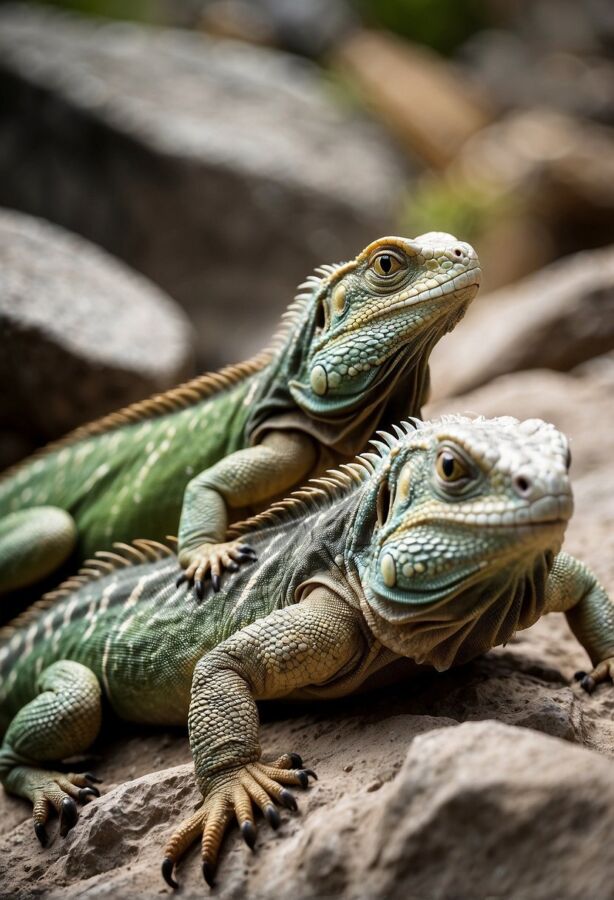
Many lizards, including the green iguana (Iguana iguana), have a small parietal eye beneath a translucent scale on top of the head. It contains photoreceptor cells but does not produce the detailed images formed by the two lateral eyes.
Research on the green iguana’s parietal eye and pineal complex shows that these organs participate in light sensing, melatonin rhythms, and the regulation of daily body-temperature cycles. Sudden changes in overhead illumination may also provide useful warning information, but the best-supported function is photoreception tied to biological timing.
2. Tuatara
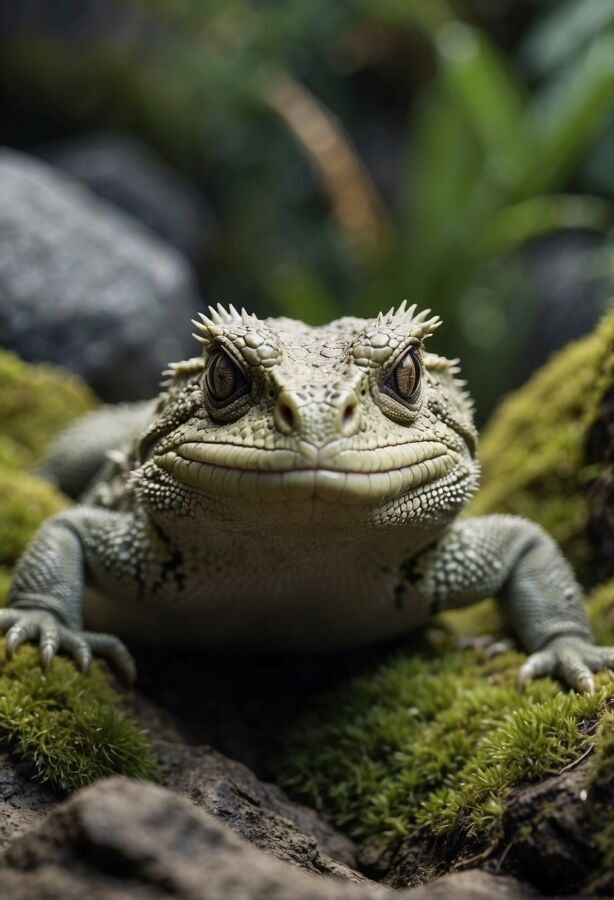
The tuatara (Sphenodon punctatus) is the only living representative of Rhynchocephalia, a reptile lineage distinct from lizards and snakes. Its third, parietal eye has a lens, retina, and nerve endings, but it is used for light detection rather than ordinary scene vision.
According to the San Diego Zoo Wildlife Alliance, the organ is visible through the skin of young tuatara and becomes covered with scales and pigment within months. It may help track the time of day or season. Tuatara are endemic to New Zealand, where the Department of Conservation monitors remnant island populations and threats from introduced mammals.
3. Lamprey

Lampreys are jawless vertebrates with two conventional lateral eyes and two median photoreceptive organs: the pineal and parapineal. A Current Biology study of the vertebrate pineal complex describes lampreys as four-eyed because both median organs form eye-like, light-sensitive structures.
The lateral eyes support image vision after metamorphosis, while the pineal complex helps animals respond to environmental light cycles. Calling all four structures identical would be misleading, but the lamprey is one of the clearest living examples of a vertebrate with more than two distinct eye-like photoreceptors.
Insects and arachnids with multiple eyes
Insects and arachnids often split visual tasks across different eye types. The sections below also show why the fact that insects are animals matters when comparing vision across the animal kingdom.
4. Praying mantis
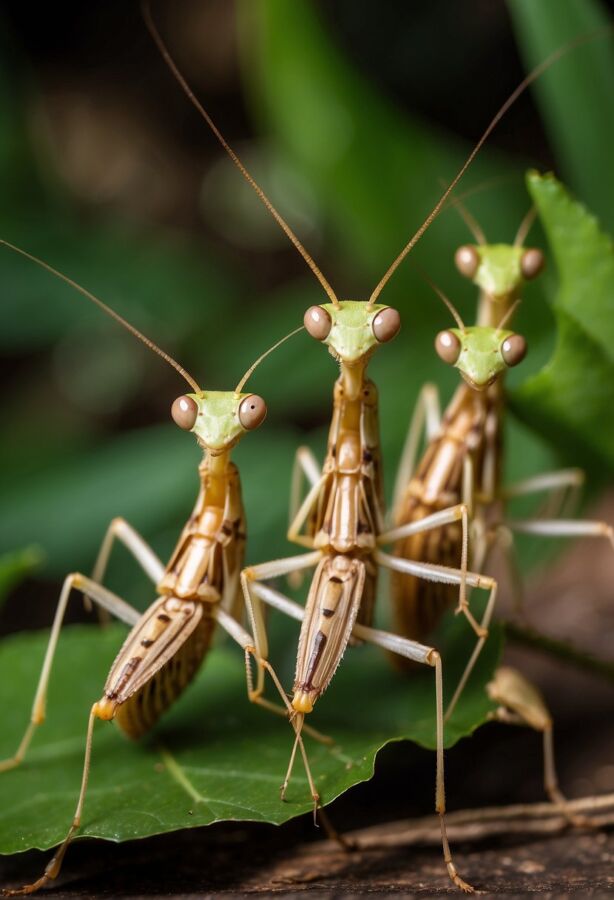
A praying mantis has five eyes: two large compound eyes and three small ocelli between them. The compound eyes supply the spatial and motion information needed to aim a strike, while the ocelli are better suited to broad changes in brightness and orientation.
Mantises are especially important to vision research because they use binocular depth information. Experiments reported in Current Biology showed that mantis stereopsis follows a visual strategy different from human stereopsis, demonstrating that small nervous systems can solve the same depth problem in a different way.
5. Honey bee

Honey bees (Apis mellifera) also have five eyes. Their two compound eyes detect motion, patterns, and color, including ultraviolet wavelengths that humans cannot see. Three ocelli on the top of the head monitor light and changes in illumination.
The University of Florida’s honey bee anatomy guide explains how ultraviolet-sensitive vision helps bees locate flower patterns associated with nectar and pollen. That visual ability supports both wild pollination and greenhouse pollination by bees.
6. Ogre-faced spider
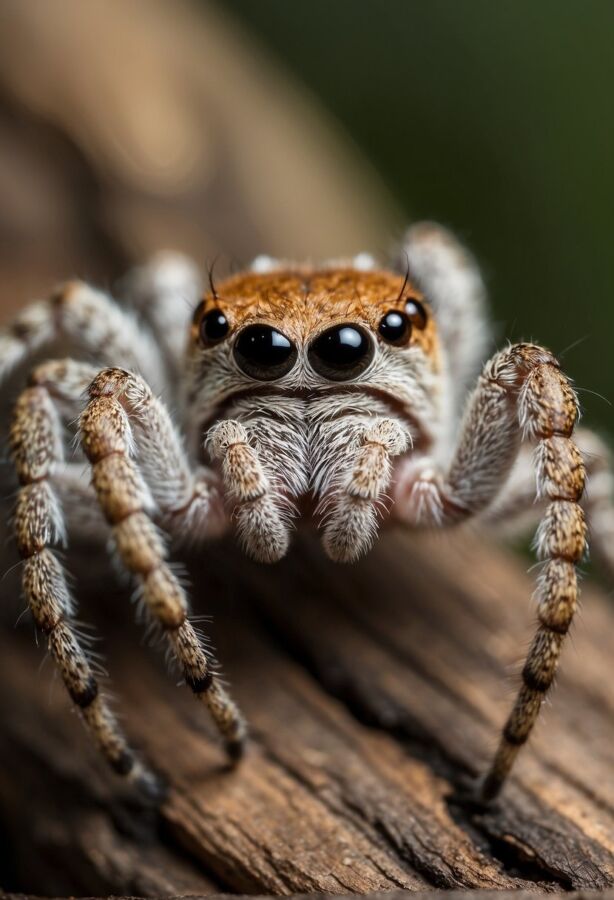
Ogre-faced spiders, also called net-casting spiders, have eight eyes. Two posterior median eyes are so enlarged that they dominate the face, an adaptation that increases sensitivity during nocturnal hunting.
In field experiments with Deinopis spinosa, blocking those enlarged eyes reduced successful captures of prey moving across the ground. The peer-reviewed study supports a precise conclusion: the oversized eyes improve night foraging, rather than giving the spider universally sharp vision in every direction.
7. Jumping spider
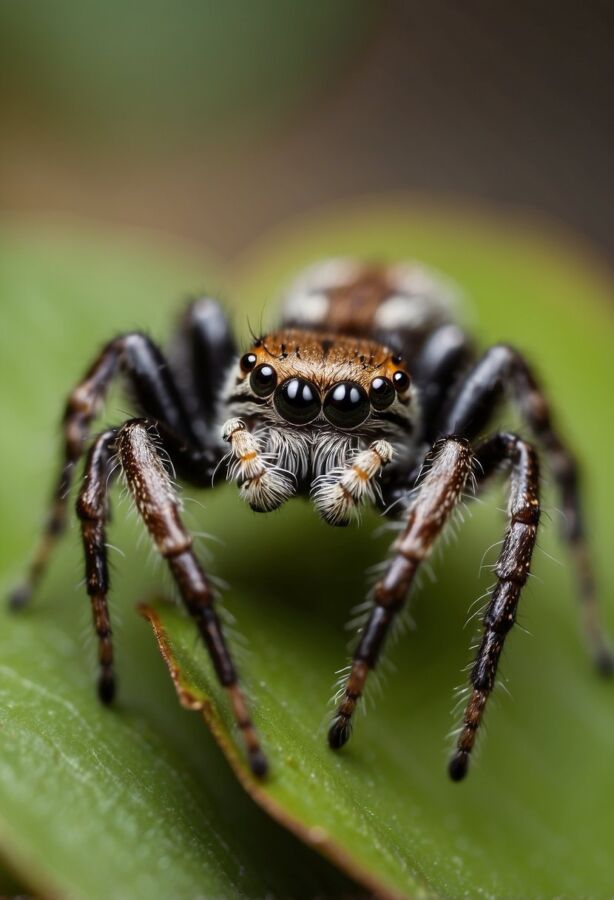
Most jumping spiders have eight eyes arranged in four pairs. The large anterior median, or principal, eyes inspect detail and can support depth judgments. The six secondary eyes cover a much wider field and are highly effective at detecting movement.
Experiments on jumping-spider responses to approaching objects show that secondary eyes can trigger rapid defensive reactions even when the principal eyes are masked. Eye number and arrangement vary across spider lineages. For a separate arachnid anatomy misconception, see why a spider may appear to be a six-legged spider.
8. Scorpion
Scorpions usually have two median eyes on top of the carapace plus two to five pairs of lateral eyes near the front corners. That produces a typical total of six to twelve eyes, although some cave-adapted species have reduced eyes or none.
More eyes do not give scorpions high-resolution vision. Texas A&M AgriLife notes that scorpions see poorly and depend heavily on touch, vibration-sensitive hairs, and comb-like pectines beneath the body. Their eyes are most useful for monitoring light and broad movement.
Marine animals with unusual visual systems
Some of the most unusual visual organs belong to unusual sea creatures. In these animals, eyes can be built into armor, distributed across arms, or combined with extraocular photoreceptors.
9. Chiton

Chitons are marine mollusks protected by eight overlapping shell plates. Certain species have hundreds of tiny eyes embedded directly in those plates. These are not merely unstructured light spots: they contain pigment, a retina, and a lens made from aragonite, a form of calcium carbonate.
Research on Acanthopleura granulata found that the aragonite lenses can form coarse images in both air and water. The animal can respond to dark objects overhead, although its resolution is far below that of a human or jumping spider. Not every chiton species has this eye type, so “hundreds of eyes” should not be applied to the entire class.
10. Sea star (starfish)
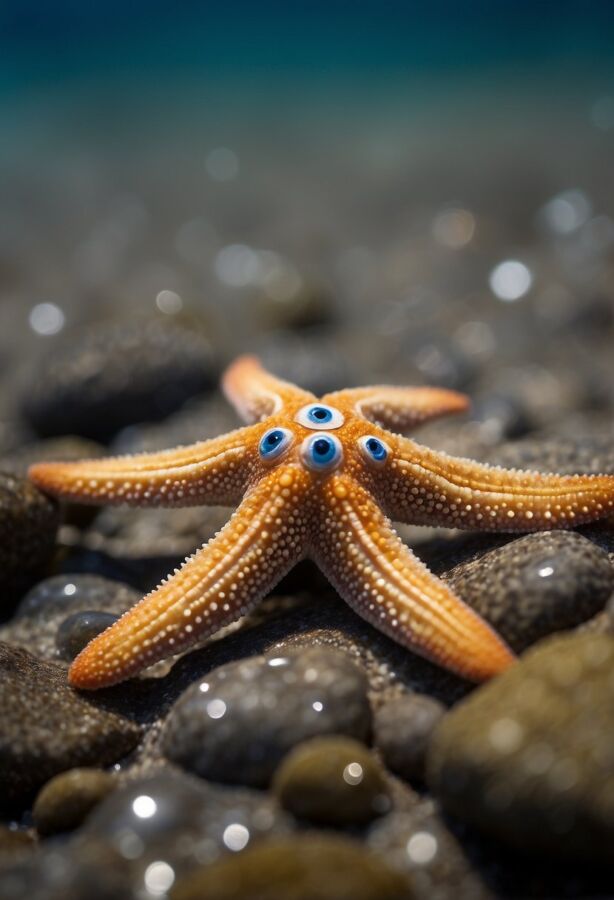
Most known non-burrowing sea stars have a compound eye at the tip of each arm. A typical five-armed sea star therefore has five eyes, but species with more arms can have more.
These eyes are more capable than the old label “eyespot” suggests. Experiments with the blue sea star Linckia laevigata showed that its arm-tip eyes form low-resolution images used for navigation. The animal cannot resolve fine detail, but it can recognize large habitat structures and orient toward a reef.
11. Horseshoe crab

Horseshoe crabs are chelicerates, making them closer relatives of spiders and scorpions than of true crabs. They are commonly described as having ten eyes, including two large lateral compound eyes, several median and simple eyes on the carapace, and a pair of ventral eyes near the mouth.
The two lateral eyes are the main image-forming organs and contain more than a thousand ommatidia each. Other photoreceptors detect visible or ultraviolet light and help coordinate behavior. Educational sources often reach ten by counting the telson photoreceptor system, while anatomical descriptions may list nine discrete eyes and treat the tail receptors separately. A detailed review of the horseshoe crab visual system explains this division of labor.
Ancient crustaceans and fossil animals with extra eyes
12. Triops

Triops are branchiopod crustaceans that often live in temporary pools. They have two sessile compound eyes close to the midline and one naupliar eye located centrally, giving them three eyes in total.
An anatomical guide from Lander University notes that light reaches the naupliar eye through a ventral window in the head. Together, the three eyes help the animal orient and move through short-lived habitat types such as rain-filled depressions and vernal pools.
13. Opabinia
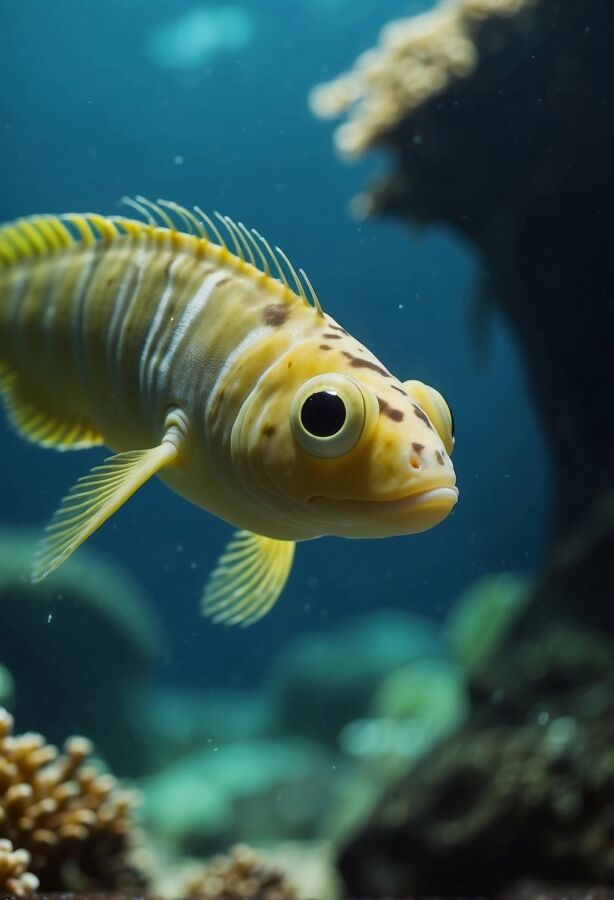
Opabinia regalis lived about 505 million years ago and is known from Burgess Shale fossils. Reconstructions show four eyes on short stalks plus a larger central eye, for a total of five.
The Royal Ontario Museum’s Burgess Shale record describes the five eyes, flexible frontal proboscis, swimming lobes, and the uncertainty surrounding the animal’s exact relationship to later arthropods. Because no living Opabinia can be observed, claims about how well it saw or exactly how each eye functioned remain informed inferences from anatomy and ecology.
Why the “four-eyed fish” does not count
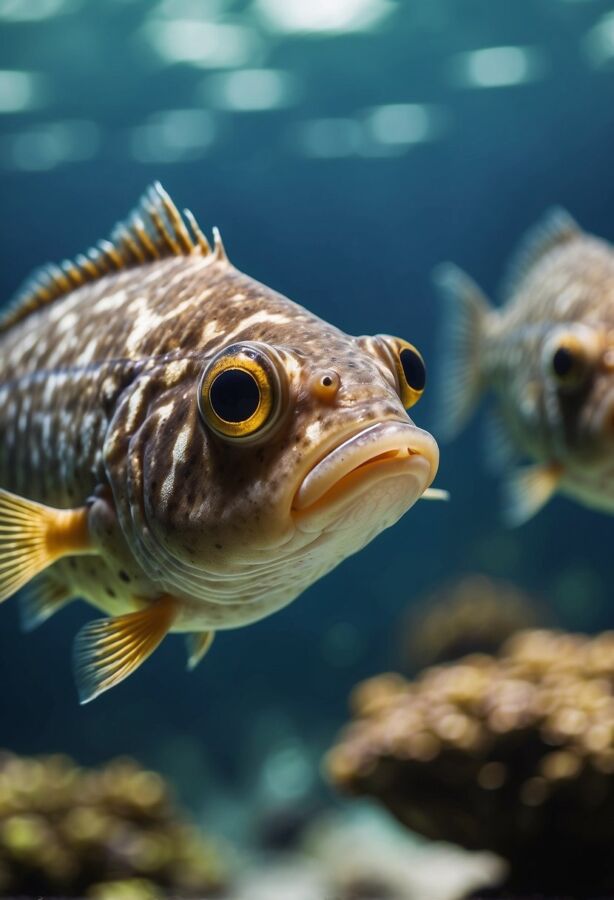
Four-eyed fish in the genus Anableps are often included in lists of multi-eyed animals, but they have only two eyes. Each eye has duplicated corneal and pupil regions positioned around the waterline, while light from both regions passes through a single lens to specialized parts of the retina.
A developmental study of Anableps anableps eye anatomy documented the divided pupils, divided corneal regions, and dorsal-ventral retinal specializations. The fish belongs in a discussion of unusual vision, but not in the numbered list of animals with more than two actual eyes.
Why multiple eyes evolve
Multiple eyes evolve when dividing sensory work improves survival or reproduction. The advantage is not simply “more vision.” It is specialization.
- Detailed inspection plus early warning: Jumping spiders use principal eyes for detail and secondary eyes for wide-field motion.
- Depth plus light monitoring: Mantises use compound eyes to judge prey distance and ocelli to track broad illumination cues.
- Day-night and seasonal timing: The parietal and pineal organs of reptiles and lampreys connect environmental light to internal rhythms.
- Distributed coverage: A sea star places one eye at each arm tip, while a chiton spreads eyes across protective shell plates.
- Vision at an environmental boundary: Anableps does not add more eyes, but it divides each eye to handle air and water at the same time.
These examples show how animals adapt to their environment by modifying an existing sensory system rather than following one universal design. Evolution can enlarge two eyes, distribute many small eyes, split tasks among different eye types, or repurpose a light-sensitive organ for biological timing.
Frequently asked questions
What animal has the most eyes?
There is no universally agreed winner because scientists distinguish between image-forming eyes, simple ocelli, and other light-sensitive organs. Among the animals in this article, certain chitons have the highest count, with hundreds of lens-bearing eyes embedded in their shell plates.
Why do some animals have more than two eyes?
Multiple eyes can divide visual tasks. One set may resolve detail or depth, while other eyes detect motion, changes in brightness, the horizon, or threats approaching from another direction.
Do all spiders have eight eyes?
No. Eight is common, but some spider species have six, four, two, or no functional eyes. Eye number and arrangement vary with evolutionary history and habitat.
Does a four-eyed fish really have four eyes?
No. Four-eyed fish in the genus Anableps have two eyes. Each eye is divided into upper and lower optical regions that receive light from above and below the waterline.
Do sea stars have eyes?
Most non-burrowing sea stars have a compound eye at the tip of each arm. A five-armed sea star therefore usually has five eyes, but the total varies with the number of arms.