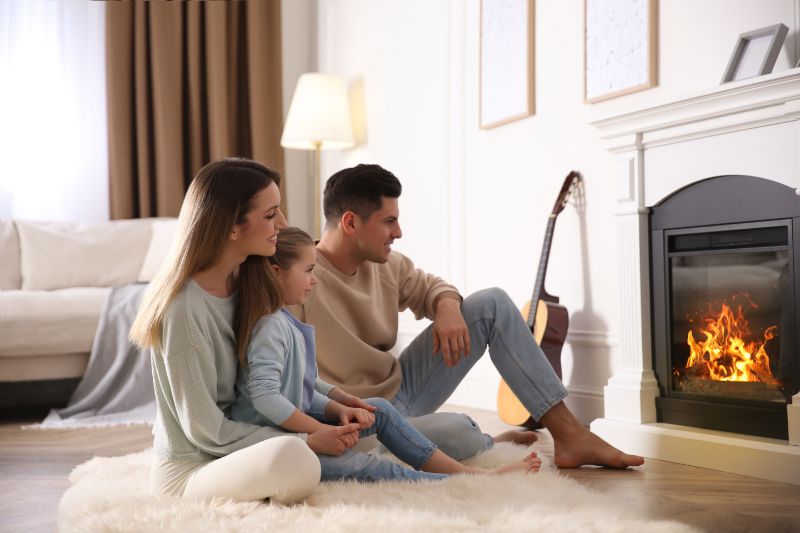
Eco-friendly fireplaces are lower-impact alternatives to open wood-burning hearths that reduce direct indoor air pollution, avoid unnecessary fuel use, or deliver useful heat more efficiently. For most homes, an electric fireplace is the lowest-emission option inside the room because it does not burn fuel at the appliance. Its total environmental impact still depends on the local electricity supply, the heater setting, and how long it runs.
Electric fireplaces are best treated as decorative appliances with supplemental zone heat. Most plug-in models top out near 1,500 watts, or approximately 5,100 Btu per hour. That can take the chill off an occupied room, but it does not make the unit a replacement for a properly sized whole-home heating system.
Last reviewed: July 14, 2026. Product specifications and availability were checked against manufacturer and retailer documentation. We did not personally laboratory-test these units. This article contains affiliate links; Our Endangered World may earn a commission from qualifying purchases at no additional cost to you.
What Is the Most Eco-Friendly Type of Fireplace?
An electric fireplace is usually the best fireplace choice for indoor air quality because it produces no combustion smoke, soot, carbon monoxide, or nitrogen dioxide at the appliance. Electric resistance heat converts the incoming electricity into heat inside the room, but that does not make every electric fireplace carbon-free. The wider impact depends on how the electricity was generated.
The U.S. Department of Energy’s electric-heating guidance distinguishes point-of-use efficiency from upstream generation losses. U.S. readers can use the EPA Power Profiler to compare their regional electricity mix and emission rates.
If your main objective is efficient primary heating rather than a flame effect, an air-source heat pump is normally the stronger option. A heat pump moves heat rather than creating it through electrical resistance and can deliver substantially more heat per unit of electricity.
Key Takeaways
- Best for indoor air quality: Electric fireplaces, because there is no combustion at the appliance.
- Best for serious renewable-fuel heat: A correctly sized, professionally vented, EPA-certified pellet appliance where local rules and fuel supply make sense.
- Best for a real flame without handling wood: A professionally installed direct-vent gas fireplace, with the understanding that it still burns a fossil fuel.
- Best used cautiously: Bioethanol fireplaces. They create a real flame but are not emission-free, and liquid-fuel refilling requires strict safety controls.
- Weakest environmental choice: A traditional open wood fireplace, which releases smoke and fine particles while sending substantial heat up the chimney.
- Primary-heating alternative: Consider a heat pump before relying on a decorative electric fireplace for long daily heating periods.
Electric, Pellet, Gas, Bioethanol, and Wood Fireplaces Compared
| Fireplace type | Direct indoor emissions | Venting | Best use | Main tradeoff |
|---|---|---|---|---|
| Electric | No combustion emissions at the appliance | None | Ambiance and supplemental zone heat | Upstream impact depends on the electricity supply; resistance heat is less efficient than a heat pump |
| EPA-certified pellet | Particulate matter and combustion gases remain | Required | More substantial space heating where biomass fuel and local rules permit | Requires fuel, electricity, ash removal, vent maintenance, and emission control |
| Direct-vent gas | Combustion products are vented through a sealed system | Required | Real flame and higher heat output | Uses natural gas or propane and requires professional installation |
| Bioethanol | Carbon dioxide, water vapor, and potentially other combustion pollutants | Often marketed as ventless; room-volume and ventilation instructions still matter | Decorative real flame | Fuel cost, indoor-air effects, spill risk, and severe refilling hazards in poorly designed units |
| Open wood fireplace | Smoke, fine particles, carbon monoxide, and other pollutants | Chimney required | Occasional ambiance where legally permitted | High pollution and poor practical heating efficiency compared with modern sealed appliances |
Wood pellets are compressed biomass, but they are not always made exclusively from “recycled sawdust.” Feedstock, sourcing, moisture content, appliance quality, and local air-quality restrictions all affect the result. EPA certification reduces emissions compared with older uncertified heaters; it does not eliminate combustion pollution.
How We Selected These Fireplaces
The shortlist prioritizes products with accessible specifications, a clear use case, realistic 120-volt heating expectations, appropriate installation information, and current or continuing manufacturer or retailer documentation. We also considered format, controls, furniture function, safety features, assembly burden, and the risk of buying an incomplete or obsolete bundle.
- Direct indoor emissions: Every ranked product is electric and avoids combustion inside the room.
- Useful specifications: Wattage, insert size, TV capacity, installation method, and controls were favored over vague environmental claims.
- Realistic heating role: These are supplemental heaters, not whole-home HVAC systems.
- Availability transparency: Model revisions and bundle uncertainties are stated rather than hidden.
- Category fit: Fuel bottles were excluded because they are consumables, not fireplaces.
The previous Dynasty Harmony 55-inch recommendation was also removed. Dynasty currently documents a revised Harmony range, while the older linked 55-inch product no longer has enough current manufacturer support to justify a primary recommendation.
Best Eco-Friendly Fireplaces at a Glance
| Model | Format | Heating specification | Best for | Important limitation |
|---|---|---|---|---|
| R.W.FLAME 50-Inch | Wall-mounted or recessed | 750W or 1,500W | Best all-around wall format | Confirm the exact model dimensions before framing a recess |
| Ameriwood Lamont | Freestanding mantel with bookcases | 120V supplemental insert | Storage and a traditional mantel look | Not designed to support a television |
| Dimplex Fieldstone | Large stone-look mantel | 1,500W; approximately 5,118 Btu/h | Premium rustic design | Exact insert revision and availability vary |
| Ameriwood Farmington | Rustic TV console | 23-inch supplemental insert | Value-oriented media storage | Heavy flat-pack furniture requiring assembly |
| Real Flame Torrey | Premium media cabinet | Thermostat-controlled infrared insert | Hidden storage and a wide firebox | High price and substantial assembled weight |
| ClassicFlame Deerfield | Large media console with speakers | Depends on the selected 42-inch insert | Large televisions and integrated audio | Confirm that the firebox is included in the linked bundle |
| ClassicFlame Pioneer | Compact stone-look mantel | 18-inch infrared insert | Traditional styling in a smaller footprint | Supplemental heat despite broad area-coverage marketing |
1. R.W.FLAME 50-Inch Electric Fireplace — Best All-Around Wall Model
Best for: Buyers who want a modern wall-mounted or recessed focal point without adding a full furniture cabinet.
Not for: Anyone expecting whole-room heating comparable to a furnace, heat pump, or permanently installed high-output appliance.
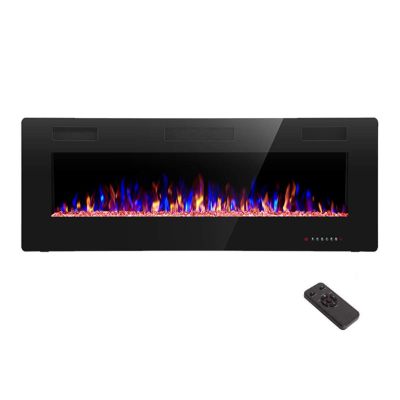
The linked 50-inch R.W.FLAME combines a slim linear format with two heater settings: 750 watts for lower output and 1,500 watts for full output. The flame effect can run without heat, which is useful when the visual effect matters more than room temperature.
This is the best all-around wall model in the shortlist because it supports several installation approaches, offers extensive flame controls, and stays within the normal electrical limits of a plug-in fireplace. Its environmental advantage comes from avoiding combustion—not from producing more heat per kilowatt-hour than another resistance heater.
Advantages
- Wall-mounted, semi-recessed, or recessed installation options, subject to the manual
- 750-watt and 1,500-watt heat settings
- Flame-only operation for year-round use
- Multiple flame colors, brightness levels, and speed settings
Limitations
- The linked model and the manufacturer’s newer smart versions have different depths and controls
- A recessed installation requires accurate framing, ventilation clearance, and access to power
- Flame realism is subjective and should be judged from current customer photos and video
Confirm the exact model number and dimensions on the current listing before cutting or framing a wall opening.
2. Ameriwood Home Lamont Mantel Fireplace — Best Mantel With Bookcases
Best for: A living room, bedroom, or home office that needs a traditional mantel appearance and display storage.
Not for: Supporting a television or fitting into a narrow wall area.
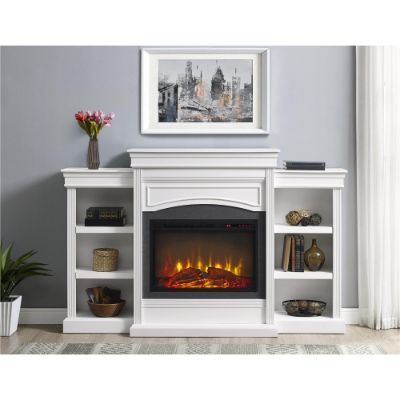
The Lamont uses a central electric insert surrounded by a broad mantel and two bookcases. Each side has three shelves, making the unit more useful than a decorative firebox alone. The flame effect can operate without the heater, and current variants include remote controls and adjustable settings.
The assembled unit is approximately 69 inches wide, so measure the complete wall rather than only the insert. It is made primarily from engineered wood products and arrives as flat-pack furniture. Two-person assembly and wall anchoring are sensible requirements rather than minor details.
Advantages
- Traditional mantel form without a chimney or combustion fuel
- Six shelves for books, decorations, or small storage baskets
- Flame effect can operate without heat
- Wall-anchor hardware improves stability when installed correctly
Limitations
- Not rated as a TV stand
- Wide footprint and substantial assembly time
- Engineered-wood construction may show damage if handled roughly during delivery or assembly
- Colors, inserts, and availability differ among current retailer variants
3. Dimplex Fieldstone Electric Fireplace — Best Premium Rustic Mantel
Best for: Buyers who prioritize a substantial rustic surround and a more permanent-looking focal point.
Not for: A tight budget, frequent room changes, or buyers who cannot confirm the exact insert revision.
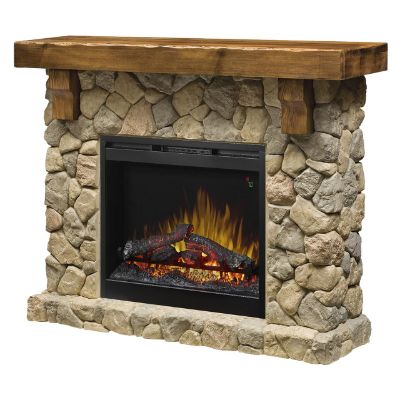
The Fieldstone combines a stone-look surround, wood mantel, log-style media, remote controls, and approximately 1,500 watts of resistance heat. That corresponds to about 5,118 Btu per hour, which is the normal upper range for a 120-volt plug-in fireplace.
The surround is roughly 55 inches wide and nearly 43 inches high, so it has considerably more visual mass than the wall-mounted models. Its appeal is primarily the furniture and flame presentation rather than unusually high heating efficiency.
Advantages
- Substantial rustic appearance without masonry construction
- Approximately 1,500 watts and 5,118 Btu per hour of supplemental heat
- Flame effect can operate independently from the heater
- Remote operation and thermostat controls on supported insert versions
Limitations
- Premium price and a large, heavy mantel package
- The stone is a decorative stone-look finish rather than a site-built masonry fireplace
- Retail listings reference different 26-inch and 28-inch insert revisions
- Availability is inconsistent, so warranty coverage and exact model numbers require verification
Buy only when the listing clearly identifies the included firebox, current warranty, return policy, and replacement-part support.
4. Ameriwood Home Farmington Electric Fireplace TV Console — Best Value Media Console
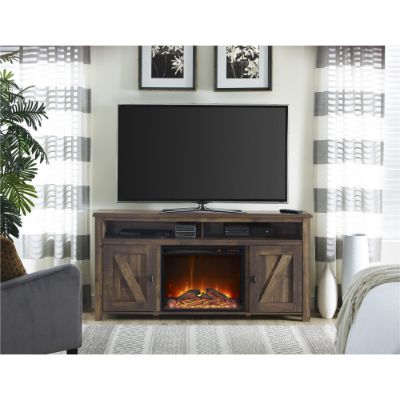
Best for: Buyers who need a fireplace, television stand, and media storage in one moderately priced unit.
Not for: Large-room primary heating or anyone who wants solid-wood furniture.
The Farmington is an electric fireplace TV console—not a gas fireplace. Current 60-inch-console variants support televisions up to 60 inches and approximately 95 pounds. A central 23-inch insert sits between two enclosed storage cabinets, with an open shelf for media equipment.
The insert can operate with or without heat and includes multiple heat and flame-brightness settings. This is a practical option when furniture function matters as much as the fire effect, but its heater remains a supplemental 120-volt appliance.
Advantages
- Combines a TV stand, media storage, and electric insert
- Supports many televisions up to 60 inches and 95 pounds
- Open component shelf and adjustable concealed shelving
- Flame-only operation, timer, remote, and adjustable controls on current variants
Limitations
- Large, heavy flat-pack package
- Two adults are recommended for assembly
- Engineered-wood construction and finish quality vary by version
- Color and stock availability differ substantially among retailers
5. Real Flame Torrey Electric Fireplace — Best Premium TV Stand

Best for: A formal living room where hidden storage, a wide firebox, and a furniture-grade appearance justify a higher price.
Not for: Budget shoppers, narrow rooms, or anyone who expects a lightweight ready-assembled unit.
The Torrey supports televisions up to 60 inches and 100 pounds. Sliding top panels and hinged side panels conceal one center shelf and adjustable side shelving. The standard firebox offers six flame colors, five brightness levels, timer settings, an adjustable thermostat, and an automatic safety shutoff.
Real Flame currently lists CSA and FCC certification for the standard version. The manufacturer also offers smart insert configurations, so buyers should verify which firebox and controls are included in the retailer listing.
Advantages
- Wide landscape firebox and substantial mantel appearance
- Hidden adjustable shelving
- Adjustable thermostat, timer, flame colors, and brightness
- Automatic shutoff and documented certification on the standard configuration
Limitations
- Substantially more expensive than basic wall-mounted fireplaces
- Heavy and time-consuming to assemble
- Large footprint despite the hidden-storage benefit
- Standard and smart insert packages have different features and prices
6. ClassicFlame Deerfield Media Console — Best for Large TVs and Integrated Audio
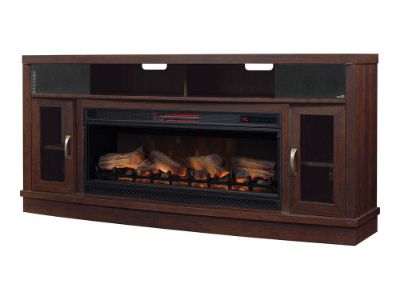
Best for: Large televisions, enclosed media storage, and buyers who want an integrated speaker system.
Not for: Anyone unwilling to verify every component in the package before ordering.
The Deerfield cabinet supports televisions up to 80 inches and 155 pounds. Its audio system includes two main speakers, two tweeters, passive bass ports, and Bluetooth connectivity. Glass-front side cabinets and a partitioned media shelf provide substantial component storage.
The important qualification is the firebox. Twin Star Home’s current manufacturer page describes the electric fireplace as a separately sold component, while the linked Amazon title may describe a bundle with a 42-inch insert. Do not assume that a cabinet-only listing contains the heater.
Advantages
- Supports televisions up to 80 inches and 155 pounds
- Integrated Bluetooth audio system
- Partitioned media shelf and glass-front storage cabinets
- Can accept a large 42-inch ClassicFlame insert
Limitations
- The cabinet and firebox may be sold separately
- Heating specifications depend on the exact insert
- Large, heavy, and more complicated than a standalone wall unit
- Returns can be difficult if an incomplete bundle is discovered after assembly
Before purchasing, confirm in writing that the package includes the cabinet, 42-inch electric firebox, remote, media, hardware, and applicable warranty.
7. ClassicFlame Pioneer Stone Electric Fireplace — Best Compact Traditional Mantel
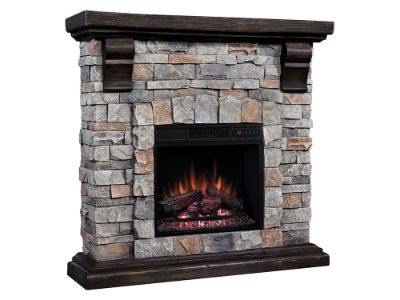
Best for: Smaller rooms that need a traditional mantel appearance without the width of the Lamont or Dimplex Fieldstone.
Not for: Buyers who need substantial primary heat or a television stand.
The Pioneer combines a brushed dark pine finish, stone-look detailing, corbels, and an 18-inch infrared quartz electric insert. The smaller scale makes it easier to place than the broader bookcase and media-console options.
The manufacturer promotes supplemental heating over a broad area, but shoppers should compare wattage and Btu output rather than relying on square-foot coverage alone. Room insulation, ceiling height, outdoor temperature, air leakage, and thermostat placement can change the result substantially.
Advantages
- Traditional stone-and-wood appearance in a compact format
- Current manufacturer documentation remains available
- Infrared quartz insert provides ordinary supplemental resistance heat
- Useful where a large TV console or broad bookcase unit would overwhelm the room
Limitations
- Small firebox relative to the full mantel
- Stone is decorative rather than structural masonry
- Not intended as a whole-home heating system
- Traditional styling will not suit every interior
How to Choose an Electric Fireplace
Decide Whether You Need Ambiance or Meaningful Heat
A flame-only mode is appropriate when the visual effect is the main objective. Using the heater adds a much larger electrical load. A fireplace can support zone heating, but it saves energy only when it lets you reduce heating elsewhere. Running it while leaving the central system unchanged adds electricity use rather than reducing it.
Readers who mainly need practical space heating should also compare energy-efficient electric heaters for large rooms. A simpler heater may offer better controls or airflow for less money because you are not paying for a mantel, media console, or flame display.
Compare Watts and Btu, Not Just Square-Foot Claims
A typical 120-volt plug-in fireplace has a maximum heater setting near 1,500 watts. The conversion is straightforward:
1,500 watts × 3.412 = approximately 5,118 Btu per hour.
Two 1,500-watt resistance heaters cannot create radically different quantities of heat from the same electrical input. Fan design, thermostat behavior, radiant distribution, noise, placement, and controls may change comfort, but marketing a unit as “infrared” does not allow it to produce free extra heat.
Claims such as “heats 400 square feet” or “heats 1,000 square feet” are not enough by themselves. Ask about wattage, Btu output, ceiling height, insulation, climate, air leakage, and whether the product is intended only to supplement another heating system.
Calculate the Operating Cost
Use this formula to estimate the heater’s hourly electricity cost:
Hourly cost = wattage ÷ 1,000 × electricity price per kilowatt-hour.
A 1,500-watt fireplace uses 1.5 kilowatt-hours during one hour of continuous full-power heating. Multiply 1.5 by the rate shown on your electricity bill. A thermostat may cycle the heater off after reaching the set temperature, so actual consumption can be lower than continuous full-power use.
Consider the Electricity Source
An electric fireplace has no combustion emissions in the room, but electricity-generation emissions differ by region. The EPA Power Profiler can show the fuel mix and emission rate associated with a U.S. ZIP code. Households supplied by lower-carbon electricity generally reduce the upstream impact of electric heating.
Our overview of different types of green energy explains how renewable generation sources differ. Green-power enrollment, community solar, rooftop solar, and utility procurement can all change the broader context, although the most effective first step is still to avoid unnecessary heating.
Match the Installation Method to the Room
- Wall-mounted: Usually the simplest linear format, but the heater outlet and wall clearance must remain unobstructed.
- Recessed: Produces a cleaner built-in appearance but requires accurate framing, approved clearances, ventilation, and electrical access.
- Freestanding mantel: Avoids wall construction but occupies floor space and may require anti-tip anchoring.
- TV console: Adds storage but requires strict compliance with television size and weight limits.
- Hardwired unit: Should be installed according to the manual and local electrical code, normally by a qualified professional.
Check Safety Certification and Documentation
Look for a recognizable certification mark from a qualified testing organization, such as UL, ETL, or CSA, and verify the model in the certifier’s directory when possible. A logo in a marketplace image is not a substitute for a model-specific manual and legitimate certification record.
Also review the warranty, replacement-part availability, installation manual, required outlet type, clearance instructions, overheating protection, anti-tip hardware, and return policy before ordering.
Consider Durability and Waste
The lowest-emission product is not necessarily the lowest-impact purchase if it fails quickly or cannot be repaired. Favor replaceable inserts, documented parts, accessible customer support, stable model families, and furniture that can survive disassembly or relocation. These principles also support broader efforts to reduce waste at home.
Where Pellet, Wood, Gas, and Bioethanol Fireplaces Fit
EPA-Certified Pellet and Wood Heaters
A modern certified pellet or wood heater can be substantially cleaner and more useful for heating than an open fireplace. It still produces particulate matter and combustion gases, requires a correctly designed vent, and needs regular cleaning and suitable fuel.
Consult the EPA-certified wood-heater database and guidance, local air-quality rules, and a qualified installer. Burn only the fuel specified by the manufacturer. Damp firewood and poor combustion increase smoke.
Direct-Vent Gas Fireplaces
A sealed direct-vent gas fireplace can deliver more heat and a real flame without drawing combustion air from the room in the same way as an open fireplace. It still consumes natural gas or propane and produces greenhouse-gas emissions. Installation, vent routing, gas connections, clearances, and permits should be handled professionally.
Bioethanol Fireplaces
Bioethanol can burn without producing ash or wood smoke, but it is not emission-free. Combustion produces carbon dioxide and water vapor and can produce additional indoor pollutants when the burner, fuel, room, or operating conditions are unsuitable.
Use only an appliance designed and listed for the intended indoor or outdoor location. Follow minimum room-volume and ventilation instructions. Never pour fuel into a hot or burning appliance, and never rely on a small or difficult-to-see flame to determine that the burner is safe to refill.
The U.S. Consumer Product Safety Commission warns against pooled-alcohol fire products that can create uncontrollable pool fires or flame jetting. Those warnings are especially relevant to open-bowl and tabletop products that are refilled from a liquid-fuel container.
Traditional Open Wood Fireplaces
An open hearth is a poor choice when the priorities are low emissions and dependable heat. The EPA identifies fine-particle pollution as a major wood-smoke hazard. Smoke can also contain carbon monoxide and other harmful compounds. See our explanation of why carbon monoxide is dangerous for additional context.
Electric Fireplace Safety Checklist
- Read the complete model-specific manual before installation or operation.
- Plug a portable or plug-in heater directly into a suitable wall outlet unless the manufacturer specifies an approved hardwired installation.
- Do not use an extension cord or power strip for the heater.
- Stop using the unit if the plug, cord, outlet, or faceplate becomes unusually hot.
- Keep combustible materials away from the heater outlet. For portable heating products, the CPSC recommends at least three feet unless the manufacturer requires more.
- Do not block intake or exhaust vents with furniture, curtains, bedding, electronics, or decorative objects.
- Turn the heater off before sleeping or leaving it unattended.
- Use anti-tip or wall-anchor hardware supplied with mantels and media consoles.
- Keep children and pets away from heater outlets and hot glass or trim.
- For recessed or hardwired installations, follow local electrical and building codes and use a qualified installer when required.
- Maintain working smoke alarms. Homes with any combustion appliance should also have correctly located carbon monoxide alarms.
Final Verdict
The R.W.FLAME 50-inch is the strongest all-around choice for a modern wall-mounted or recessed installation. The Ameriwood Lamont is more useful when shelving and a traditional mantel matter. The Farmington offers the clearest value among TV consoles, while the Real Flame Torrey provides a more substantial premium cabinet.
Choose the Dimplex Fieldstone for a large rustic surround only after confirming the exact insert and warranty. Consider the Deerfield for large televisions and integrated audio only when the seller verifies that the 42-inch firebox is included. The Pioneer is the most practical traditional option for a smaller wall.
None of these products should be mistaken for a highly efficient primary heating system. When the real objective is to lower whole-home heating energy, compare a properly sized heat pump before investing heavily in decorative resistance heat.
Frequently Asked Questions
What is the most eco-friendly type of fireplace?
For indoor air quality, an electric fireplace is usually the best choice because it does not burn fuel or release combustion pollutants at the appliance. Its total climate impact depends on the local electricity mix and how long the heater runs. For primary heating, a heat pump generally uses less electricity.
Do eco-friendly fireplaces actually provide heat?
Yes. Most plug-in electric fireplaces provide supplemental resistance heat, commonly up to 1,500 watts, or about 5,100 Btu per hour. That can warm an occupied room, but it is not the same as a whole-home heating system.
How much electricity does a 1,500-watt electric fireplace use?
At full heat, a 1,500-watt electric fireplace uses 1.5 kilowatt-hours of electricity per hour. Multiply 1.5 by your electricity rate per kilowatt-hour to estimate the hourly cost. Flame-only mode usually uses much less power.
Are wood-burning fireplaces bad for the environment?
Traditional open wood fireplaces release fine particles and other combustion pollutants and often send much of their heat up the chimney. EPA-certified wood or pellet heaters can reduce emissions and improve efficiency, but they still require proper venting, dry fuel, maintenance, and compliance with local air-quality rules.
Are bioethanol fireplaces emission-free?
No. Bioethanol can burn without soot or ash, but combustion still produces carbon dioxide and water vapor and may produce other pollutants when conditions are not ideal. Indoor use requires the correct appliance, adequate room volume and ventilation, and strict refilling safety.
See Related: 15 Eco-Friendly Tips for Sustainable Living in 2026
See Related: Eco-Friendly Living: How to Reduce Your Carbon Footprint in 5 Easy Steps