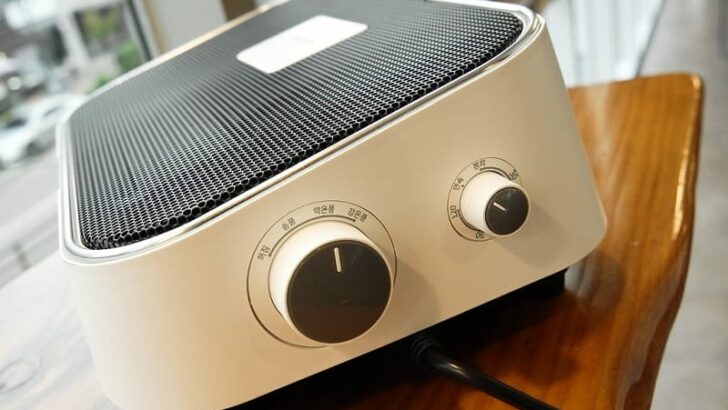
Direct answer: Most plug-in electric resistance heaters are equally efficient at converting the electricity they use into heat inside the room. The models that cost less to operate in practice have accurate thermostats, lower-power settings, timers, and heat delivery that matches how you use the space. For broad circulation in a large enclosed room, start with the Honeywell ThermaWave 6 or Lasko FH500. Choose the Heat Storm HS-1500-PHX-WIFI when wall mounting matters, and consider a fanless panel or hardwired baseboard heater for quiet, longer-duration zone heating.
Last verified: July 2026. This guide focuses on products and electrical specifications sold in the United States. Product availability, exact features, and safety certifications can change, so confirm the model number and current manual before buying.
Affiliate disclosure: Our Endangered World may earn a commission from qualifying purchases made through some links in this guide, at no additional cost to you. Recommendations are based on published specifications, current safety guidance, recall checks, and recent independent test reports—not undisclosed hands-on testing.
- A 1,500-watt heater uses 1.5 kilowatt-hours of electricity for every hour it runs continuously at full power.
- At an electricity rate of $0.20 per kWh, full-power operation costs about $0.30 per hour, or about $36 for four hours a day over 30 days.
- “ECO” modes usually save energy by cycling the heater off after reaching the set temperature; they do not make the resistance element fundamentally more efficient.
- Square-foot coverage claims are not standardized. Insulation, outdoor temperature, ceiling height, drafts, doors, and room layout can change real-world performance substantially.
- For a large open-plan space or daily whole-room heating, a properly sized heat pump or hardwired system is usually a better long-term solution than a portable 1,500-watt heater.
Quick Picks: Best Electric Heaters for Large Rooms
| Best for | Heater | Heat delivery | Best room fit | Main tradeoff |
|---|---|---|---|---|
| Best overall portable | Honeywell ThermaWave 6 | Ceramic fan-forced | Occupied seating area in a medium-to-large enclosed room | No remote; not a primary heater for a large open floor plan |
| Best wall-mounted smart heater | Heat Storm HS-1500-PHX-WIFI | Infrared/radiant with fan | Bedrooms, offices, kitchens, and supplemental zones where floor space is limited | Manufacturer’s large coverage figure is for supplemental heat, not primary heat |
| Best heater-and-fan combination | Lasko FH500 | Ceramic tower | Larger enclosed rooms that need wide oscillation | Very tall; requires clear floor space |
| Best hybrid cabinet heater | Dr Infrared Heater DR-968 | Infrared quartz plus PTC convection | Longer heating sessions in a living room or home office | Bulkier and heavier than a compact ceramic model |
| Best slim digital panel | De’Longhi HCX9115E | Convection with dual lateral fans | Medium-to-large enclosed rooms; floor or wall placement | Fan-assisted operation is not silent |
| Best quiet fanless panel | De’Longhi HMP1500 | Micathermic/radiant-convection | Bedrooms, offices, and other spaces where fan noise is distracting | Slower response and fewer digital controls than fan heaters |
| Best compact oscillating heater | Dreo Whole Room Heater 714 | Ceramic with multidirectional oscillation | Small-to-medium rooms or a defined occupied zone in a larger room | Compact output is better for personal comfort than a large open area |
| Best budget tower | Pelonis PHTPU1501 | Ceramic tower | Bedrooms and the smaller end of living-room sizes | Current listing states 106–167 sq. ft. of coverage |
| Best design-forward option | Lasko 6435 Designer Series | Ceramic with oscillation | Decor-conscious bedrooms and living areas | Current listing does not clearly state a tip-over shutoff |
| Best permanent silent zone heat | Cadet 48-Inch Electric Baseboard Heater | Natural convection | Dedicated rooms needing quiet, fixed heat | Model sizing and professional hardwiring are required |
What “Energy-Efficient Electric Heater” Really Means
The U.S. Department of Energy explains that electric resistance heating converts essentially all incoming electricity into heat at the point of use. That means two 1,500-watt resistance heaters running continuously for the same amount of time use roughly the same electricity, regardless of whether one is marketed as ceramic, infrared, oil-filled, or “eco.”
The meaningful differences are how quickly the heater makes you feel warm, how evenly it distributes heat, how accurately it controls temperature, and how often it can switch off. A well-matched thermostat can prevent overheating. A radiant heater can reduce the need to heat all the air when you only need warmth at a desk or sofa. A timer can stop needless operation after you leave.
This is also why zone heating can save money without making a particular heater more efficient. The Department of Energy notes that heating occupied rooms while keeping unused zones cooler can reduce energy use when those zones are genuinely separated. For more portable-heater use cases, see our energy-efficient space heater guide. For a broader sustainability view, compare how different electricity sources affect greenhouse-gas emissions.
How Much Does an Electric Heater Cost to Run?
Use this formula:
Hourly operating cost = (heater watts ÷ 1,000) × your electricity price per kWh
| Power draw | At $0.15/kWh | At $0.20/kWh | At $0.30/kWh |
|---|---|---|---|
| 750 watts | $0.11/hour | $0.15/hour | $0.23/hour |
| 1,000 watts | $0.15/hour | $0.20/hour | $0.30/hour |
| 1,500 watts | $0.23/hour | $0.30/hour | $0.45/hour |
A 1,500-watt heater also produces about 5,118 BTU per hour. That output can make a meaningful difference in an enclosed room, but it does not guarantee comfortable temperatures across a drafty 500-square-foot living area. Treat unusually large coverage numbers as supplemental-heating claims unless the manufacturer specifically states otherwise.
Which Heater Type Uses the Least Electricity?
| Heater type | How it feels | Best use | Efficiency reality |
|---|---|---|---|
| Ceramic fan heater | Fast, moving warm air | Raising comfort across an occupied room | Not inherently more efficient; oscillation and thermostat control may reduce runtime |
| Infrared or radiant | Immediate warmth on people and objects in its path | Short sessions at a sofa, desk, or workbench | Can use less total energy when it warms the occupant instead of all room air |
| Oil-filled radiator | Slow, quiet, steady warmth | Longer sessions where silence matters | Heat storage smooths cycling, but the element still uses resistance heat |
| Micathermic panel | Quiet radiant and convective warmth | Bedrooms and offices with limited floor depth | Comfort and noise are the advantages, not a different conversion efficiency |
| Baseboard or in-wall heater | Steady room-level zone heat | Permanent heating in a dedicated room | Good zoning and thermostat placement can reduce waste; installation and sizing matter |
| Heat pump | Whole-room or whole-home conditioned air | Frequent heating, large areas, and open plans | Transfers heat instead of creating it through resistance, so it can use substantially less electricity |
How We Selected These Heaters
Our Endangered World did not claim hands-on testing that was not performed. We compared current manufacturer and retailer specifications with recent independent test reports, then checked each recommendation against Department of Energy buying and safety guidance, U.S. Fire Administration recommendations, and the Consumer Product Safety Commission recall database.
- Useful heat delivery: broad circulation for an enclosed room, direct radiant warmth for an occupied zone, or steady fanless heat for longer sessions.
- Control quality: an adjustable thermostat, useful lower-power settings, a timer, and controls that are easy to understand.
- Safety: current safety documentation, overheat protection, tip-over protection where applicable, stable placement, and clear operating instructions.
- Room fit: realistic expectations for a typical U.S. 1,500-watt plug-in heater rather than accepting every advertised square-foot figure at face value.
- Information quality: preference for identifiable model numbers and current specifications over vague “large room” marketing.
The 10 Best Energy-Efficient Electric Heaters for Large Rooms
1. Honeywell ThermaWave 6: Best Overall Portable Heater
Best for: Warming the occupied portion of a medium-to-large living room without a narrow stream of heat.
The Honeywell ThermaWave 6 earns the top position because its top-mounted outlet and adjustable louver move warm air upward and outward. That layout is useful around a sofa or TV area, where a small desktop heater can leave the rest of the occupied zone cold. During long-term home testing, it performed particularly well around the seating area, and testers praised its heat output, straightforward controls, and safety features.
The 1,500-watt ceramic heater has two heat levels, a fan-only setting, digital temperature controls, timer functions, tip-over shutoff, overheating protection, and cool-touch housing. There is no remote. It is a strong portable option for broad circulation, but it should still be treated as supplemental heat in a large, drafty, or open-plan room.
- Pros: Broad upward airflow, intuitive controls, robust safety features, fan-only mode.
- Watch-outs: No remote; audible fan hum; best around an occupied zone rather than an entire open floor plan.
Read the independent Honeywell ThermaWave 6 test and specifications.
2. Heat Storm HS-1500-PHX-WIFI: Best Wall-Mounted Smart Heater
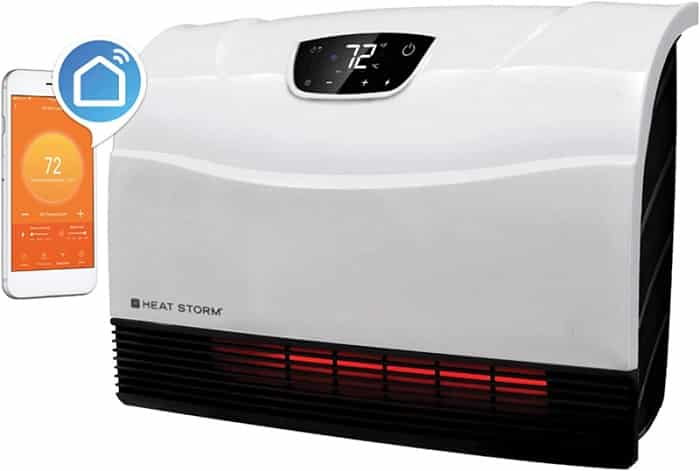
Best for: Supplemental zone heat when floor space is limited and phone control is useful.
The Heat Storm combines a wall-mounted cabinet with Wi-Fi control, a digital thermostat, remote control, child lock, washable filters, and tip-over protection. The current listing specifies 1,500 watts, approximately 5,200 BTU per hour, 110 volts, and a 12.5-amp draw. Its cabinet, grill, and the wall behind it are designed to remain cool to the touch during normal operation.
The manufacturer’s coverage language needs context: it states up to 150 square feet as a primary heat source in a well-insulated room and up to 750 square feet as supplemental heat. Do not read the larger figure as a promise that one plug-in heater can independently heat a 750-square-foot room. This is a space-saving zone heater, not a replacement for a properly sized central system.
- Pros: Wall mounting, Wi-Fi and remote control, child lock, thermostat, cool-touch design.
- Watch-outs: Wall-only version does not include feet; installation is required; app support adds another potential failure point.
3. Lasko FH500: Best Heater-and-Fan Combination
Best for: A larger enclosed room that benefits from wide oscillation and year-round fan use.
The Lasko FH500 is a tall ceramic tower that also works as a cooling fan. In a current independent comparison, it produced the strongest and most even temperature increase in a 15-by-10-foot test room. Its thermostat-controlled ECO mode, three heat settings, oscillation, remote control, and timer give it more useful control than a basic high/low heater.
Safety features include tip-over protection and automatic overheat shutoff, and the tested model carries a three-year warranty. The main compromise is physical size: at roughly 42 inches tall, it needs stable, unobstructed floor space. It is a better choice for moving heat across an enclosed room than for placing beside a desk.
- Pros: Strong room circulation, heater and fan in one unit, ECO mode, remote, timer, wide oscillation.
- Watch-outs: Tall footprint; still limited to 1,500 watts; filter needs periodic cleaning.
See the current Lasko FH500 test results and comparison.
4. Dr Infrared Heater DR-968: Best Hybrid Cabinet Heater
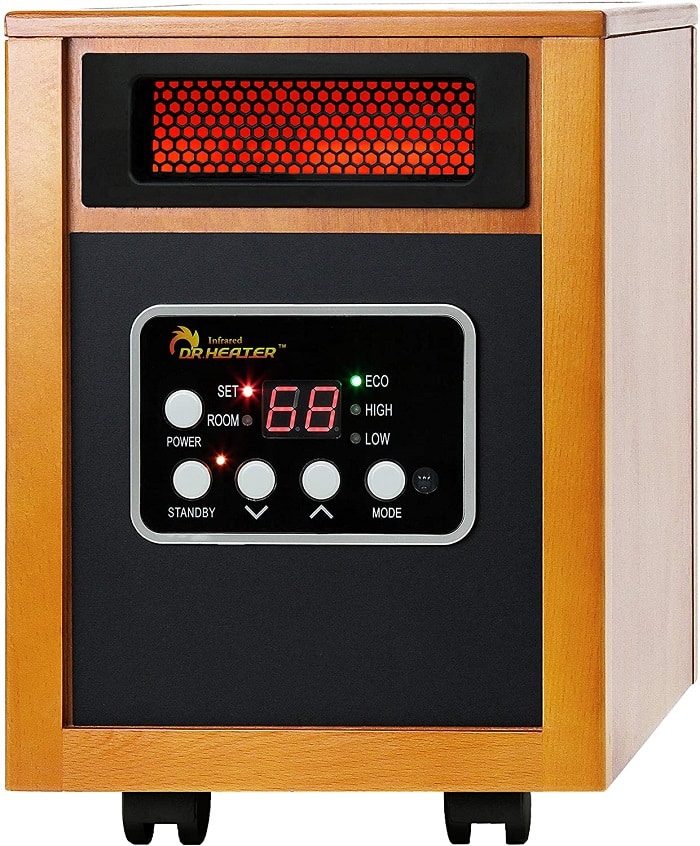
Best for: Longer heating sessions where both direct radiant warmth and room-air circulation are useful.
The DR-968 uses a dual heating system: an infrared quartz tube provides direct radiant warmth while a PTC element and blower circulate heated air. Current specifications list 1,500 watts, approximately 5,200 BTU per hour, a 50–85°F electronic thermostat range, high and low settings, a 12-hour automatic shutoff timer, remote control, caster wheels, and a six-foot cord.
The manufacturer lists a 39 dB noise level, but treat that as a manufacturer claim rather than a guaranteed measurement in your room. At about 19 pounds, the cabinet is heavier than a compact ceramic heater, although the wheels make it easier to move. It suits users who value steady comfort and a traditional furniture-like appearance more than minimal size.
- Pros: Radiant and convective heat, caster wheels, remote, timer, tip-over and overheat protection.
- Watch-outs: Bulky cabinet; narrow thermostat range; stated noise figure is not an independent test result.
5. De’Longhi HCX9115E: Best Slim Digital Convection Panel
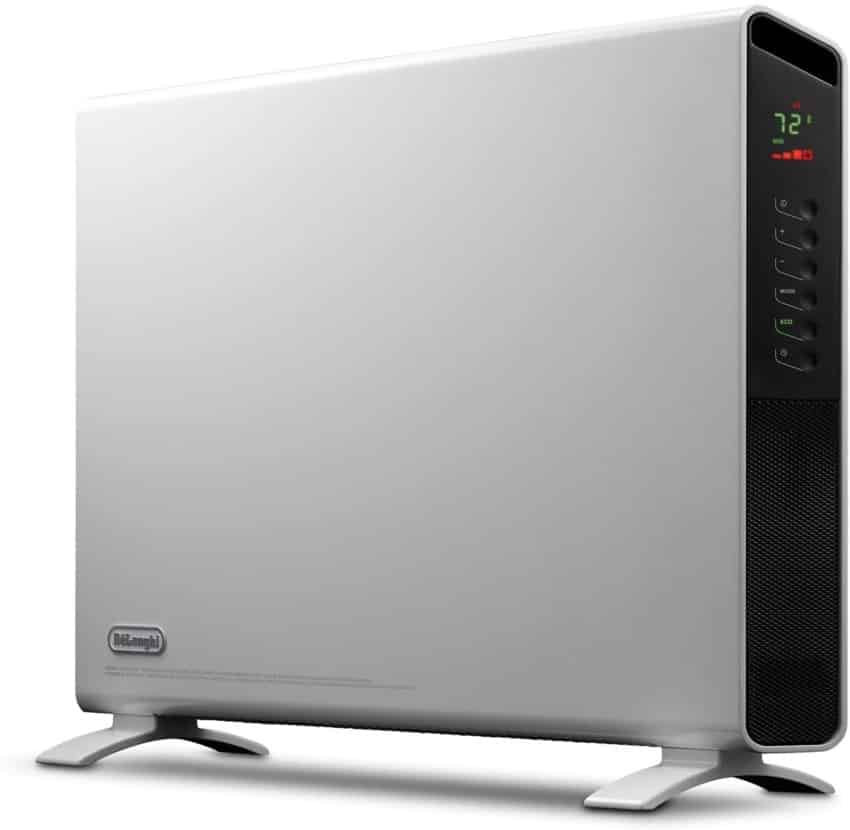
Best for: Users who want a slim, digitally controlled heater that can be freestanding or wall-mounted.
The HCX9115E delivers up to 1,500 watts and uses dual lateral fans to improve heat distribution across a medium-to-large enclosed room. Its ECO Plus function automatically adjusts power and heat settings around the selected temperature. It also includes an adjustable thermostat, multiple heat settings, digital controls, a delayed on/off 24-hour timer, carrying handle, and anti-freeze mode that activates below 41°F.
Thermal shutoff and an internal tip-over switch address two core hazards. The panel is much slimmer than a tower or cabinet heater, but it is not completely silent because fans assist airflow. Choose it when wall placement and scheduling matter more than fanless operation.
- Pros: Floor or wall placement, 24-hour timer, ECO control, even lateral airflow, tip-over and overheat protection.
- Watch-outs: Higher purchase price than a basic ceramic tower; fan noise; wall mounting requires correct clearance.
6. De’Longhi HMP1500: Best Quiet Fanless Panel
Best for: Bedrooms, offices, and longer heating sessions where fan noise is more distracting than slow warm-up.
The HMP1500 uses a broad micathermic panel rather than a high-velocity fan. It can be wheeled between rooms or mounted on a wall, and the panel is only about three inches deep before the wheel assembly is added. That makes it easier to position along a wall without the visual bulk of a cabinet heater.
This style is better for quiet, steady comfort than a quick blast of heat. Controls and safety details can vary by listing or regional version, so confirm the exact model manual, thermostat, shutoff features, voltage, and included mounting hardware before purchase. It is not automatically cheaper to run than another 1,500-watt resistance heater; its advantages are silence, surface area, and placement flexibility.
- Pros: Fanless operation, slim profile, wheels or wall mounting, broad heat surface.
- Watch-outs: Slower perceived warm-up; model details vary; fewer smart controls than newer digital heaters.
Read the current independent De’Longhi HMP1500 assessment.
7. Dreo Whole Room Heater 714: Best Compact Oscillating Heater
Best for: Fast personal comfort and multidirectional heat in a small-to-medium room or a defined zone within a larger room.
The Dreo 714 is a compact 1,500-watt ceramic heater with three heat levels, a broad thermostat range, a 12-hour timer, remote control, child lock, overheat protection, tip-over protection, and oscillation that moves both horizontally and vertically. The multidirectional airflow is the main differentiator: it can share heat between people around a table or distribute warmth more evenly than a fixed desktop unit.
Recent independent testing found it effective for immediate comfort in a drafty home office, but not ideal for sustained whole-room heating like a larger oil-filled or panel heater. The manufacturer states 161–269 square feet of coverage. Treat that as a useful sizing reference, not a guarantee, and do not expect this compact model to carry a large open-plan room by itself.
- Pros: Compact, multidirectional oscillation, remote, child lock, year-round fan mode, strong safety package.
- Watch-outs: Best for quick occupied-zone heat; front outlet becomes hot; remote response may feel slow.
Read the detailed Dreo Whole Room Heater 714 test.
8. Pelonis PHTPU1501: Best Budget Ceramic Tower
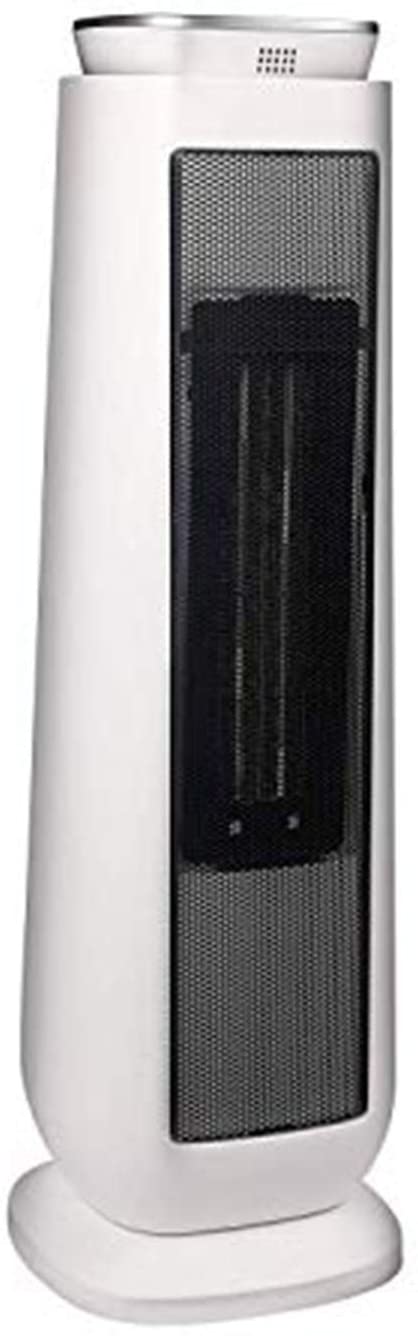
Best for: Bedrooms, offices, and living rooms at the smaller end of the “large room” category.
The PHTPU1501 provides a familiar set of controls at a lower-cost position: 1,500-watt high heat, low heat, ECO mode, thermostat control, oscillation, remote control, an eight-hour timer, a carry handle, overheating protection, and a tip-over switch. The manufacturer lists a 50 dB operating-noise figure and a one-year warranty.
The most important limitation is visible in the current specification: stated coverage is 106–167 square feet. That is closer to a bedroom or modest office than a large open living room. It remains a useful budget pick for zone heating, but the product name’s “large room” language should not override the stated coverage figure.
- Pros: Affordable tower format, ECO mode, remote, timer, oscillation, tip-over and overheat protection.
- Watch-outs: Limited stated coverage; manufacturer noise claim is not an independent measurement; one-year warranty.
9. Lasko 6435 Designer Series: Best Design-Forward Heater
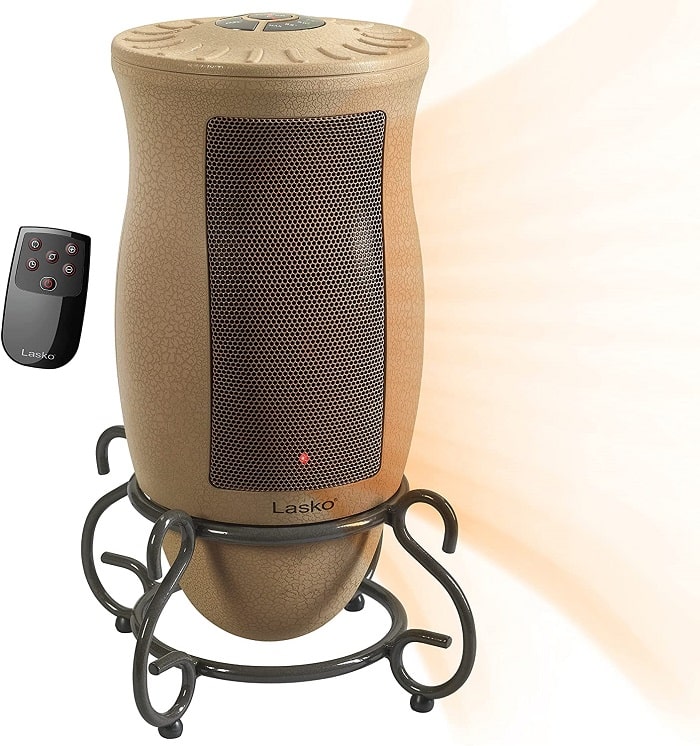
Best for: A bedroom or living area where appearance matters as much as portable heat.
The Lasko 6435 combines a 1,500-watt ceramic element with two heat settings, an adjustable thermostat, widespread oscillation, a seven-hour auto-off timer, remote control, overheat protection, and a cool-touch exterior. It arrives assembled and carries a three-year limited warranty.
The key caution is that the current product listing clearly names overheat protection but does not clearly state a tip-over shutoff. Confirm that feature in the exact manual before placing the heater in a home with children, pets, or frequent foot traffic. Its short decorative body also spreads heat differently from a tall tower, so it is better for an occupied area than a very large room.
- Pros: More attractive than a conventional tower, remote, timer, oscillation, cool-touch exterior, three-year warranty.
- Watch-outs: Tip-over protection is not clearly stated on the current listing; limited height and reach; no smart controls.
10. Cadet 48-Inch Electric Baseboard Heater: Best Permanent Silent Zone Heat
Best for: A dedicated room that needs quiet, fixed heat without a portable appliance in the traffic path.
A Cadet baseboard heater is a different category from the portable products above. It uses natural convection, has no fan, and can be controlled by a properly located line-voltage thermostat. This makes it a practical option for a bedroom, addition, finished basement, or other room that needs recurring zone heat.
Cadet sells multiple lengths, voltages, and wattages, so the model must be selected from a room heat-load calculation—not from length alone. Installation generally requires a dedicated circuit and correct clearances, and it should be handled by a qualified electrician. Review our guide to energy-efficient baseboard heaters before choosing a permanent system.
- Pros: Silent, fixed, unobtrusive, useful for thermostat-controlled zone heating, no portable cord.
- Watch-outs: Professional sizing and hardwiring; furniture and curtains need clearance; not portable; slow response.
See the current independent comparison that includes the Cadet 48-inch baseboard heater.
How to Choose an Electric Heater for a Large Room
Start With the Room, Not the Marketing Claim
Measure floor area, note ceiling height, and identify exterior walls, large windows, stairways, and open doorways. A well-insulated 250-square-foot room can be easier to warm than a drafty 150-square-foot room with a vaulted ceiling. If the space cannot be closed off, a portable heater may improve comfort near people without raising the temperature evenly across the room.
Choose Heat Delivery Around Your Use
- For quick personal warmth: Choose infrared or a compact ceramic heater aimed at the occupied zone.
- For broader circulation: Choose a tower or convector with oscillation or multidirectional airflow.
- For quiet, longer sessions: Choose an oil-filled radiator, micathermic panel, or permanent baseboard heater.
- For limited floor space: Choose a correctly installed wall-mounted panel.
Prioritize Controls That Reduce Runtime
An accurate thermostat matters more than a green leaf icon or an “energy-saving” label. Look for a useful low-power setting, a timer, clear temperature feedback, and a memory function only if it genuinely helps your routine. Do not pay extra for app control unless you will use scheduling or remote shutoff.
Check the Exact Safety Documentation
Confirm the model number, rated voltage, wattage, third-party safety certification, overheat protection, tip-over switch, clearance requirements, and permitted locations. Similar-looking variants can have different features. Search the CPSC recall database by brand and model before using a secondhand or older heater.
Electric Space Heater Safety
Portable heaters deserve more caution than their size suggests. The U.S. Fire Administration reports that portable-heater fires represented a small share of home heating fires in 2017–2019 but a much larger share of fatal heating fires. Use the heater’s safety features as a backup—not as permission to leave it unattended.
- Keep anything that can burn at least three feet from the heater, including curtains, bedding, clothing, paper, upholstered furniture, and pet beds.
- Place a portable heater on a stable, level surface away from doorways and foot traffic. Do not place it on furniture unless the manufacturer explicitly permits that use.
- Plug it directly into a suitable wall outlet and follow the manual. Avoid power strips and extension cords.
- Turn it off when leaving the room or going to bed. A timer, thermostat, or app does not replace supervision.
- Stop using the heater if the plug, outlet, cord, or wall plate becomes unusually hot, discolored, loose, cracked, or scorched.
- Keep children and pets away from the hot-air outlet, grill, cord, and controls—even when the cabinet is marketed as cool-touch.
- Use only models approved for the intended location. A living-room heater is not automatically suitable for a bathroom, damp basement, workshop, or garage.
- Check current recalls and stop using a recalled model until the stated remedy is complete.
Heating an outbuilding introduces different clearance, moisture, dust, and ignition risks. Use our guide on how to heat a garage safely rather than applying indoor living-room advice to a workshop.
When a Portable Electric Heater Is the Wrong Choice
A portable resistance heater is a practical tool when you need temporary heat in one occupied room. It is less compelling when it will run for many hours every day, when the room is open to the rest of the home, or when multiple heaters are needed at once.
Because a heat pump transfers heat rather than generating it through resistance, the Department of Energy says modern heat pumps can reduce electricity use for heating by up to 75% compared with electric resistance systems. The upfront cost is higher, but a mini-split or central heat pump can be the more efficient answer for frequent large-room heating.
For a permanent single-room solution, compare a wall heater or baseboard system. For heat plus a visible flame effect, see our guide to energy-efficient electric fireplaces. Before adding more heating capacity, also reduce drafts and heat loss; these steps are especially important when trying to make a mobile home more energy-efficient.
Bottom Line
The most energy-efficient electric heater for a large room is not the model with the boldest “eco” claim. It is the safest properly sized heater that warms the people or zone you actually use, maintains the set temperature without overheating, and turns off when heat is no longer needed.
Choose the Honeywell ThermaWave 6 for broad portable circulation, the Heat Storm HS-1500-PHX-WIFI for a wall-mounted zone, the Lasko FH500 for wide tower airflow and summer fan use, or the Dr Infrared DR-968 for a mobile hybrid cabinet. For daily heating in a large open room, price a heat pump or professionally sized hardwired system before committing to long hours of 1,500-watt resistance heat.
Frequently Asked Questions
Are all electric space heaters equally energy efficient?
At the point of use, electric resistance heaters convert essentially all incoming electricity into heat. A 1,500-watt ceramic, infrared, oil-filled, or panel heater therefore uses about the same electricity while its element runs continuously. Practical savings come from thermostat accuracy, lower-power settings, timers, zoning, and choosing a heat-delivery method that matches the task.
What type of electric heater is best for a large room?
A ceramic tower or convection heater is usually the best portable choice when you need to circulate warm air through an enclosed room. Infrared heat is better for quickly warming people in a defined line-of-sight zone, while oil-filled, micathermic, and baseboard heaters suit quiet, longer-duration heating. Large open-plan spaces often need a heat pump or professionally sized hardwired system.
How much electricity does a 1,500-watt heater use?
A 1,500-watt heater uses 1.5 kilowatt-hours for every hour it runs continuously at full power. At $0.20 per kWh, that equals about $0.30 per hour. A thermostat can reduce actual use by cycling the element off after the room reaches the set temperature.
Can a 1,500-watt heater warm 500 square feet?
It may provide supplemental warmth in 500 square feet, but one 1,500-watt plug-in heater usually should not be treated as the primary heat source for a large, drafty, or open 500-square-foot room. Insulation, outdoor temperature, ceiling height, windows, and room layout matter. Use a heat-load calculation when reliable whole-room heating is required.
Are infrared heaters more efficient than ceramic heaters?
Not in basic electricity-to-heat conversion: both are resistance heaters. Infrared can use less total energy for short sessions when it warms a person or object directly instead of heating all the room air. Ceramic fan heaters are usually better when the goal is broader air circulation.
Can I run an electric space heater overnight?
The U.S. Fire Administration advises turning space heaters off when going to bed. Use a heater to pre-warm the room, then switch it off before sleeping. A timer, thermostat, tip-over switch, or app is a backup safety feature, not a substitute for supervision.
Is a heat pump more efficient than an electric space heater?
Yes, for frequent room or whole-home heating. A heat pump moves heat instead of generating it through resistance, so it can use substantially less electricity. The Department of Energy says modern heat pumps can reduce heating electricity use by up to 75% compared with electric resistance systems.
See Related: Are Sliding Doors or French Doors More Energy Efficient?