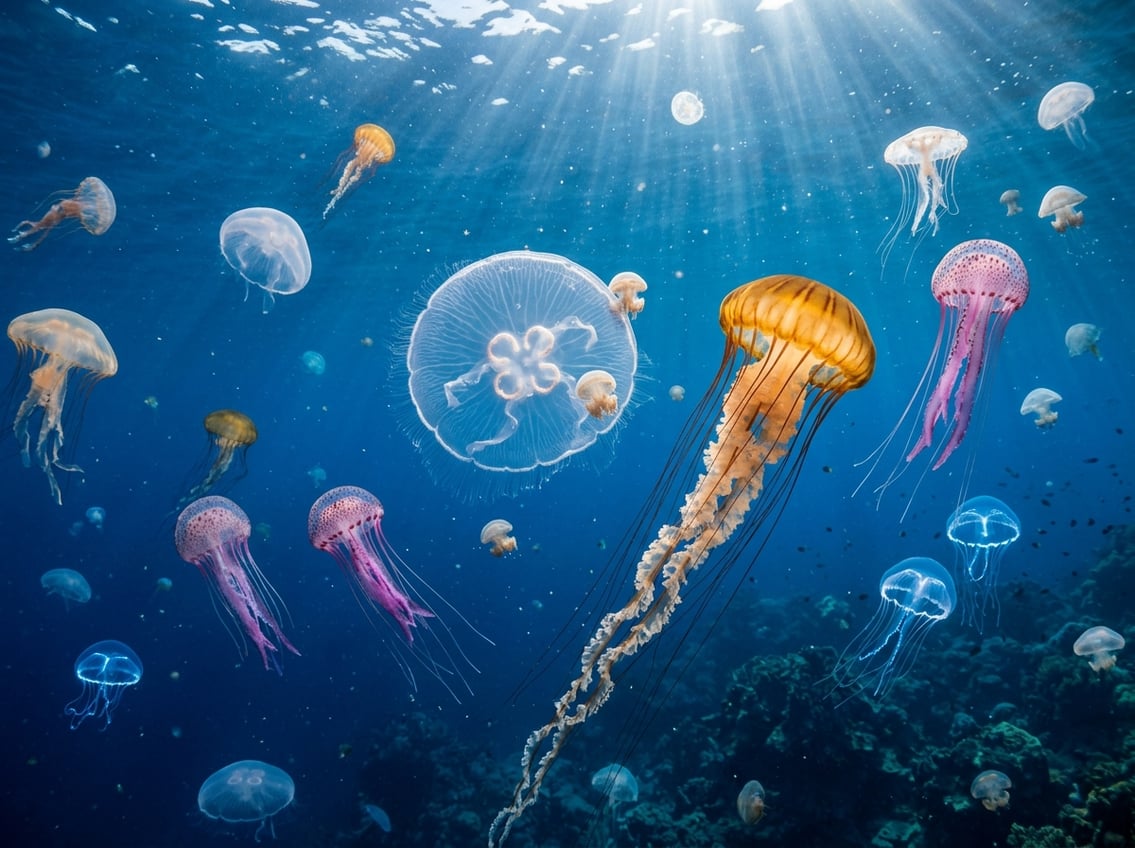
Types of jellyfish range from nearly transparent moon jellies to fast-swimming box jellies. The 11 species below include true jellyfish, hydrozoan jellies, and one box jellyfish. Each profile explains how to identify the animal, where it lives, what it eats, and how seriously to treat its sting.
Jellyfish are cnidarians: animals equipped with specialized stinging cells called nematocysts. Their bodies are mostly water, and they lack bones, a heart, and a centralized brain. Fossil evidence shows that jellyfish-like animals were swimming in the ocean more than 500 million years ago.
The familiar bell-shaped form is called a medusa, but many species also spend part of their life attached to a surface as a polyp. That two-stage life cycle helps explain why jellyfish can appear suddenly in large seasonal blooms.
Last fact-checked: August 6, 2026.
Key takeaways
- Most familiar species: moon jellies, cannonball jellies, and sea nettles are common in coastal waters or aquariums.
- Highest medical risk in this list: the Australian box jellyfish, Chironex fleckeri, can cause life-threatening envenoming.
- Most unusual biology: crystal jellies helped scientists develop green fluorescent protein as a research tool, while the immortal jellyfish can reverse from the medusa stage toward a polyp stage under stress.
- Identification has limits: color, size, and tentacle length change with age and conditions. Local beach warnings are more reliable than a quick visual guess.
- First aid is species- and region-specific: vinegar is recommended for suspected Australian box jellyfish stings in northern Australia, but it is not universal advice for every jellyfish sting.
11 types of jellyfish at a glance
| Species | Class | Approximate bell size | Main range | Typical human sting concern |
|---|---|---|---|---|
| Moon jelly, Aurelia spp. | Scyphozoa | Commonly 10–40 cm; some species reach about 60 cm | Coastal waters worldwide | Low |
| Lion’s mane jellyfish, Cyanea capillata | Scyphozoa | Often 50–100 cm; exceptional specimens are much larger | Cold northern oceans | Moderate; painful |
| Crystal jelly, Aequorea victoria | Hydrozoa | Up to about 25 cm | Northeast Pacific | Low |
| Blue blubber jellyfish, Catostylus mosaicus | Scyphozoa | Up to about 35 cm | Eastern Australia and nearby Indo-Pacific waters | Low |
| Cannonball jellyfish, Stomolophus meleagris | Scyphozoa | Usually 15–25 cm | Western Atlantic, Gulf of Mexico, and parts of the Pacific | Very low |
| Upside-down jellyfish, Cassiopea spp. | Scyphozoa | Up to about 40 cm | Tropical lagoons and mangroves | Low, including contactless irritation |
| Mauve stinger, Pelagia noctiluca | Scyphozoa | Usually 3–12 cm | Mediterranean and warm Atlantic waters | Moderate; often painful |
| Pacific sea nettle, Chrysaora fuscescens | Scyphozoa | Up to about 45 cm | North Pacific | Moderate; painful |
| White-spotted jellyfish, Phyllorhiza punctata | Scyphozoa | Often 45 cm; some introduced populations exceed 60 cm | Indo-Pacific; introduced elsewhere | Low |
| Immortal jellyfish, Turritopsis dohrnii | Hydrozoa | About 4.5 mm | Mediterranean origin; now reported widely | Very low |
| Australian box jellyfish, Chironex fleckeri | Cubozoa | Commonly 16–24 cm; some reach roughly 30–35 cm | Northern Australia and nearby Indo-Pacific waters | Extreme; medical emergency |
What counts as a jellyfish?
In everyday language, “jellyfish” covers several related groups within the cnidarian subphylum Medusozoa. The World Register of Marine Species recognizes four living classes:
- Scyphozoa: the “true jellyfish,” including moon jellies, lion’s mane jellies, sea nettles, and most large species seen near beaches.
- Cubozoa: box jellyfish, named for their cube-shaped bells. Some species have medically dangerous venom.
- Hydrozoa: a broad class that includes small medusae such as crystal and immortal jellies, as well as colonial animals. The Portuguese man o’ war is a hydrozoan siphonophore colony, not one individual true jellyfish.
- Staurozoa: stalked jellyfish that remain attached to seaweed, rocks, or other surfaces instead of drifting as a free-swimming adult medusa.
This distinction matters when people ask how many jellyfish species exist. As of August 2026, the World Register of Marine Species displays roughly 4,100 accepted living marine species across those four classes, but only about 240 are Scyphozoa, the true jellyfish most readers picture. Counts change as species are described, split, combined, or reclassified.
Types of jellyfish: species profiles
1. Moon jellyfish
Scientific name: Aurelia spp.
Sting concern: Low for most people
Best identification clue: A translucent saucer-shaped bell with four visible, horseshoe-like reproductive organs
Moon jellies are among the most recognizable coastal jellyfish. Their clear bells pulse slowly, and the four structures near the center often appear pale pink, violet, or cream. Short tentacles form a fine fringe around the bell rather than trailing several meters behind it.
Calling every moon jelly Aurelia aurita is no longer precise. Genetic research has shown that Aurelia contains many lookalike species that cannot always be separated by appearance alone. A 2021 systematic review of the genus Aurelia documented a much more complex species group than the old idea of one nearly cosmopolitan species.
Moon jellies live in bays, estuaries, harbors, and other productive coastal waters. Their mucus-coated bell and short tentacles collect zooplankton, fish eggs, and other small prey. In the typical life cycle, a swimming larva settles as a polyp; the polyp later releases tiny juvenile medusae called ephyrae.
Most moon jelly stings are too weak to penetrate human skin effectively, although sensitive people can still develop irritation. The animals also matter as prey for sea turtles, fishes, seabirds, and other marine predators.
2. Lion’s mane jellyfish
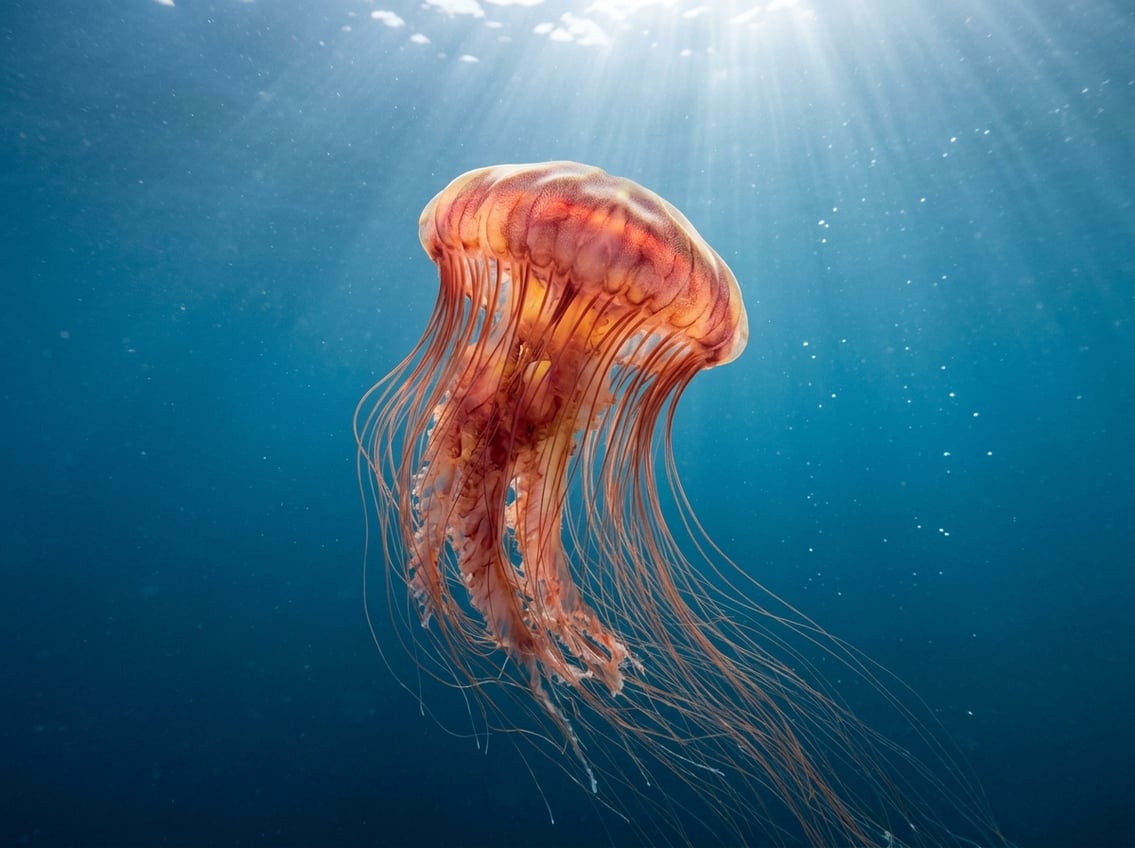
Scientific name: Cyanea capillata
Sting concern: Moderate and painful; severe reactions are uncommon
Best identification clue: A large red, orange, or maroon bell with a mass of hair-like tentacles
The lion’s mane is the largest known jellyfish species. Most individuals are far smaller than record specimens: the Monterey Bay Aquarium gives a common bell range of about 50 centimeters to one meter, while exceptionally large Arctic animals can exceed 1.8 meters across. Their tentacles can extend beyond 30 meters, longer than some blue whales.
The tentacles hang in eight clusters. Sources often repeat a claim that each cluster holds 1,200 strands, but the better-supported figure is up to roughly 1,200 tentacles in total. The dense curtain catches zooplankton, small fish, crustaceans, and other jellies.
Lion’s mane jellies favor cool waters of the Arctic, North Atlantic, and North Pacific. Juvenile fish may shelter around the bell and tentacles, creating a moving microhabitat. The sting can cause immediate pain, redness, and welts, and detached tentacles can remain active after the animal washes ashore.
3. Crystal jellyfish
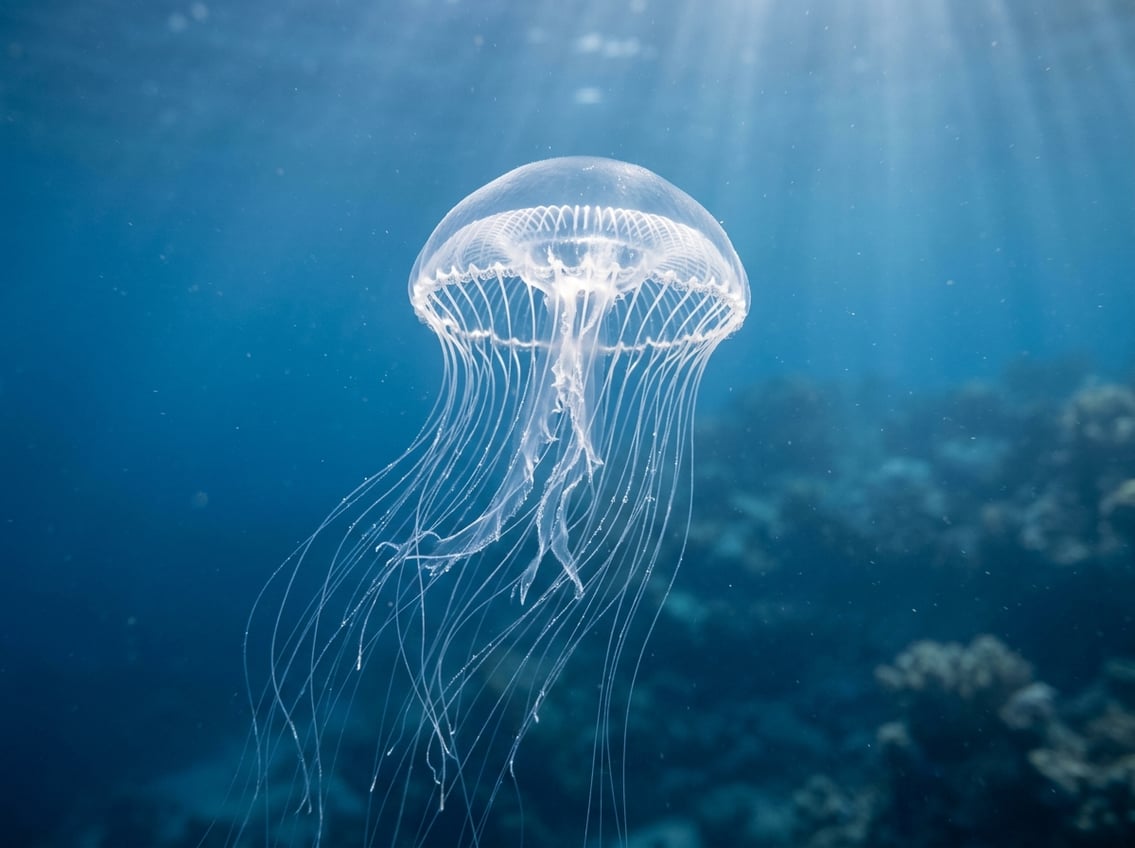
Scientific name: Aequorea victoria
Sting concern: Low
Best identification clue: A glass-clear bell edged by many fine radial canals and delicate tentacles
Crystal jellies occur in the northeast Pacific from Southern California to Vancouver. They can reach about 25 centimeters across, although many are smaller. They feed on copepods, comb jellies, and other hydromedusae, sometimes swallowing gelatinous prey more than half their own diameter.
The species changed modern biology. When disturbed, it produces blue light with the calcium-sensitive protein aequorin. Green fluorescent protein, or GFP, absorbs some of that blue energy and emits green light. The 2008 Nobel Prize in Chemistry recognized Osamu Shimomura, Martin Chalfie, and Roger Tsien for the discovery and development of GFP as a biological marker.
That distinction is useful: bioluminescence creates light through a chemical reaction, while fluorescence re-emits light at another wavelength. Our guide to bioluminescence in nature explains the difference in more detail.
Crystal jellies are fragile and require highly controlled water flow in aquariums. Their sting is not considered a meaningful hazard to most people.
4. Blue blubber jellyfish
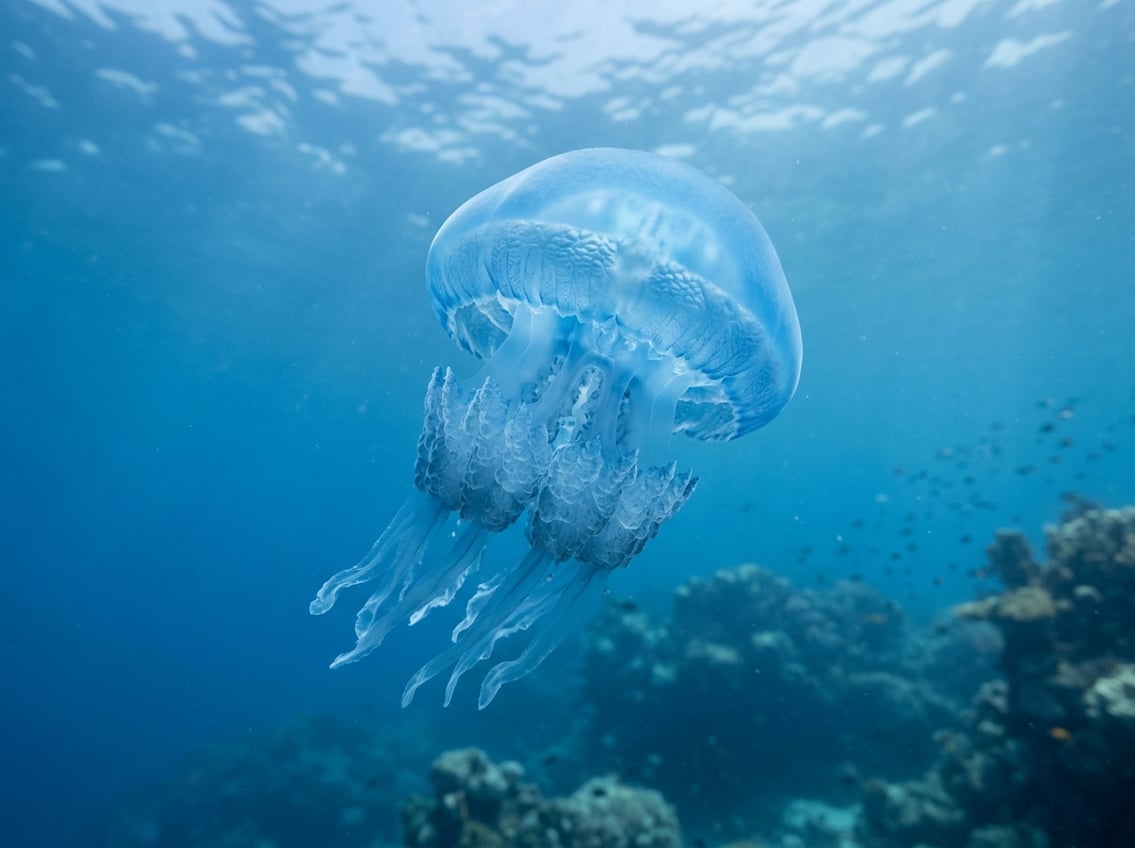
Scientific name: Catostylus mosaicus
Sting concern: Low
Best identification clue: A rounded blue, cream, or brown bell above eight compact, frilled oral arms
Blue blubber jellyfish are familiar in bays, estuaries, and lagoons along eastern Australia. Adults can reach about 35 centimeters across. Their color varies among populations and individuals, ranging from cream and brown to a saturated blue.
Unlike a sea nettle, a blue blubber has no long curtain of marginal tentacles. Eight robust oral arms beneath the bell carry many small mouth openings that gather microplankton, crustaceans, fish eggs, and other suspended food.
Blue blubbers can host photosynthetic dinoflagellates in their tissues. Those symbionts transfer some photosynthetically produced nutrients to the jellyfish, but the animal still feeds on prey and suspended organic material; describing it as living on sunlight alone would be inaccurate.
Large seasonal aggregations can form in sheltered water. Their sting is usually mild, although direct contact can still cause itching or a temporary rash.
5. Cannonball jellyfish
Scientific name: Stomolophus meleagris
Sting concern: Very low for most people
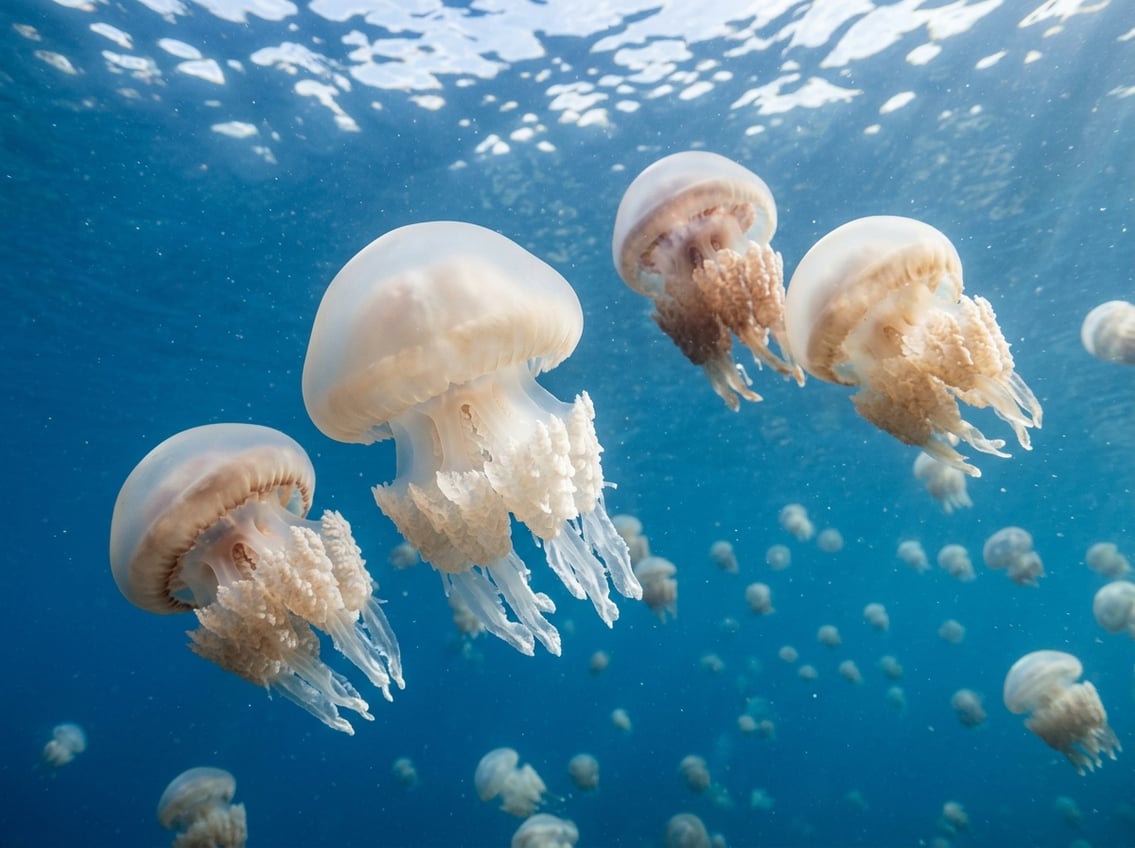
Best identification clue: A firm, nearly spherical white bell with a brown, purple, or maroon edge
Cannonball jellies are among the most abundant jellyfish along parts of the southeastern United States and Gulf of Mexico. The South Carolina Department of Natural Resources describes them as common in coastal and estuarine waters, especially in summer and fall.
Adults are typically 15 to 25 centimeters across. Instead of long tentacles, they have short, fused oral arms under the bell. The compact shape is why stranded animals can look unusually solid compared with other jellies.
Cannonball jellyfish capture zooplankton and provide food for sea turtles, fishes, and seabirds. They also support a commercial fishery in parts of the southeastern United States, where they are processed for food markets. Processing is essential; a washed-up jellyfish should never be treated as ready-to-eat seafood.
The sting is weak, but mucus and contact can still irritate eyes or sensitive skin. Seasonal strandings may cover a beach without indicating pollution or an ecological emergency.
6. Upside-down jellyfish
Scientific name: Cassiopea spp.
Sting concern: Low, but irritation can occur without touching the animal
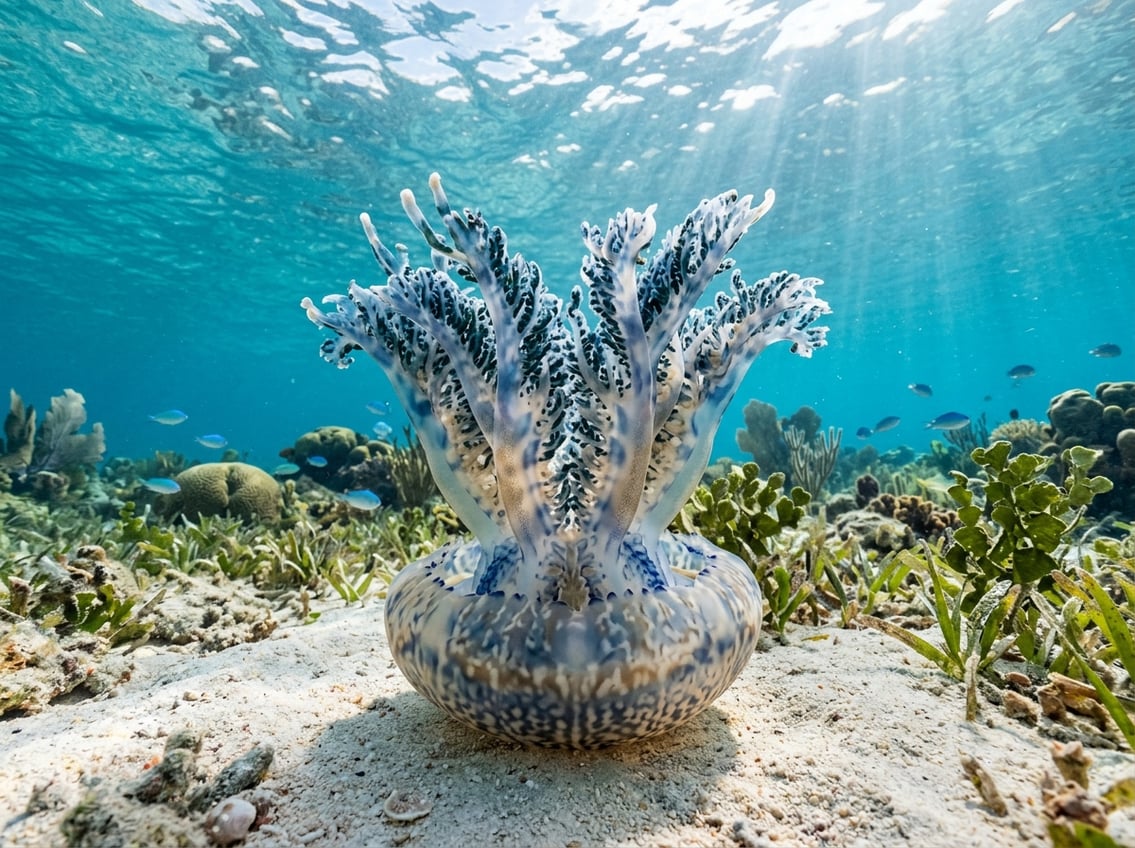
Best identification clue: A flattened jelly resting bell-down with branching oral arms pointed upward
Upside-down jellyfish live in shallow, sunlit mangrove lagoons, seagrass beds, and sheltered tidal areas across tropical and subtropical regions. Rather than drifting through open water, they pulse gently on the bottom with their oral arms exposed to light.
Photosynthetic dinoflagellates live inside their tissues and provide nutrients to the host. The jellyfish still captures zooplankton, but the symbiosis explains its sun-facing posture and preference for shallow water.
Cassiopea also produces the phenomenon called “stinging water.” Research led by Smithsonian scientists identified cassiosomes: microscopic structures containing stinging cells that are released in mucus. Swimmers can therefore feel itching or burning without making direct contact with the jellyfish.
Give these bottom-dwellers space and avoid stirring sediment above them. Protecting mangrove and reef habitat also supports many other species, including the hawksbill sea turtle.
7. Mauve stinger
Scientific name: Pelagia noctiluca
Sting concern: Moderate and often painful
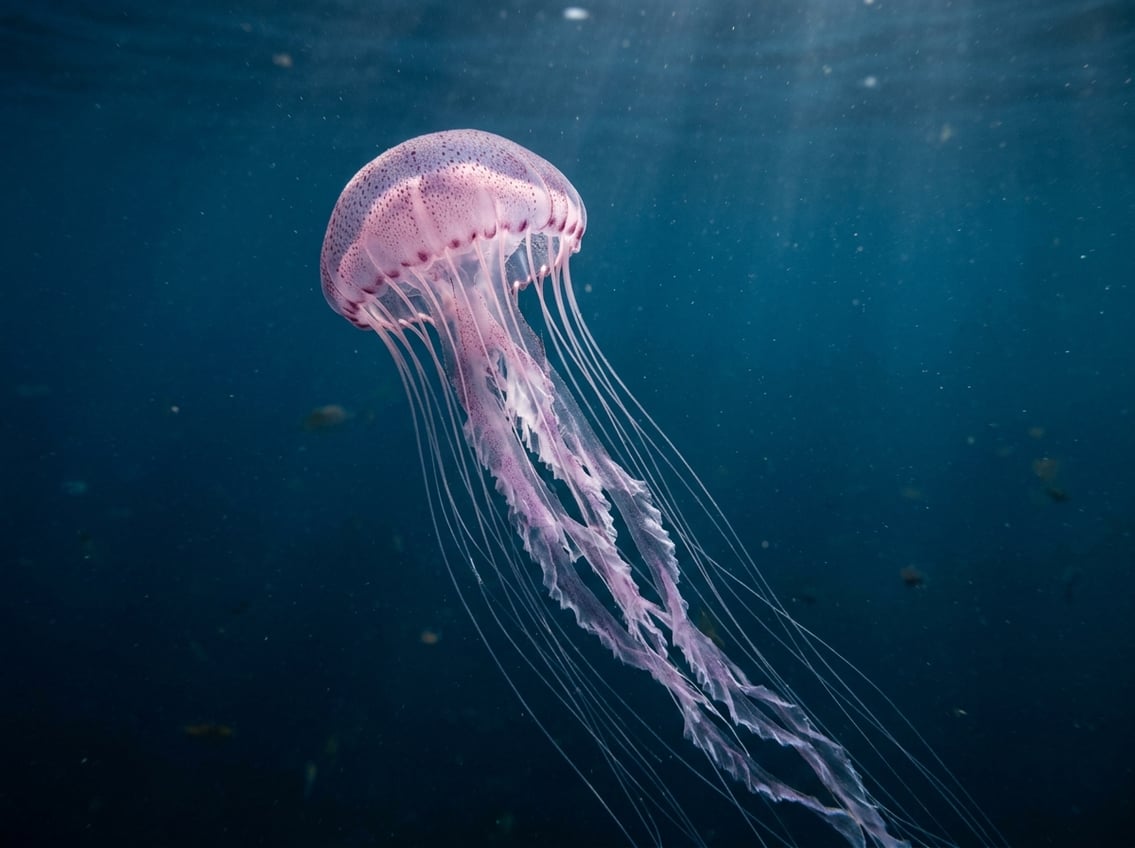
Best identification clue: A small pink, purple, or mauve bell covered with raised spots
The mauve stinger is common in the Mediterranean and parts of the eastern Atlantic. Its bell is often only 3 to 12 centimeters wide, yet the animal can deliver a disproportionately painful sting. Stinging cells occur on the bell as well as the tentacles and oral arms.
The species name noctiluca refers to its light-producing ability. Disturbance can trigger flashes of bioluminescence, making dense nighttime aggregations visible from boats or shore.
Unlike many scyphozoans, Pelagia noctiluca has no attached polyp stage; it develops entirely in the open water. It eats zooplankton, fish eggs, larvae, and small fish.
A sting usually causes immediate burning, red welts, and itching. A peer-reviewed review of mauve stinger envenoming also documents occasional systemic or allergic reactions. Large blooms can disrupt beaches, fishing, and aquaculture, but their timing depends on currents, food, temperature, reproduction, and longer-term ocean cycles rather than one simple cause.
8. Pacific sea nettle
Scientific name: Chrysaora fuscescens
Sting concern: Moderate and painful
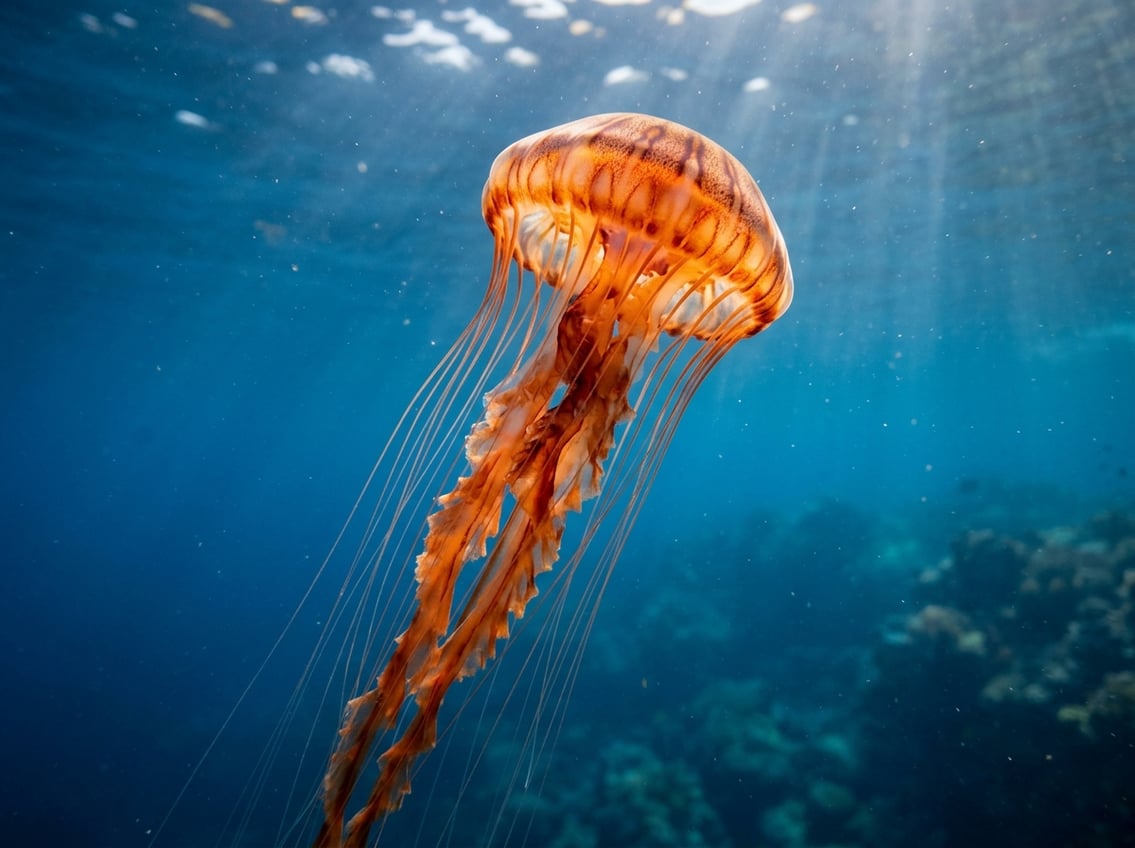
Best identification clue: A golden-brown bell with pale radial stripes and long red-brown oral arms
Pacific sea nettles occur in the North Pacific, including coastal waters from Alaska toward California. Their bells can reach about 45 centimeters across, while the ruffled oral arms may extend several meters.
The tentacles capture zooplankton, fish eggs, larvae, small fish, and other jellies. Nutrient-rich upwelling can concentrate both prey and sea nettles near the surface, which is why sightings often vary sharply by season and location.
The sting causes immediate pain and welts but is rarely life-threatening in a healthy adult. Surfers and swimmers should leave the water when large numbers are present because repeated contact increases the venom dose.
Sea nettles are well suited to circular kreisel tanks, where carefully controlled flow keeps their delicate bodies away from corners. They are a signature display at the Monterey Bay Aquarium and other public aquariums.
9. White-spotted jellyfish
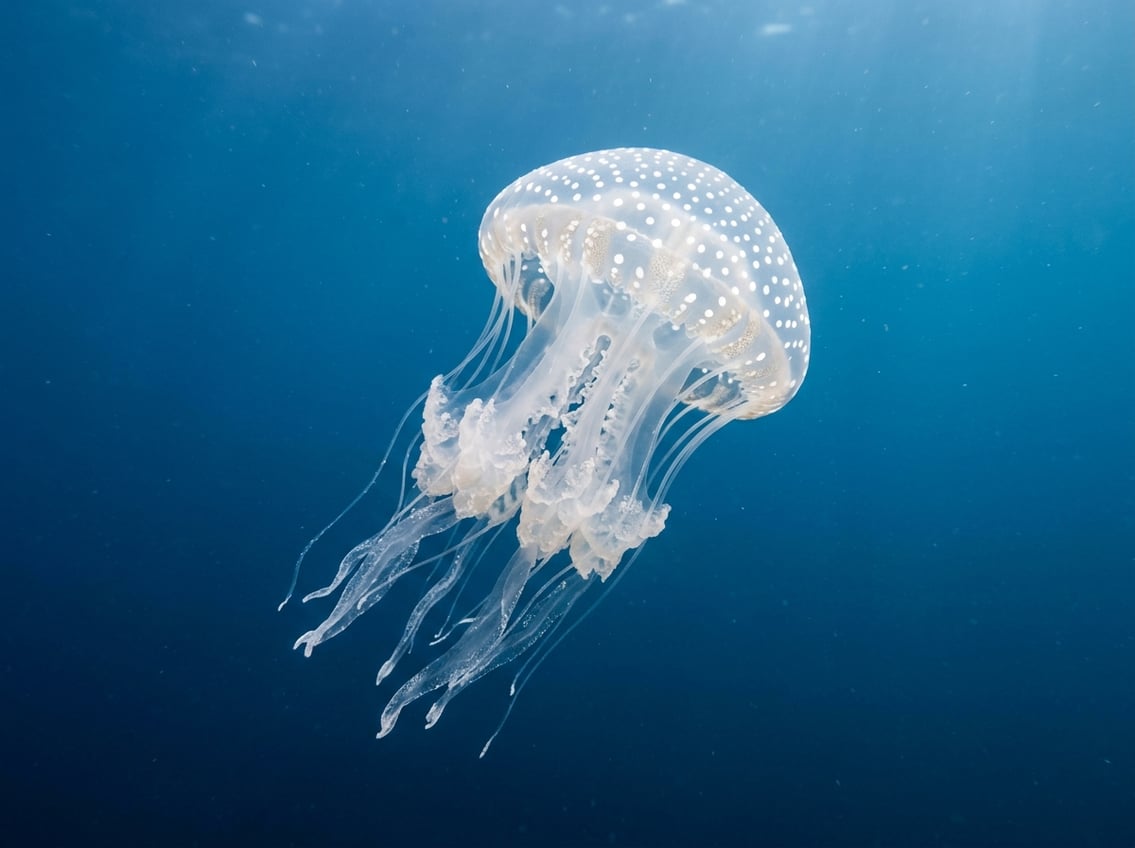
Scientific name: Phyllorhiza punctata
Sting concern: Low
Best identification clue: A large brown or blue-gray bell densely covered with white spots
White-spotted jellyfish are native to tropical western Pacific and Indo-Pacific waters. In their native range, many host photosynthetic symbionts. Introduced populations can differ: the U.S. Geological Survey species profile notes that Gulf of Mexico animals have lacked the symbiotic algae seen in many Indo-Pacific populations.
The species has appeared far outside its native range, including the Gulf of Mexico, Caribbean, and Mediterranean. Ship transport, hull fouling, ballast water, and subsequent movement by currents are among the likely pathways.
A major Gulf of Mexico bloom in 2000 clogged fishing gear and interfered with shrimping. Because each animal filters plankton from the water, a dense introduced population can also compete with fish larvae and other native plankton feeders. The ecological impact matters more than the sting, which is generally mild.
10. Immortal jellyfish
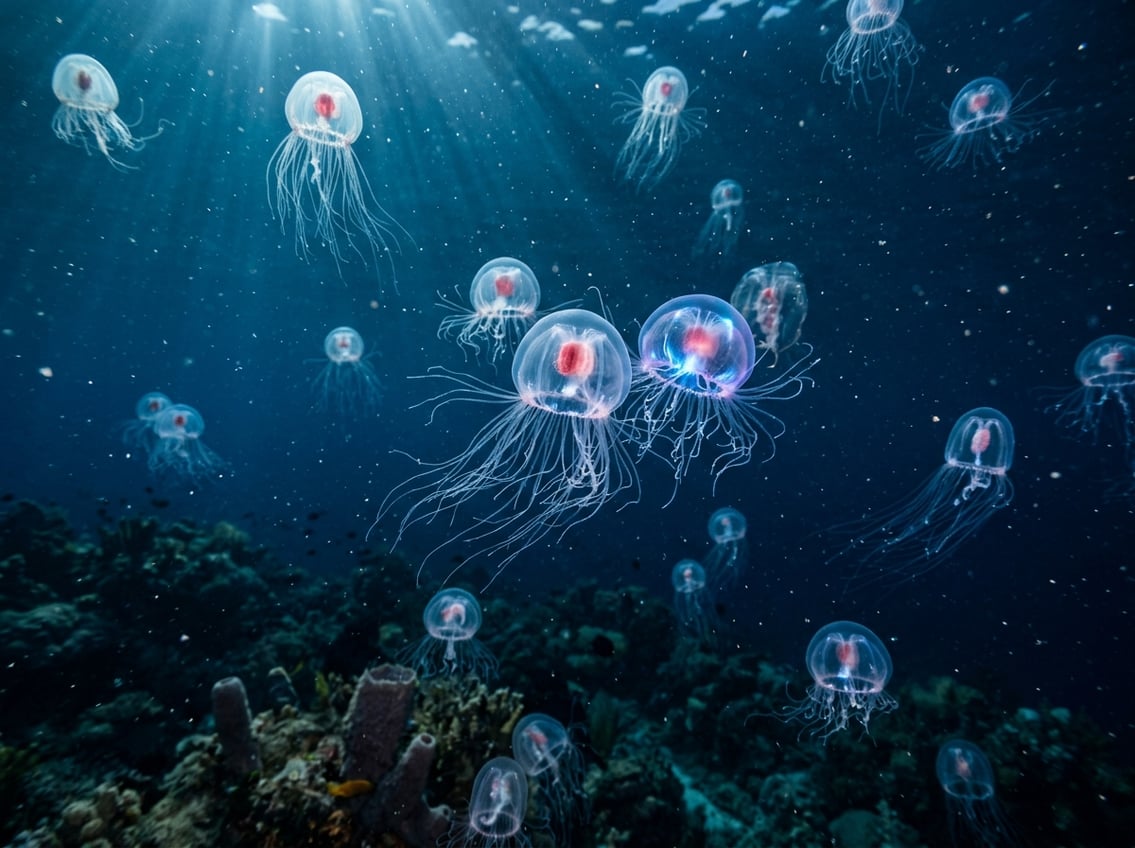
Scientific name: Turritopsis dohrnii
Sting concern: Very low
Best identification clue: A minute transparent bell with a red stomach—usually too small for a casual swimmer to identify
The immortal jellyfish is about 4.5 millimeters across. Under injury, starvation, or other stress, a medusa can shrink, lose its swimming form, settle as a cyst-like stage, and generate a new polyp colony. That life-cycle reversal is why the species is described as biologically immortal.
The name does not mean an individual is indestructible. Predators, disease, environmental stress, and physical damage can still kill it. Nor does the process make humans immortal: it is a specialized developmental pathway in a tiny hydrozoan.
A 2022 comparative genomics study in PNAS identified candidate mechanisms involving DNA repair, telomere maintenance, stem-cell regulation, and cellular reprogramming. The research is valuable for understanding regeneration, but it remains a long step from any clinical application.
Turritopsis dohrnii was described from the Mediterranean region and has since been reported in widely separated waters. Shipping is a plausible contributor to that spread, although records of tiny Turritopsis species can be difficult to verify without genetic work.
11. Australian box jellyfish
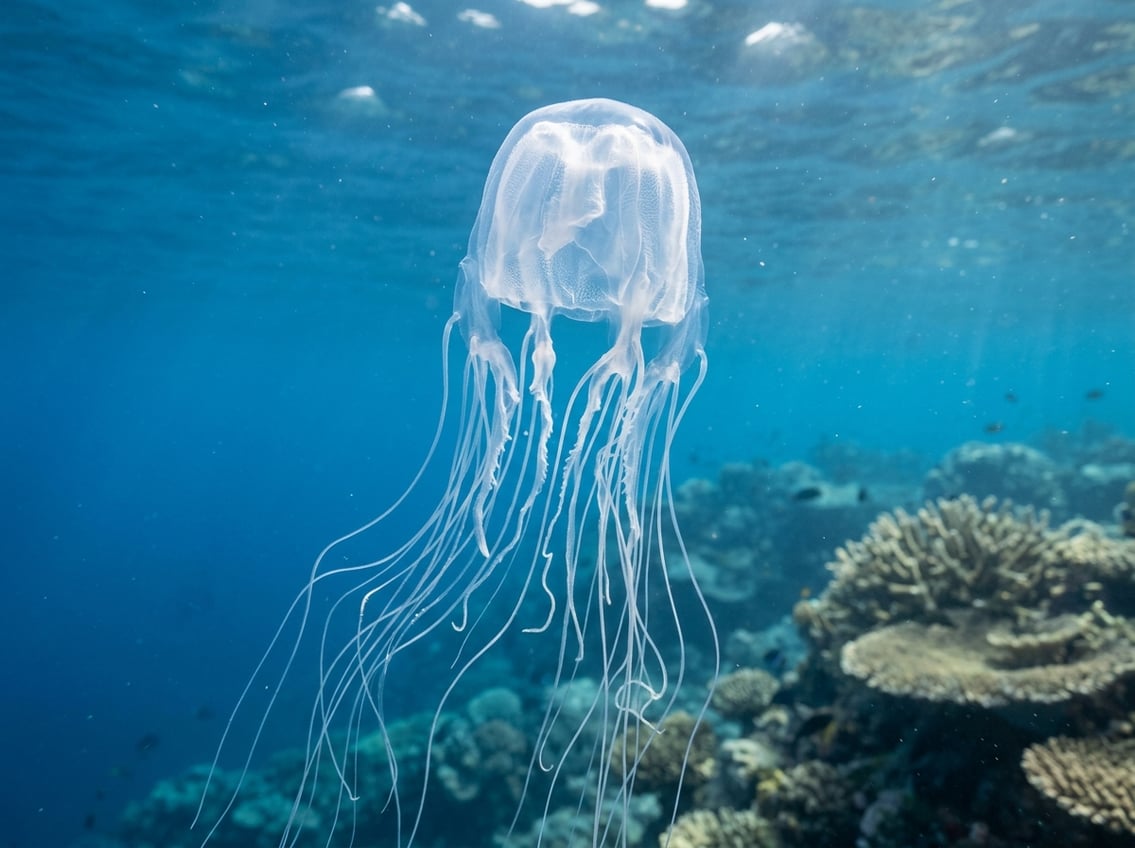
Scientific name: Chironex fleckeri
Sting concern: Extreme; a suspected sting is a medical emergency
Best identification clue: A nearly transparent cube-shaped bell with tentacles hanging from four corners
Chironex fleckeri is one of the most medically dangerous marine animals. Its bell is commonly 16 to 24 centimeters across, though larger individuals can approach 30 to 35 centimeters. Each of the four corners can carry up to 15 tentacles, for a total of as many as 60, and the tentacles may extend about three meters.
Unlike many drifting jellies, box jellyfish are strong, directional swimmers. They have 24 eyes grouped in four sensory structures and use visual information to navigate, avoid obstacles, and stay in suitable habitat. Adults prey on prawns, shrimp, and small fish.
The species occurs around northern Australia and nearby Indo-Pacific waters, especially in shallow coastal habitat, estuaries, and river mouths. Seasonal risk varies by latitude, weather, rainfall, and local conditions, so posted beach closures and lifeguard instructions take priority over a fixed calendar.
Heavy tentacle contact can produce excruciating pain, whip-like skin marks, cardiovascular collapse, and cardiac arrest within minutes. Queensland Health classifies severe box jellyfish envenoming as a life-threatening medical emergency. Prevention—stinger suits, managed swimming areas, and compliance with local warnings—is far safer than relying on identification after contact.
How jellyfish fit into marine ecosystems

They are both predators and prey
Jellyfish consume copepods, fish eggs, larvae, small crustaceans, other jellies, and—in larger species—small fish. At the same time, they feed turtles, fishes, seabirds, and invertebrates. The leatherback sea turtle is especially dependent on gelatinous prey and can travel long distances between feeding areas.
Some juvenile fish shelter beside or beneath large jellies, gaining protection while accepting the risk of becoming prey. Those associations make a jellyfish a temporary three-dimensional habitat, not merely an animal drifting alone.
They move nutrients through the water column
Jellyfish excrete dissolved nutrients that can be used by microbes and plankton. When a jelly dies and sinks, its soft body delivers organic material to scavengers and microbes below. These “jelly falls” connect surface production with deeper habitats, although how much carbon reaches the seafloor depends on decomposition, temperature, depth, and scavenging.
What jellyfish blooms do—and do not—tell us about ocean health
A bloom is a temporary concentration of many jellyfish. Blooms can be natural, seasonal events caused by reproduction, currents, winds, prey availability, and favorable temperature. One crowded beach does not prove that an ecosystem is collapsing.
Human activity can still change the odds. NOAA researchers note that increases have been reported in many coastal areas and that several stressors may favor some jellyfish: nutrient pollution, overfishing, warming water, low-oxygen zones, transport of non-native species, and new hard surfaces where polyps can attach. The pattern is regional, not a uniform worldwide rise.
- Warm water can speed growth or lengthen the reproductive season for some species, while pushing others out of an area.
- Nutrient runoff can increase plankton food and contribute to low-oxygen conditions that some jellies tolerate better than fish.
- Fishing pressure may remove predators or competitors, but the effect depends on the local food web.
- Piers, seawalls, docks, and aquaculture gear can create additional surfaces for the attached polyp stage.
- Ships can transport polyps or medusae on hulls or in ballast water, helping species establish outside their native range.
The most defensible interpretation is specific: identify the species, compare several years of local records, and examine temperature, plankton, oxygen, currents, fishing, and coastal development together.
Jellyfish safety near beaches
Safety note: First aid differs by species and location. Follow lifeguards, local public-health authorities, and emergency services rather than applying one universal jellyfish remedy. This section provides general information, not a substitute for emergency or medical care.
How to lower your risk
- Read beach flags, lifeguard notices, marine park alerts, and seasonal stinger warnings.
- Do not enter the water when a dangerous species is reported or a beach is closed.
- Wear a full-body stinger suit in tropical northern Australian waters when local guidance recommends one.
- Keep children close to shore and out of water where visibility is poor or warnings are active.
- Do not touch a jellyfish or detached tentacle, including animals that appear dead on the beach.
What to do after a jellyfish sting
Get the person out of the water and call emergency services immediately for collapse, trouble breathing, chest pain, confusion, severe or widespread pain, repeated vomiting, signs of shock, a suspected Australian box jellyfish sting, or possible Irukandji syndrome.
For a typical non-box jellyfish sting, the American Red Cross advises carefully removing tentacles with a gloved hand, plastic barrier, towel, blunt stick, or utensil; seawater can be used to flush tentacles away when those items are unavailable. Do not rub the skin. Hot-water immersion—as hot as can be safely tolerated without scalding—for at least 20 minutes can reduce pain.
For a suspected Australian box jellyfish sting in northern Australia: call emergency services, begin CPR if the person is unresponsive and not breathing normally, apply vinegar liberally to the sting area for 30 seconds, and remove tentacles with gloves or forceps. Queensland guidance specifically warns against using fresh water.
Vinegar is not a universal treatment. Queensland guidance says not to use it for bluebottle and many other jellyfish stings because it may increase pain. This is why the location, likely species, and local protocol matter.
How to observe jellyfish without harming them
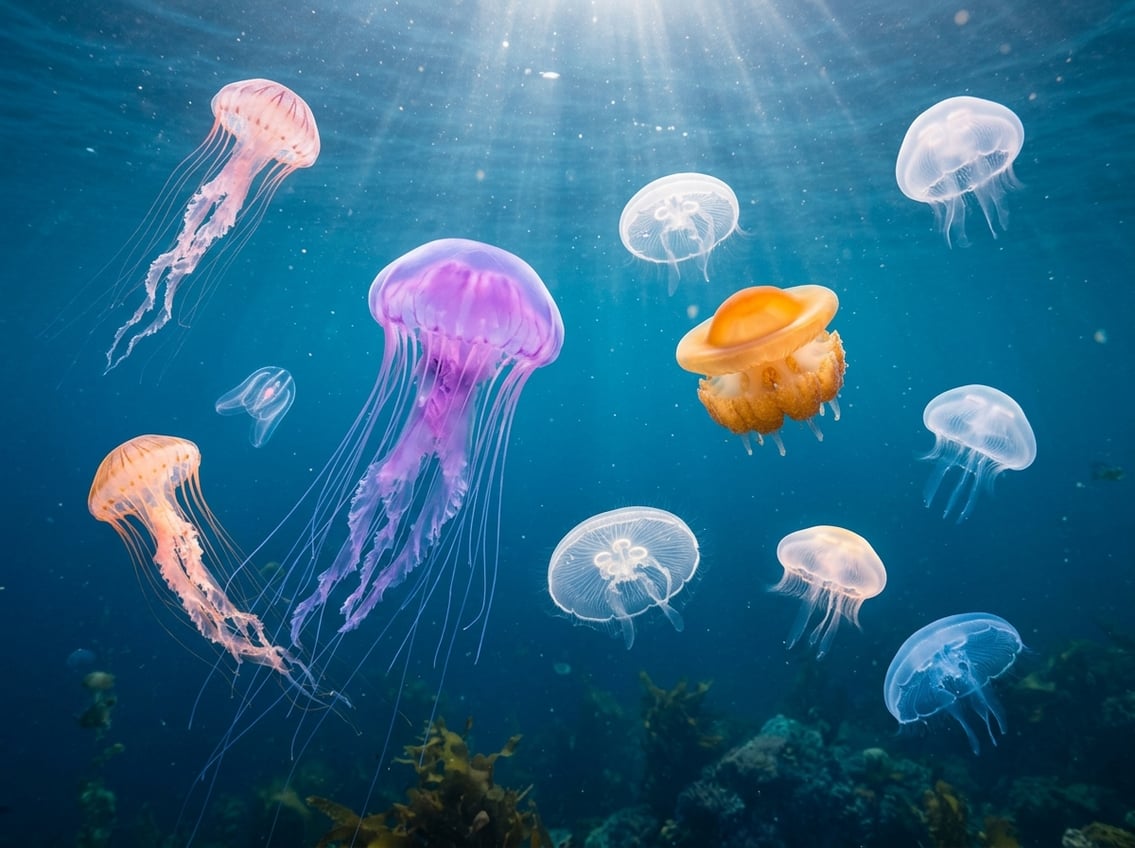
- Keep your distance. Long tentacles can be difficult to see, and some species release stinging material into the surrounding water.
- Do not handle stranded animals. Nematocysts can remain capable of firing after a jellyfish dies.
- Maintain neutral buoyancy. Divers and snorkelers should avoid kicking sediment onto upside-down jellies, seagrass, or coral.
- Photograph without crowding. Use zoom, avoid flash when prohibited, and never reposition wildlife for a cleaner composition.
- Report unusual blooms responsibly. A clear photo, date, location, approximate size, and water conditions can help an aquarium, park, or citizen-science program verify a sighting.
Jellyfish are one part of a much larger community of unusual sea creatures. The best viewing rule is simple: observe closely enough to learn, but not so closely that the animal has to absorb the cost of your curiosity.
Frequently asked questions
How many jellyfish species are there?
The answer depends on what is counted. As of August 2026, WoRMS displays roughly 4,100 accepted living marine species across Hydrozoa, Scyphozoa, Cubozoa, and Staurozoa. About 240 are Scyphozoa, the true jellyfish most people picture.
What are the four main classes of jellyfish?
The four living medusozoan classes are Scyphozoa, Cubozoa, Hydrozoa, and Staurozoa. They include true jellyfish, box jellyfish, hydromedusae and related colonies, and stalked jellyfish.
Which jellyfish is most dangerous to humans?
The Australian box jellyfish, Chironex fleckeri, is among the most dangerous because a severe sting can cause cardiovascular collapse within minutes. Several smaller Irukandji-type box jellyfish can also cause medical emergencies.
Are all jellyfish dangerous?
No. Many species cause little or no noticeable reaction in most people. Risk depends on the species, amount of tentacle contact, body area exposed, the person’s sensitivity, and access to prompt first aid.
Is the Portuguese man o’ war a jellyfish?
No. It is a siphonophore: a floating colony of specialized hydrozoan individuals that function together. It can still deliver a painful and occasionally serious sting, so the taxonomic distinction does not make it safe to touch.
What should you do if a jellyfish stings you?
Leave the water, avoid rubbing, remove tentacles with a barrier, and follow local first-aid guidance. Hot water often reduces pain. Suspected Australian box jellyfish, Irukandji syndrome, breathing difficulty, collapse, or severe widespread symptoms require emergency care.
Jellyfish are ancient, adaptable animals whose biology ranges from photosymbiosis to life-cycle reversal. Most deserve curiosity rather than fear. The practical rule is to identify cautiously, respect local warnings, avoid contact, and treat a severe sting as an emergency.