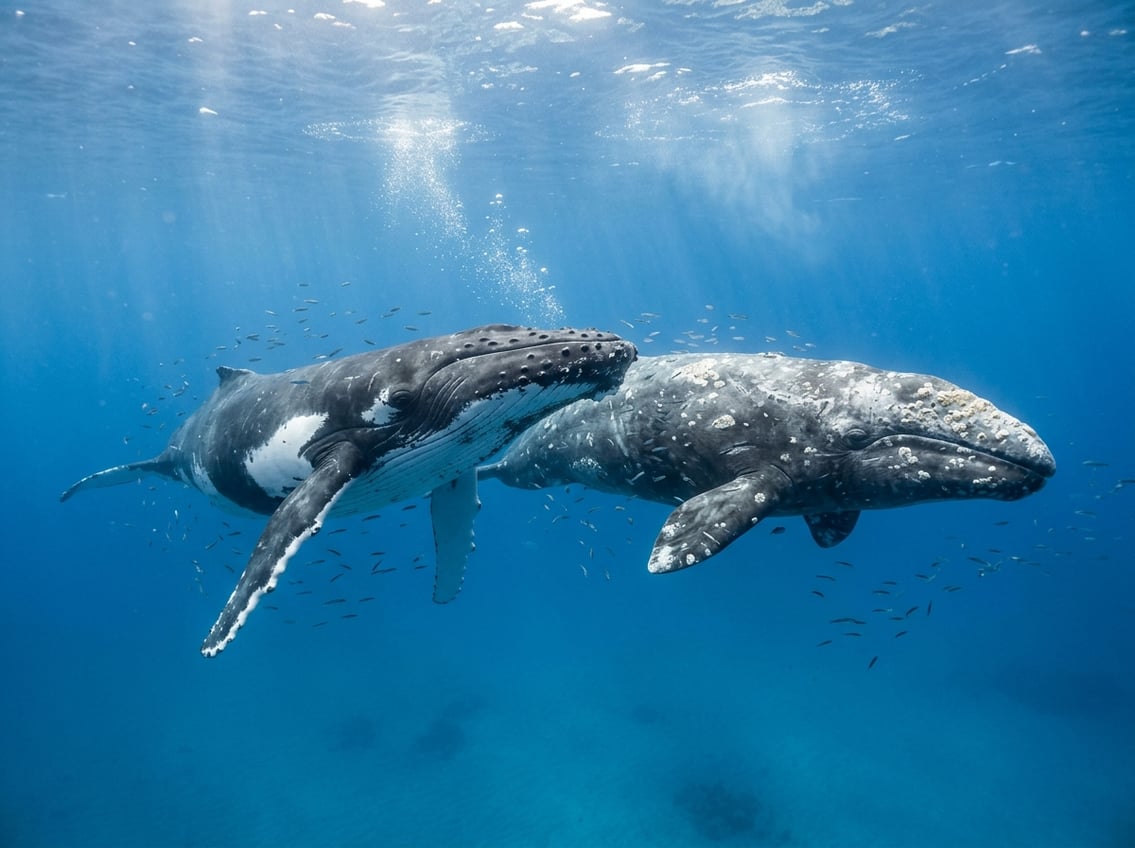
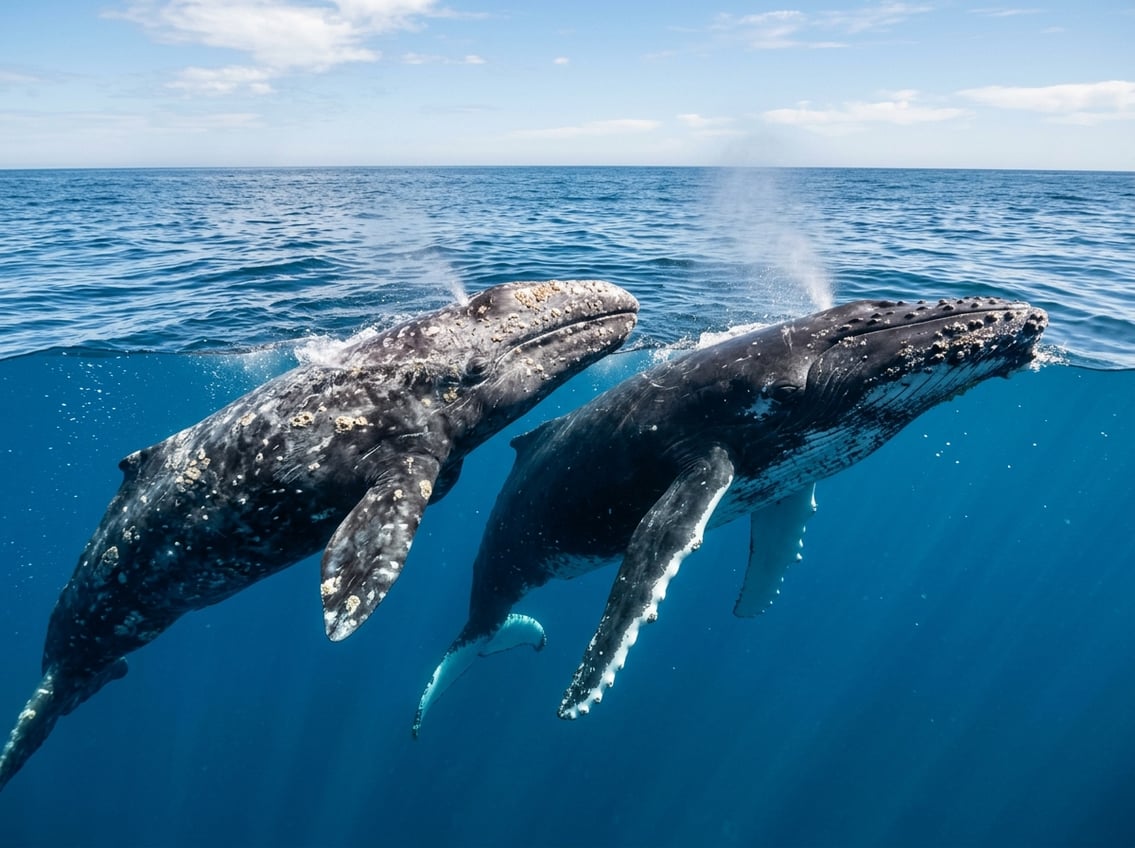
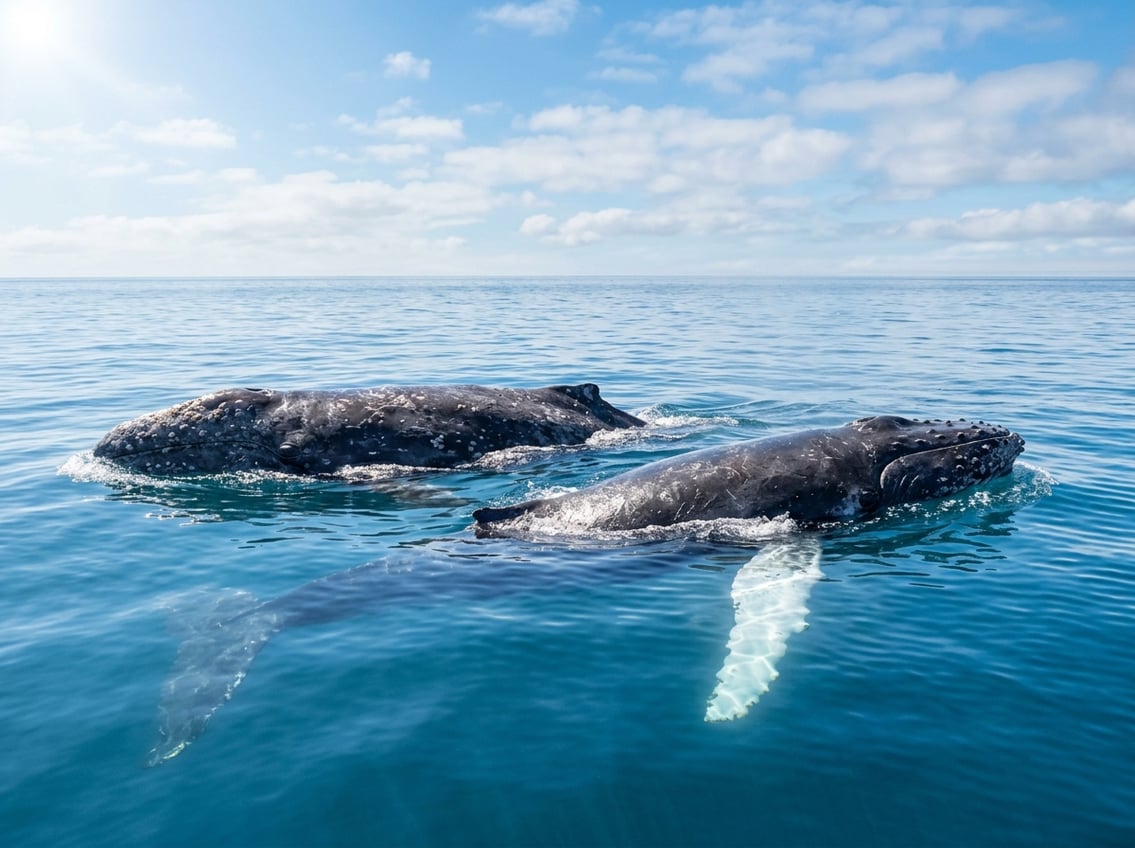
The clearest grey whale vs humpback whale differences are visible in the back, pectoral fins, skin, and feeding behavior. A gray whale has mottled, barnacle-marked skin, no true dorsal fin, and a low hump followed by a row of knuckles. A humpback has a small dorsal fin, extremely long pectoral fins, a bumpy head, and often shows black-and-white markings beneath its tail.
Both are baleen whales, but they are not close look-alikes once you know the field marks. Gray whales primarily suction-feed on animals in or near the seafloor and live in the North Pacific. Humpbacks lunge-feed on krill and schooling fish, occur in every major ocean, and are the species known for long, structured songs.
Spelling note: “Grey whale” and “gray whale” refer to the same species. This guide uses “gray” after the title because that is the spelling used by NOAA Fisheries and most North American field guides.
Key takeaways
- Best gray whale clue: no true dorsal fin; look for a low hump followed by 6 to 12 knuckles.
- Best humpback clue: very long pectoral fins, often with white underneath, plus tubercles on the head.
- Feeding difference: gray whales mainly suction-feed near the bottom; humpbacks lunge-feed on krill and fish, sometimes with bubble nets.
- Size is not a reliable field mark: humpbacks can grow longer, but adult weight estimates overlap.
- Conservation status depends on the population: the eastern North Pacific gray whale population is not listed under the U.S. Endangered Species Act, while the western North Pacific population is endangered. Several humpback populations are also listed.
Gray whale vs humpback whale comparison
| Feature | Gray whale | Humpback whale |
|---|---|---|
| Scientific family | Eschrichtiidae; Eschrichtius robustus | Balaenopteridae; Megaptera novaeangliae |
| Maximum length | About 49 feet | Up to about 60 feet |
| Reported adult mass | About 90,000 pounds | Up to about 40 tons |
| Skin | Mottled gray, commonly marked by barnacles and whale lice | Mostly dark, with variable white on the belly, fins, and flukes |
| Dorsal profile | No true dorsal fin; one hump followed by 6 to 12 knuckles | Small dorsal fin on a fleshy hump |
| Pectoral fins and head | Short, broad, paddle-shaped flippers; no head tubercles | Exceptionally long pectoral fins; prominent tubercles on the head and jaws |
| Blow | Often appears heart- or V-shaped in calm conditions | Usually tall and bushy or column-like |
| Feeding | Primarily suction-feeds on benthic and near-bottom invertebrates | Lunge-feeds on krill and small fish; some populations use bubble nets |
| Range | North Pacific | Every major ocean |
| Migration | About 10,000 miles round trip; some journeys exceed 14,000 miles | Some populations travel about 5,000 miles between feeding and breeding areas |
| Vocal behavior | Uses low-frequency calls but is not known for a structured song | Adult males produce long, changing songs, especially on breeding grounds |
| Individual photo ID | Mottling, scars, barnacle patterns, and fluke-edge shape | Unique black-and-white patterns on the underside of the flukes |
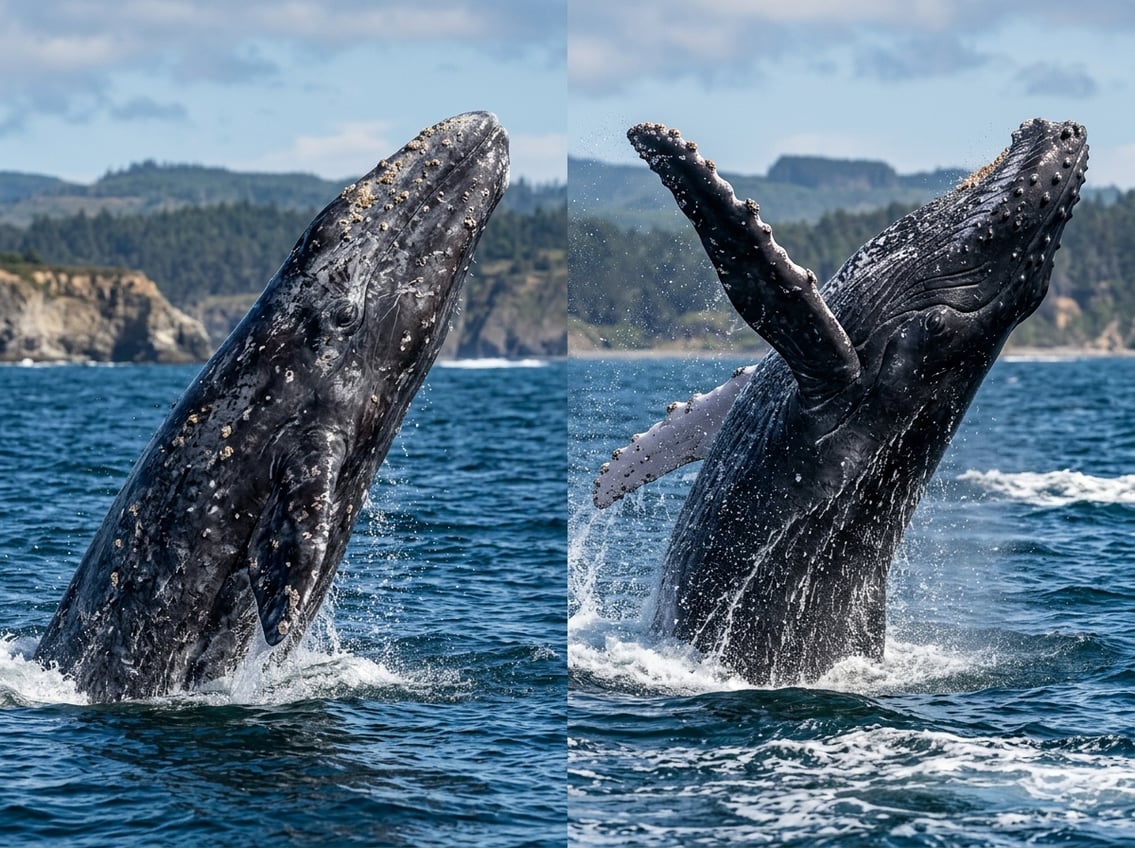
How to tell a gray whale from a humpback
Gray whale field marks
The back is the fastest place to look. According to NOAA Fisheries’ gray whale profile, the species lacks a true dorsal fin. Instead, it has a low hump about two-thirds of the way down the body, followed by 6 to 12 smaller knuckles before the tail.
Gray whales also have broad, pointed, paddle-shaped flippers and heavily mottled skin. Barnacles and orange-to-yellow whale lice are often concentrated around the head and tail. Those marks can make an adult look rough or patchy rather than evenly gray.
Humpback whale field marks
A humpback has a small dorsal fin, but its pectoral fins are the stronger clue. They can reach roughly one-third of the whale’s body length. Depending on the population and individual, the fins may look dark, white, or dark above and white below.
The head and lower jaw carry rounded bumps called tubercles. Humpbacks are also darker and more uniformly colored across the back than most gray whales.
Blow and fluke clues
A gray whale’s paired blow can look heart- or V-shaped in calm air, while a humpback’s blow is usually taller and bushier. Wind, viewing angle, distance, and backlighting can distort both shapes, so treat the blow as supporting evidence rather than a final identification.
When a whale lifts its tail before a deep dive, check the underside. Humpback flukes carry individually distinctive black-and-white pigmentation, scars, and edge shapes. Gray whales lack the same bold patterning; researchers identify them from mottling, scars, barnacle patches, and the shape of the fluke’s trailing edge.
Which whale is bigger?
Humpbacks have the greater maximum length, but “bigger” is less straightforward than many comparisons suggest. NOAA lists gray whales at 42 to 49 feet and about 90,000 pounds. Its humpback whale profile lists that species at up to about 60 feet and 40 tons.
Those rounded figures show why body mass is a poor field mark: large adults overlap, and estimates vary by sex, age, season, and measurement method. A humpback may look bulkier, but a distant whale cannot be identified reliably from size alone. Both are also far smaller than the blue whale.
Feeding style and diet
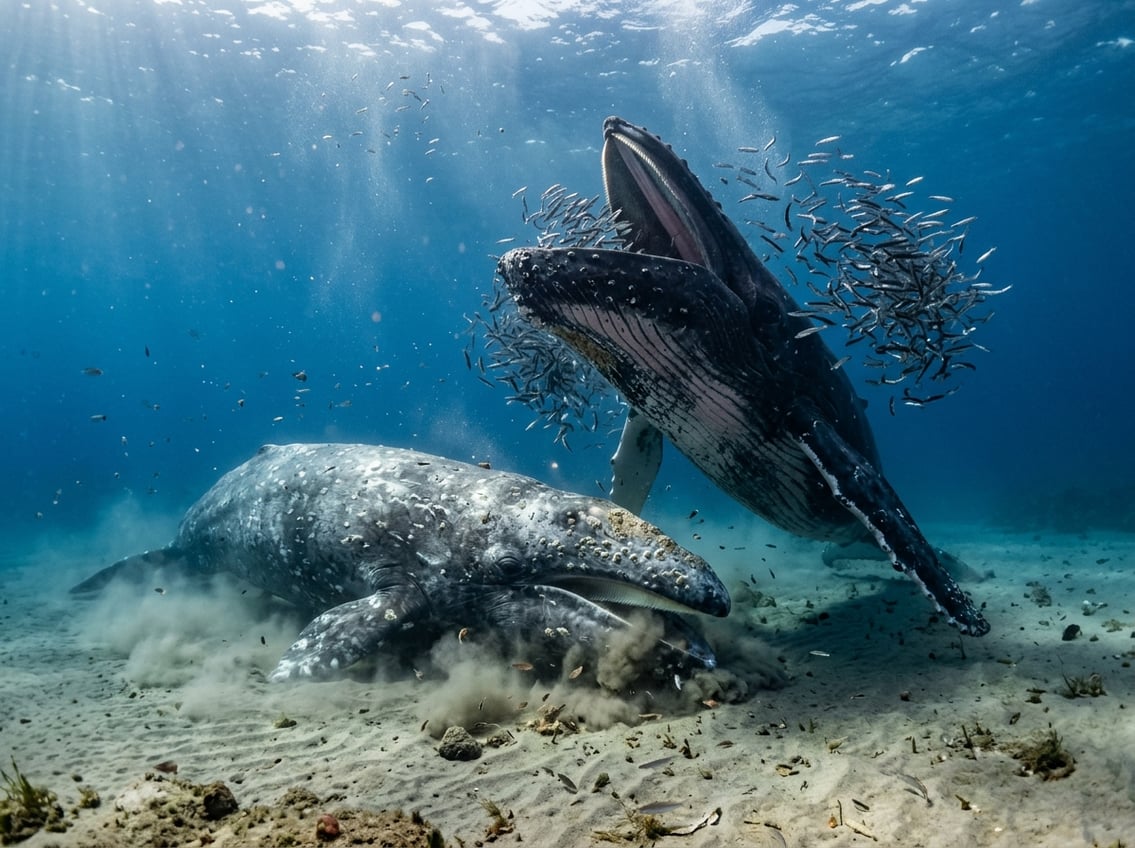
Gray whales suction-feed near the bottom
Gray whales are primarily benthic and epibenthic feeders. They roll partly onto one side, pull sediment and prey into the mouth, and push water and mud through short, coarse baleen. Amphipods are important prey, along with other small invertebrates living on or just above the bottom.
This method can leave long mud plumes and feeding pits. Gray whales are not limited to the seafloor, however. Some feed opportunistically in the water column or along the migration route, so “bottom feeder” describes the main strategy rather than an absolute rule.
Humpbacks lunge-feed and sometimes use bubble nets
Humpbacks eat krill and small schooling fish. They expand their grooved throat region, accelerate into a dense prey patch, and take in a large volume of prey-filled water before filtering it through baleen.
Some groups use coordinated bubble-net feeding: whales release curtains or spirals of bubbles below fish, compress the school, and lunge upward through it. NOAA notes that bubble-feeding behavior varies by region. Many humpbacks feed alone or use other tactics involving sound, pectoral fins, currents, or seafloor contours.
Field clue: a muddy plume in shallow water supports a gray whale identification. A circular patch of bubbles, concentrated seabirds, and a sudden open-mouth lunge point more strongly to a humpback. Keep well clear of bubble patches because whales may surface rapidly beneath them.
Surface behavior and sound
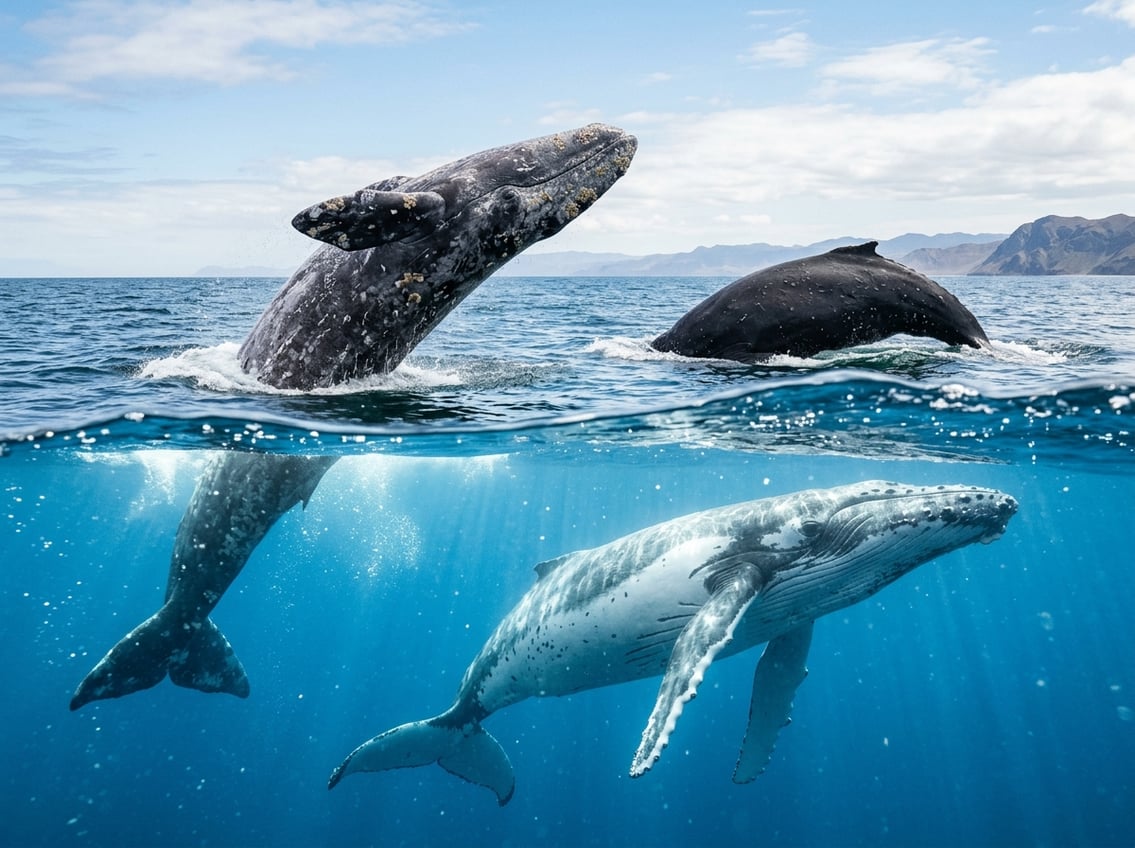
Breaching, slapping, and spyhopping
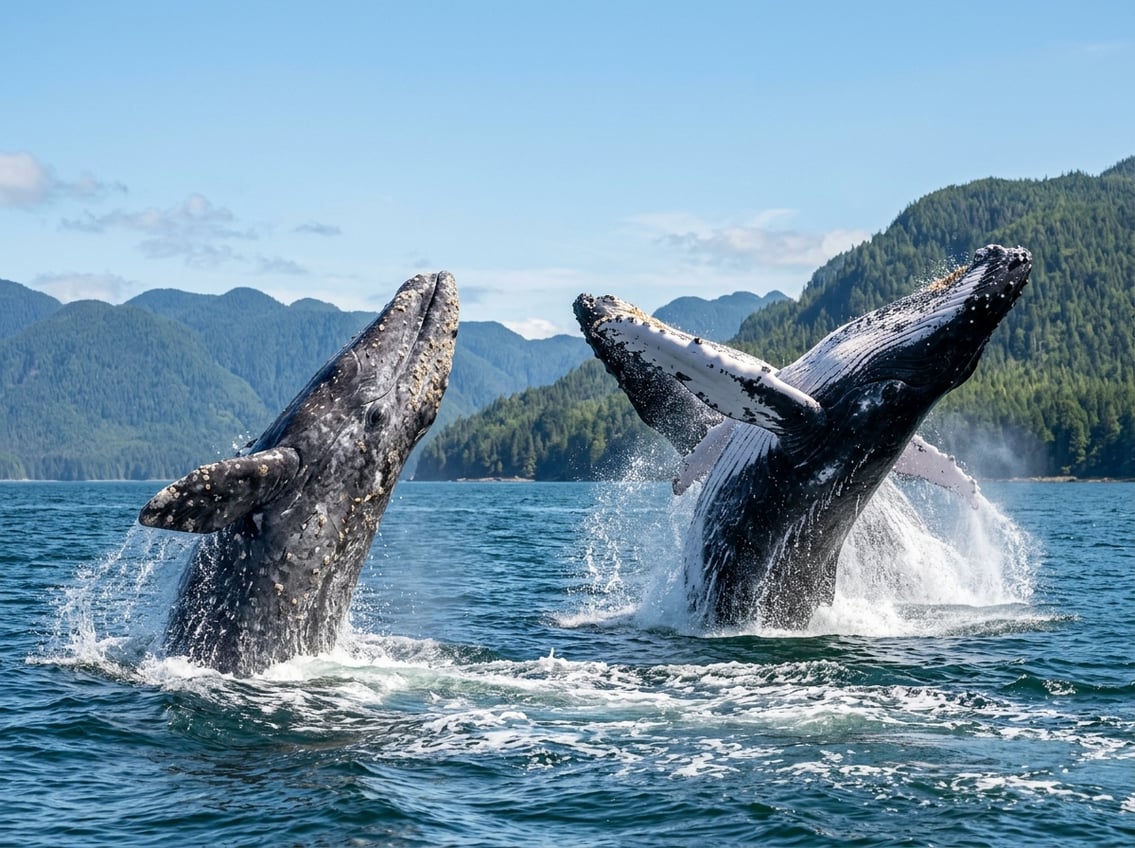
Both species breach, slap their tails, and raise their heads above the surface. Humpbacks are especially well known for breaches and pectoral-fin slaps, which are conspicuous because the fins are so long. Gray whales also breach, but whale watchers often notice them for slow coastal travel, rolling, and spyhopping.
Gray whales sometimes approach boats in specific Baja California lagoons, but that behavior should never be treated as permission to pursue or touch a whale. The safe response is to let the animal control the encounter while the vessel remains neutral and follows local rules.
Humpback songs and gray whale calls
Adult male humpbacks produce long, repeated songs that change over time. Songs are most strongly associated with breeding areas and probably play a role in mating behavior, although their exact function is not fully understood. NOAA’s overview of humpback whale song also notes that the animals make shorter social and feeding calls.
Gray whales vocalize too, using low-frequency moans, pulses, and other calls. They are not known to build the long, hierarchical song sequences associated with humpbacks.
Social behavior
Neither species lives in permanent pods like many toothed whales. Both are commonly seen alone or in small, temporary groups. Humpbacks may assemble to feed cooperatively or form competitive groups on breeding grounds. Gray whales can gather in feeding areas and calving lagoons, but most associations are temporary.
Range, migration, and viewing seasons

Gray whale migration
Gray whales now occur regularly only in the North Pacific. Most eastern North Pacific animals feed in the Bering and Chukchi Seas, then travel south along North America to wintering and calving areas in Baja California, Mexico. NOAA describes the round trip as about 10,000 miles, with some journeys exceeding 14,000 miles.
Calves are born during migration or in Mexican lagoons from early January to mid-February. Northbound movement along the U.S. West Coast runs roughly from mid-February through May, with mothers and new calves generally traveling later. A smaller group feeds during summer along parts of the Pacific coast rather than completing the full Arctic journey.
Humpback whale migration
Humpbacks live in every major ocean. Most populations move between productive high-latitude feeding grounds and warmer breeding areas, although routes differ. Some individuals travel about 5,000 miles between seasonal habitats.
In the North Pacific, breeding destinations include Mexico, Central America, Hawaii, and parts of the western Pacific. Feeding grounds extend from California and British Columbia to Alaska, the Bering Sea, and waters farther west.
When are you most likely to see each species?
- Gray whales on the U.S. West Coast: winter for the southbound migration and mid-February through May for the northbound return. Mothers with calves are often among the last northbound travelers.
- Humpbacks on northern feeding grounds: commonly spring through fall, with local timing tied to prey and ocean conditions.
- Humpbacks in tropical breeding areas: mainly winter, although timing varies by population and destination.
These are broad seasonal patterns, not guarantees. Check recent local sightings and responsible operator guidance before planning a trip. For more context on why species move between seasonal habitats, see our guide to animal migration.
Taxonomy, reproduction, and lifespan
The gray whale is Eschrichtius robustus, the only living species in the family Eschrichtiidae. The humpback is Megaptera novaeangliae, a member of Balaenopteridae, the rorqual family that also includes blue and fin whales.
Gray whales mature at roughly 6 to 12 years and give birth to one calf after a 12- to 13-month gestation. Humpbacks mature at about 4 to 10 years; females produce one calf every two to three years on average after an approximately 11-month gestation. A humpback calf may remain near its mother for up to a year.
The two species differ sharply in how confidently lifespan can be stated. NOAA estimates humpbacks live about 80 to 90 years. For gray whales, NOAA lists the average and maximum lifespan as unknown; one female was estimated to be 75 to 80 years old after death. That makes a fixed “55 to 70 years” gray whale lifespan too certain for the available evidence.
Conservation status and current threats
Commercial whaling severely depleted both species. Modern protection allowed many populations to recover, but a species-level label can hide important regional differences.
Gray whale status
All gray whales are protected under the U.S. Marine Mammal Protection Act. The eastern North Pacific population recovered enough to be removed from the Endangered Species Act list in 1994. The western North Pacific population remains endangered under U.S. law and is estimated by NOAA at fewer than 300 individuals.
Population update, last verified July 2026: NOAA estimated the eastern North Pacific population at 15,930 to 20,530 whales, with an average estimate near 17,750. NOAA also warned that the apparent increase from the prior estimate likely exceeds what reproduction alone could produce, so survey assumptions and changing migration behavior are under review. Its latest calf-production estimate was 85 in 2025, the lowest in the monitoring series.
These numbers should be read as estimates with uncertainty, not exact head counts. They are most useful for tracking the trend over several years.
Humpback whale status
The International Whaling Commission summarizes humpbacks as globally classified as Least Concern by the IUCN, but that does not mean every population is secure. NOAA recognizes 14 distinct population segments under the U.S. Endangered Species Act: four are endangered and one is threatened. All humpbacks remain protected under the Marine Mammal Protection Act.
Shared threats and natural predators
Both species face entanglement in fishing gear, vessel strikes, vessel-based disturbance, underwater noise, and climate-related changes in prey and habitat. Gray whales may be especially sensitive to changing Arctic feeding conditions because successful migration and reproduction depend on building sufficient energy reserves.
Killer whales are the best-documented natural predators of gray whales and often target calves. Young humpbacks can also be attacked.
Responsible whale watching
Responsible viewing protects the animals and usually produces better observations. NOAA’s marine life viewing guidance recommends staying at least 100 yards from large whales unless a stricter rule applies. Federal law specifically requires a 100-yard vessel distance from humpbacks in Hawaii and Alaska.
- Limit time with one whale or group to 30 minutes or less.
- Do not chase, encircle, leapfrog, or block a whale’s path.
- Slow to no-wake speed and put the engine in neutral if a whale approaches.
- Never separate a mother and calf.
- Stay clear of bubble patches where humpbacks may surface while feeding.
- Avoid flying drones near marine mammals. Buzzing or hovering can cause stress, and local or species-specific rules may be stricter.
From shore, binoculars provide a close view without adding vessel pressure. On a tour, choose an operator that explains local distance rules and changes course when an animal shows signs of disturbance. These practices support broader marine conservation, not just a single sighting.
30-second identification checklist
- Check the back: no dorsal fin plus a knuckled ridge strongly indicates a gray whale; a small dorsal fin suggests a humpback.
- Check the pectoral fins: extremely long fins point to a humpback.
- Check the skin and head: mottling, barnacles, and whale lice support gray whale; head tubercles support humpback.
- Check the feeding scene: sediment plume near the bottom suggests gray whale; bubble patch and upward lunge suggest humpback.
- Use the blow only as confirmation: wait for the back, fins, or flukes before making the final call.
Frequently asked questions
Are gray whales and humpback whales the same species?
No. The gray whale is Eschrichtius robustus in the family Eschrichtiidae. The humpback whale is Megaptera novaeangliae in the family Balaenopteridae.
Which is bigger, a gray whale or a humpback whale?
Humpbacks can grow longer, reaching about 60 feet compared with about 49 feet for gray whales. Adult mass estimates overlap, so size alone is not a dependable field mark.
Do gray whales have a dorsal fin?
No. A gray whale has a low dorsal hump followed by 6 to 12 smaller knuckles leading toward the tail. A humpback has a small true dorsal fin.
How can you tell a humpback from a gray whale in a photo?
Look for the pectoral fins and back. Humpbacks have exceptionally long fins, head tubercles, and a small dorsal fin. Gray whales have short paddle-shaped flippers, mottled skin, and no dorsal fin.
Which whale sings?
Adult male humpbacks produce long, structured songs, especially on breeding grounds. Gray whales make calls and pulses but are not known for comparable song sequences.
How long do gray whales live?
The average and maximum gray whale lifespan are unknown. NOAA reports that one female was estimated to be 75 to 80 years old after death.
Are gray whales endangered?
Status depends on the population. The eastern North Pacific population is not listed under the U.S. Endangered Species Act, while the western North Pacific population remains endangered. All gray whales are protected under the Marine Mammal Protection Act.
The easiest way to remember the difference
Gray means mottled, knuckled, and mainly bottom-feeding in the North Pacific. Humpback means long-winged, bumpy-headed, lunge-feeding, and singing across the world’s oceans. In the field, identify the back and pectoral fins first, then use the blow, fluke, and behavior as supporting evidence.
See Related: Sperm Whale: Is This Animal Endangered?
See Related: The Hebridean Whale and Dolphin Trust