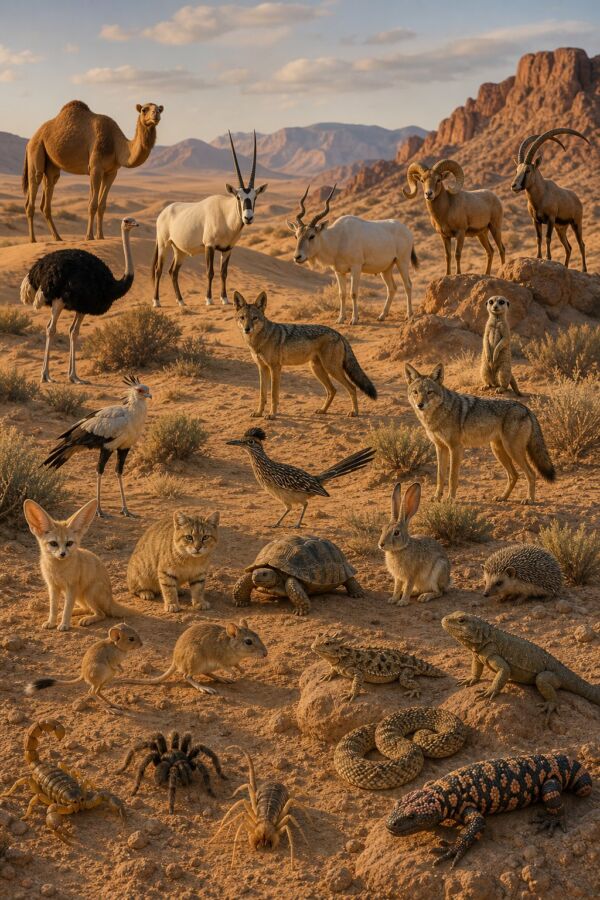
Desert animals are species adapted to arid habitats with scarce rainfall and wild temperature swings. They use water-efficient bodies, heat avoidance, burrows, camouflage, and pretty odd diets to make it work.
Deserts cover about a third of Earth’s land surface. They’re not just empty, endless sand—far from it.
A desert isn’t just about heat. Technically, it’s any place that gets less than about 10 inches of rain a year, which is why the frozen Gobi and foggy Namib are in the same club as the blazing Sonoran.
The animals here come from hot deserts, cold deserts, coastal deserts, and semi-arid scrublands spread across five continents. Each one has a trick (or three) for surviving, plus its IUCN Red List status.
Some, like the meerkat and sidewinder, are still doing fine. Others—like the addax and the wild Bactrian camel—hang on in just scraps of their old range.
It’s wild how fast hunting, livestock, and habitat loss can undo millions of years of adaptation.
25. Black-Tailed Jackrabbit (Least Concern)

The black-tailed jackrabbit (Lepus californicus) is actually a hare, not a rabbit. It roams the Mojave, Sonoran, and Chihuahuan deserts in the American Southwest and northern Mexico.
Its ears are impressive. Each one can hit 7 inches, packed with blood vessels right under the skin.
When it rests in the shade, blood flows through those vessels and dumps heat into the air—no sweating or panting needed.
Jackrabbits don’t bother with burrows. Instead, they scrape shallow spots called forms under saltbush or creosote, flatten out, and wait out the worst heat.
They eat mesquite, sagebrush, cactus pads, and dry grasses. Nearly all their water comes from these tough plants.
IUCN status: Least Concern, with stable numbers over a huge range.
24. Lesser Egyptian Jerboa (Least Concern)
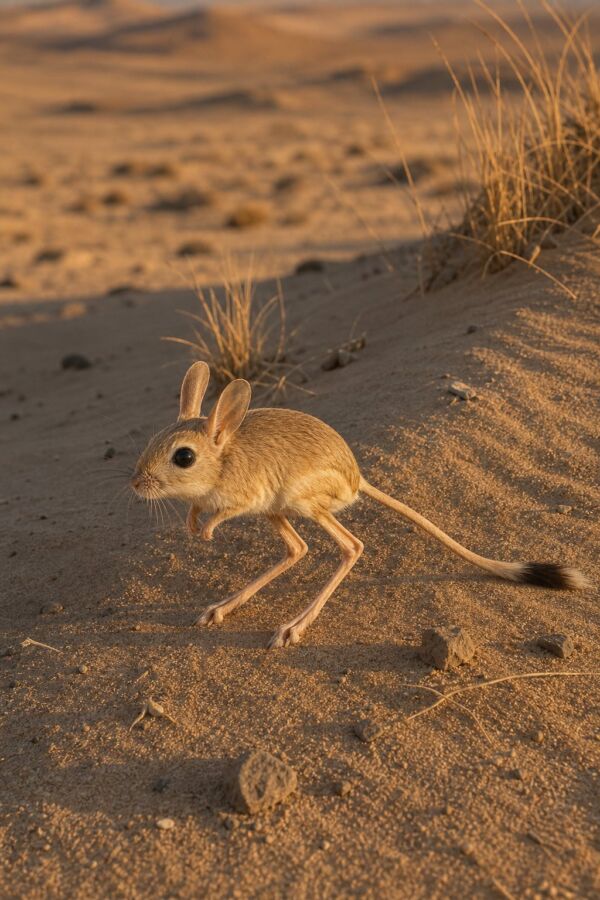
The lesser Egyptian jerboa (Jaculus jaculus) is a tiny bipedal rodent from the Sahara, Sinai, and Arabian Peninsula. It weighs about two ounces and hops on hind legs three times its body length, clearing several feet in a single bound.
This little guy’s survival trick is all about home design. It digs a burrow up to five feet long, then plugs the entrance with loose sand.
That sand plug keeps exhaled moisture inside, making the burrow way more humid than the bone-dry air above. The jerboa only comes out at night and almost never drinks.
Its kidneys crank out super-concentrated urine, and it gets water from seeds, dry plants, and bugs. Tufted hind feet help it walk on soft sand and kick dirt while digging.
IUCN status: Least Concern, found all over North Africa and Southwest Asia.
23. Perentie (Least Concern)

The perentie (Varanus giganteus) is Australia’s biggest lizard, topping 6 feet long. It lives in the arid heart of Western Australia, South Australia, and the Northern Territory.
As an ectotherm, it manages body temperature by moving around, not by burning energy. It basks on rocks in the morning, hunts when it’s warm, and dives into burrows or logs when the surface gets too hot.
Its forked tongue picks up scent particles, which it delivers to a Jacobson’s organ—handy for tracking down carrion, eggs, small mammals, and other reptiles. Strong claws help dig prey out from under the sand.
The perentie can go weeks without a big meal, which helps it handle the feast-or-famine food scene in Australia’s deserts.
IUCN status: Least Concern, though it’s rarely spotted and not well studied.
22. Desert Iguana (Least Concern)

The desert iguana (Dipsosaurus dorsalis) hangs out in the Mojave and Sonoran deserts. It’s got one of the highest heat tolerances among North American lizards.
This lizard can stay active at body temps near 107°F—well above what most similar reptiles can take. That means it forages in the open while other lizards hide from the midday sun, dodging a lot of predators in the process.
Creosote bush flowers, buds, and leaves make up most of its diet, providing both food and moisture. Salt glands help it get rid of extra minerals without wasting water.
For shelter, it’ll take over kangaroo rat burrows or dig tunnels at the base of shrubs. Not a bad setup.
IUCN status: Least Concern, common throughout its range.
21. Lappet-Faced Vulture (Endangered)

The lappet-faced vulture (Torgos tracheliotos) is Africa’s largest vulture, with a wingspan close to 9 feet. It lives on the edges of the Sahara, the Sahel, East African drylands, and parts of the Arabian Peninsula.
Soaring is its solution to the desert’s vast distances. Thermals let it cover hundreds of square miles a day with barely any effort, searching for scattered carcasses.
The vulture’s bare pink head helps cool it down and keeps things cleaner when it’s deep inside a carcass. Its massive bill tears through hide and tendon, opening up meals for smaller vultures that can’t do the job.
Unfortunately, poisoned bait, poaching, and fewer wild prey animals have caused sharp declines.
IUCN status: Endangered.
20. Greater Roadrunner (Least Concern)

The greater roadrunner (Geococcyx californianus) is a ground-loving cuckoo from the Mojave, Sonoran, and Chihuahuan deserts. It can sprint up to 20 mph and only flies in short bursts when it has to.
It’s got a couple of cool tricks. The bird flutters the loose skin under its throat (that’s called gular fluttering) to lose heat through evaporation, no sweating needed.
A nasal gland helps it shed salt, letting it keep more water than its kidneys could manage alone. On chilly mornings, it turns its back to the sun and lifts its feathers, soaking up warmth through black skin patches.
It eats lizards, insects, scorpions, small snakes, and rodents—almost all its water comes from prey.
IUCN status: Least Concern.
19. Meerkat (Least Concern)
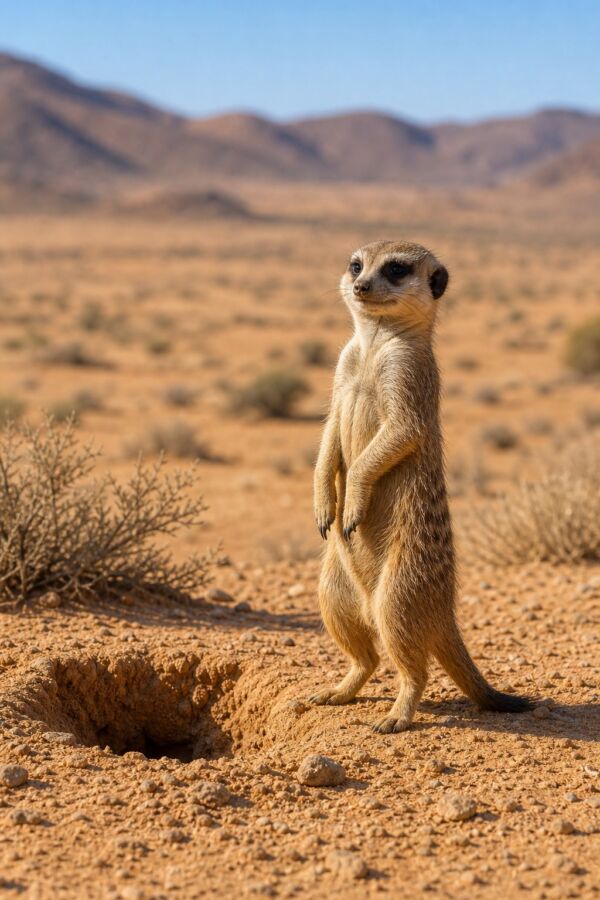
The meerkat (Suricata suricatta) lives in southern Africa’s Kalahari Desert, the Karoo, and the Namib’s edges. Groups of 10 to 30 share a network of tunnels with lots of entrances and rooms several feet underground.
Those tunnels are like free air conditioning. A yard below the surface, the temperature barely budges, so meerkats can dodge both the midday oven and freezing desert nights.
They’re big on teamwork. Sentinels stand upright and keep watch for hawks and jackals while the rest dig for scorpions, beetle larvae, spiders, and tubers.
Meerkats get most of their water from what they catch. There’s a patch of thin fur on their bellies that soaks up morning sun when they bask.
IUCN status: Least Concern, with numbers mostly shaped by drought cycles.
18. Desert Bighorn Sheep (Least Concern)
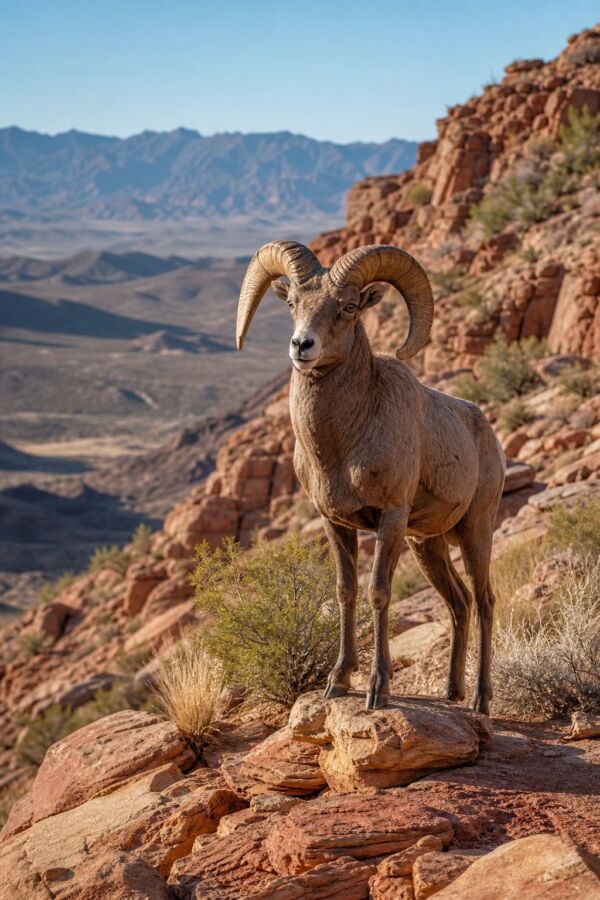
Desert bighorn sheep (Ovis canadensis nelsoni) stick to the mountains and canyons of the Mojave, Sonoran, and Chihuahuan deserts, from Nevada and California down into northern Mexico.
They can lose a surprising amount of body water and keep going, then rehydrate by drinking gallons at a spring stop. Their hooves have concave, rubbery pads with hard edges, which grip bare rock and let them use steep, tricky terrain that mountain lions usually avoid.
Lambs follow their mothers onto ledges just days after birth. In summer, they eat cactus fruit, ocotillo, and desert shrubs that hold moisture.
Water development, diseases from domestic sheep, and highways are the big threats for these herds.
IUCN status: Least Concern at the species level, but desert herds are small and isolated.
17. Przewalski’s Horse (Endangered)

Przewalski’s horse (Equus ferus przewalskii) is the last wild horse lineage. It’s native to the steppe and semi-desert of Mongolia and northern China.
The species went extinct in the wild in the 1960s. Thanks to captive breeding and reintroduction, you can now find them at places like Hustai National Park and the Gobi’s Great Gobi B reserve.
This horse is built for cold deserts. Temperatures swing wildly—from over 100°F in summer to minus 20°F in winter—so it grows a thick winter coat with a dense undercoat to survive.
Bands graze tough steppe grasses and shrubs. They travel long distances between water sources and sometimes dig into dry riverbeds to reach shallow groundwater.
Harem structure keeps foals safe within a defended group.
IUCN status: Endangered, with a wild population still only in the hundreds.
16. Saharan Cheetah (Cheetah: Vulnerable)

The Saharan cheetah (Acinonyx jubatus hecki) hangs on in scattered pockets across Algeria, Niger, Mali, and Chad. Its coat is paler and its spots are fainter than those of savanna cheetahs, blending in better with open sand and gravel plains.
Desert life forces it to adapt. Unlike savanna cheetahs, Saharan cheetahs hunt mostly at night or during twilight to dodge the brutal daytime heat.
Prey is scarce—mostly dorcas gazelle, addax calves, and hares—so home ranges can stretch over 600 square miles. That’s among the largest for any cat, really.
They get almost all their moisture from prey, not waterholes.
IUCN status: The cheetah is Vulnerable at the species level, but this subspecies is Critically Endangered, with probably fewer than 250 mature individuals left.
15. Arabian Leopard (Critically Endangered)

The Arabian leopard (Panthera pardus nimr) is the smallest leopard subspecies, with males averaging about 65 pounds. It survives mainly in the Dhofar mountains of Oman, with scattered records from Yemen and some reintroduction efforts in Saudi Arabia.
Being small helps in the mountains, where food and water are hard to find. The leopard hunts Arabian gazelle, Nubian ibex, rock hyrax, and hares, pulling most of its water from those kills and from seasonal pools in shaded wadis.
Rocky terrain offers denning caves and cool spots to escape the hottest hours. Leopards travel wide circuits along ridgelines and dry valleys.
Retaliatory killing over livestock, prey loss, and habitat fragmentation are driving its decline.
IUCN status: Critically Endangered, with fewer than 200 wild individuals.
14. Scimitar-Horned Oryx (Endangered)
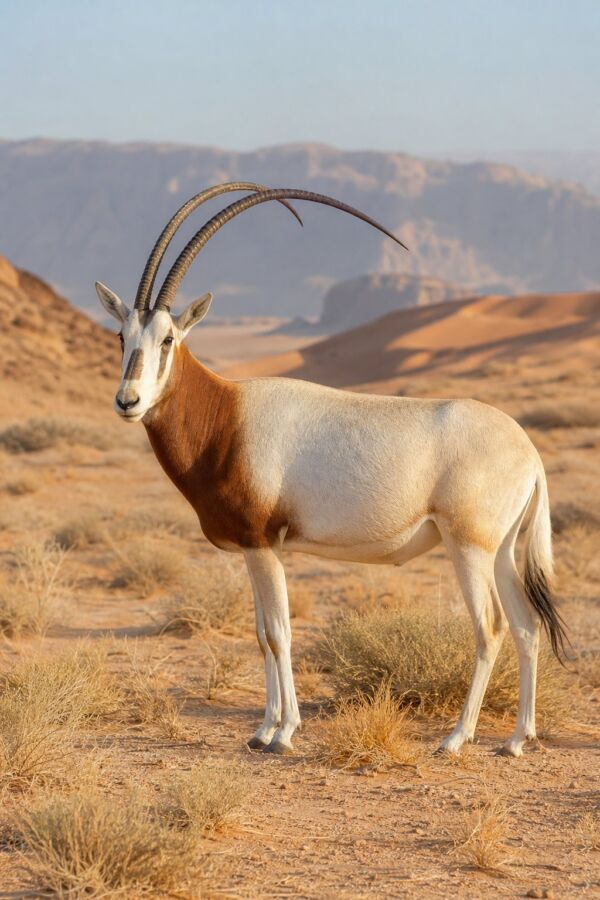
The scimitar-horned oryx (Oryx dammah) once roamed the Sahel and Saharan fringe. Hunting and drought wiped out the wild population by the late 1990s, and for decades, it was considered Extinct in the Wild.
Reintroductions into Chad’s Ouadi Rimé-Ouadi Achim Reserve, starting in 2016, created a breeding herd of several hundred. That recovery led the IUCN to reclassify the species.
Its physiology is wild. A network of blood vessels at the base of its brain cools arterial blood, so the oryx can let its body temperature rise during the day instead of sweating. The near-white coat reflects sunlight, and dark face markings cut glare.
Herds wander nomadically after rainfall, feeding on grasses that green up briefly after storms.
IUCN status: Endangered.
13. Dama Gazelle (Critically Endangered)

The dama gazelle (Nanger dama) is the largest gazelle species and sadly now the most threatened. Only isolated groups remain in Chad, Niger, and Mali.
Those long legs and neck aren’t just for show. They help the gazelle keep its body away from scorching ground-level heat and reach acacia leaves and pods that other grazers can’t.
Dama gazelles migrate seasonally—north into the Sahara during brief rains, then south to Sahel pasture in the dry season. They get water from plants and rarely drink.
Uncontrolled hunting, livestock competition, and instability in the Sahel have dropped the wild total to fewer than 200 mature animals.
IUCN status: Critically Endangered.
12. African Wild Ass (Critically Endangered)

The African wild ass (Equus africanus) is the wild ancestor of the domestic donkey. The Somali subspecies survives in the Danakil Depression and the stony deserts of Eritrea, Ethiopia, and Somalia—some of the hottest, toughest places on Earth.
This animal’s water tolerance is nuts. It can lose about 30 percent of its body water and still bounce back, plus it’ll drink brackish or slightly salty water that most other animals avoid.
Wild asses dig into dry streambeds with their hooves to reach hidden seepage, creating shallow wells other wildlife use. They eat tough grasses, bark, and desert shrubs, and usually head to water every one to three days.
Hunting for meat and traditional medicine, along with livestock competition, keeps their numbers dropping.
IUCN status: Critically Endangered.
11. Greater Bilby (Vulnerable)

The greater bilby (Macrotis lagotis) is a burrowing marsupial from Australia’s arid interior. Once widespread, it now hangs on in parts of the Northern Territory, Western Australia, and Queensland.
Bilbies dig spiral burrows up to 10 feet long and 6 feet deep. The spiral blocks light and hot air, and makes it tougher for predators to get in.
One bilby might maintain a dozen burrows in its range. Their diggings matter—excavated soil pits catch seeds, water, and leaf litter, which helps germination and makes them ecosystem engineers in poor soils.
They eat termites, ants, larvae, seeds, and bulbs, getting water from food. Those long ears? They help radiate heat.
IUCN status: Vulnerable. Feral cats and red foxes are the main threat, and fenced sanctuaries now protect key populations.
10. Addax (Critically Endangered)

The addax (Addax nasomaculatus) is the antelope most fully committed to true desert. It survives on sand seas and dune fields, with its last wild population in Niger’s Termit and Tin Toumma region.
Broad, splayed hooves spread its weight on soft sand, and it walks slowly to save energy. The coat goes near-white in summer to reflect sunlight, then darkens to gray-brown for winter warmth.
Addax seem to sense distant rainfall and travel toward it, feeding on grasses and succulents that pop up after storms. They can go ages without drinking, getting moisture from plants and producing really concentrated urine.
Oil exploration roads let hunters in, and now surveys suggest fewer than 100 mature individuals survive in the wild.
IUCN status: Critically Endangered.
9. Arabian Oryx (Vulnerable)

The Arabian oryx (Oryx leucoryx) is the smallest oryx and honestly a conservation success story. Hunting wiped out the wild population by 1972, but captive breeding and reintroductions in Oman, Saudi Arabia, Israel, Jordan, and the UAE brought it back.
Its white coat reflects sunlight, and pale skin underneath helps reduce heat absorption. Like other oryx, it lets its body temperature climb during the day instead of sweating.
Herds dig shallow scrapes beneath ghaf and acacia trees to rest in cooler sand. They travel long distances after rain clouds and feed on grasses, roots, tubers, and moisture-rich melons.
In 2011, the species moved from Endangered to Vulnerable—the first animal ever downlisted from Extinct in the Wild to Vulnerable. That’s pretty cool.
IUCN status: Vulnerable.
8. Sidewinder Rattlesnake (Least Concern)
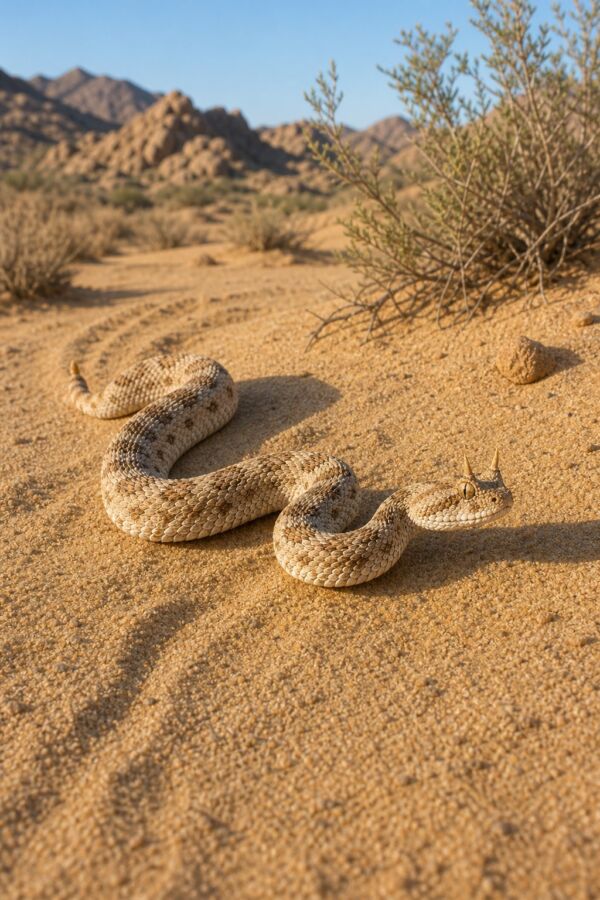
The sidewinder (Crotalus cerastes) is a small rattlesnake from the Mojave, Sonoran, and Colorado deserts. Its name comes from its unique way of moving.
Sidewinding is pretty clever. The snake throws its body into S-curves, touching the sand at just a few points and lifting the rest, which cuts slipping on dunes and keeps it off the hottest sand.
Raised scales above each eye—some call them horns—shade the eyes and might help deflect sand when the snake buries itself. It often rests coiled in a shallow sand pit beside a shrub, with just its head poking out.
When summer hits, it switches to night activity. Heat-sensing pits pick up kangaroo rats and lizards in the dark, and prey provides nearly all its water.
IUCN status: Least Concern.
7. Gila Monster (Near Threatened)

The Gila monster (Heloderma suspectum) is a chunky, venomous lizard found in the Sonoran, Mojave, and Chihuahuan deserts. It grows to about 20 inches long.
Honestly, its main move is just hanging out. This lizard spends over 90 percent of its life tucked away in burrows or under rocks, coming out mostly in spring or after summer rains.
That lazy schedule helps it save water and energy. Fat packed in its thick tail keeps it going between meals, and adults might only eat a few big meals a year—usually bird and reptile eggs, nestlings, and sometimes young rabbits.
Its venom flows through grooved lower teeth, mostly for defense and not for hunting. The lizard even stashes water in its bladder for dry spells.
IUCN status: Near Threatened, mainly due to urban sprawl and illegal collecting.
6. Sand Cat (Least Concern)

The sand cat (Felis margarita) is the only true desert cat, living across North Africa, the Arabian Peninsula, and Central Asia. Adults weigh somewhere between 4 and 8 pounds.
Its feet have thick fur on the pads, which keeps them cool and helps the cat walk on sand without sinking in. That same fur makes its tracks nearly impossible to follow.
With big, low-set ears, it can hear prey moving underground. The sand cat digs rodents, geckos, and insects right out of the sand.
It hunts at night and hides in burrows during the day. Most of its water comes from eating prey.
IUCN status: Least Concern, but populations are patchy and threatened by overgrazing and settlement.
5. Thorny Devil (Least Concern)

The thorny devil (Moloch horridus) lives in the sandy deserts of central and western Australia. Its spines might scare off predators, but its best trick is hidden.
Tiny grooves between its scales pull water across its skin by capillary action, funneling moisture to its mouth. Dew, rain, or even damp sand can become a drink this way.
It basically eats ants—thousands a day, mostly from one species. There’s also a fake head on the back of its neck for confusing predators, and its coloring blends in with sand and spinifex.
IUCN status: Least Concern, with no major threats at the moment.
4. Merriam’s Kangaroo Rat (Least Concern)

Merriam’s kangaroo rat (Dipodomys merriami) is a tiny, night-active rodent from the American Southwest and northern Mexico. It’s probably the most water-efficient mammal in North America.
Almost all its water comes from breaking down dry seeds. Its kidneys make super-concentrated urine, and a special system in its nose grabs moisture from every breath before it escapes.
It stores seeds in humid underground spots, letting them soak up moisture before eating them. Those strong back legs help it leap away from danger, and its sharp hearing picks up on owls and snakes sneaking up.
IUCN status: Least Concern, found everywhere from creosote flats to dune fields.
3. Mojave Desert Tortoise (Vulnerable)
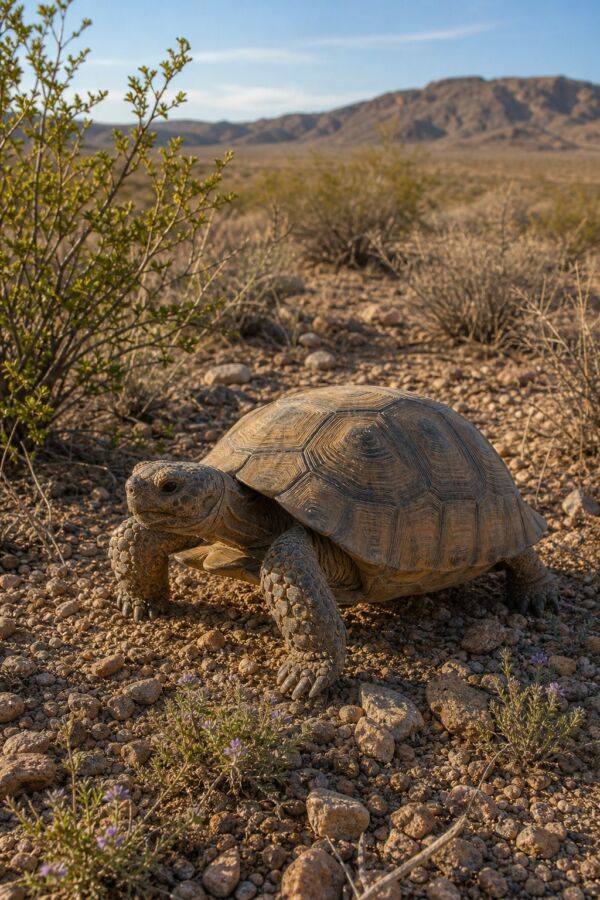
The Mojave desert tortoise (Gopherus agassizii) lives in the Mojave and parts of the Sonoran Desert, north and west of the Colorado River. It spends up to 95 percent of its life underground.
Its bladder works like a water bottle, storing diluted urine for months and reabsorbing water from it. If you ever see one in the wild, don’t pick it up—if it gets scared and empties its bladder, it could get dangerously dehydrated.
It feeds mostly in spring when wildflowers and grasses are around. The rest of the year, it’s chilling underground with a slowed-down metabolism.
Main threats? Habitat loss from development and solar farms, ravens eating hatchlings, invasive grasses fueling fires, and respiratory diseases.
IUCN status: Vulnerable, with numbers still dropping.
2. Fennec Fox (Least Concern)

The fennec fox (Vulpes zerda) is the tiniest wild canid, weighing just 2 to 3 pounds. It lives in the Sahara and sandy deserts of North Africa and the Sinai.
Its huge ears—about 6 inches long—are the biggest compared to body size of any carnivore. Those ears dump heat and pick up the faintest sounds of prey under the sand.
Thick fur on its feet keeps them safe from hot sand and helps with digging. The fox digs dens in stable sand, usually near grass roots, and naps there during the day.
Fennecs stick together in family groups, forage at night, and eat insects, small animals, eggs, roots, and fruit for food and water.
IUCN status: Least Concern, though trapping and the pet trade cause problems in some areas.
1. Wild Bactrian Camel (Critically Endangered)

The wild Bactrian camel (Camelus ferus) isn’t just a feral domestic—it’s a separate species. It survives in three isolated groups in the Gobi and Taklamakan deserts of Mongolia and China.
This camel can take on both scorching summers over 100°F and brutal winters below minus 30°F. Its two humps store fat for energy, not water, and it grows a thick winter coat that sheds in patches come spring.
Its oval red blood cells let it rehydrate fast, so it can drink a huge amount at once. Unlike domestic camels, wild Bactrians can even handle salty water from desert springs.
It closes its nostrils against sandstorms, and double eyelashes keep grit out of its eyes. Fewer than 1,000 remain, threatened by hunting, mining, and crossbreeding with domestic camels.
IUCN status: Critically Endangered.
How Desert Animals Survive Extreme Conditions
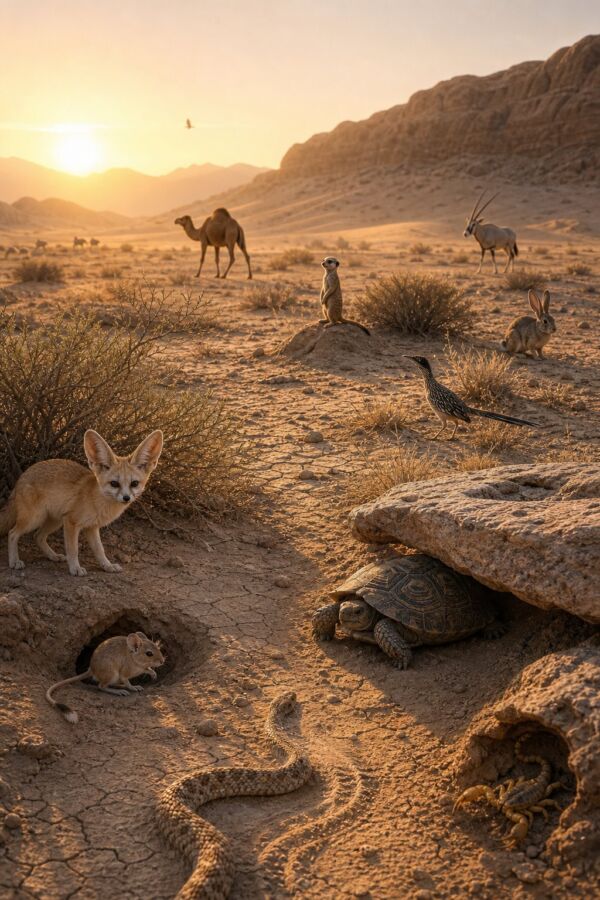
Surviving in the desert usually comes down to a few clever tricks. It’s wild how animals separated by oceans and millions of years end up with the same solutions—like a jerboa in the Sahara and a kangaroo rat in Nevada, both bouncing around and living pretty much the same way.
Water Conservation And Moisture From Food
Most desert animals almost never drink. Rodents, reptiles, and insect-eaters get water from seeds, plants, and prey, then hang onto it for dear life—super-efficient kidneys, dry poop, and in some birds and reptiles, salt glands that ditch minerals without losing much water.
Nocturnal Activity, Burrows, And Shade
Timing is everything out here. Just a few feet below the surface, the soil can be 40°F cooler than the sand on top, so burrows become life savers for everything from tortoises to meerkats. Lots of animals are active only at dawn, dusk, or night, and some just go dormant until the weather improves.
Heat Management, Body Shape, And Light Coloration
Big ears and bare patches of skin help dump heat without losing water. Pale fur reflects sunlight, long legs lift bodies off the hot ground, and antelope like the oryx let their body temperature climb instead of sweating it out.
Camouflage, Defense, And Seasonal Behavior
Sand-colored fur and speckled feathers hide animals where there’s nowhere to hide. Some rely on spines or venom, while others just make a run for it or head for rocky cliffs. A few, like the addax, wander until they find rain, turning unpredictable weather into food.
Frequently Asked Questions

What are the most common animals found in the Sahara Desert?
The Sahara is home to fennec foxes, dorcas gazelles, jerboas, dromedary camels, sand cats, horned vipers, monitor lizards, scorpions, and desert larks. Larger animals like the addax, dama gazelle, and Saharan cheetah barely hang on in scattered areas and are some of the most endangered desert animals out there.
What desert animals are suitable for kids to learn about?
Meerkats, fennec foxes, camels, roadrunners, desert tortoises, kangaroo rats, and thorny devils are all great picks. Each one shows off a clear adaptation, like big ears for cooling or burrows for shade, and pairing an animal with its survival trick really brings the desert to life for kids.
Which desert animals are considered dangerous?
Gila monsters, sidewinder rattlesnakes, saw-scaled vipers, deathstalker scorpions, and Arabian leopards can all be dangerous, but honestly, most want nothing to do with humans and only bite if they have to. They’re important predators—removing them would seriously mess with rodent and insect populations.
How many animals live in the Sahara Desert?
Researchers have found around 70 kinds of mammals in the Sahara. There are also about 90 resident bird species and roughly 100 types of reptiles.
They’re still discovering new arthropods, which is pretty wild. Counting actual animal populations is tough, though—some of the bigger mammals only have a few hundred left out there.