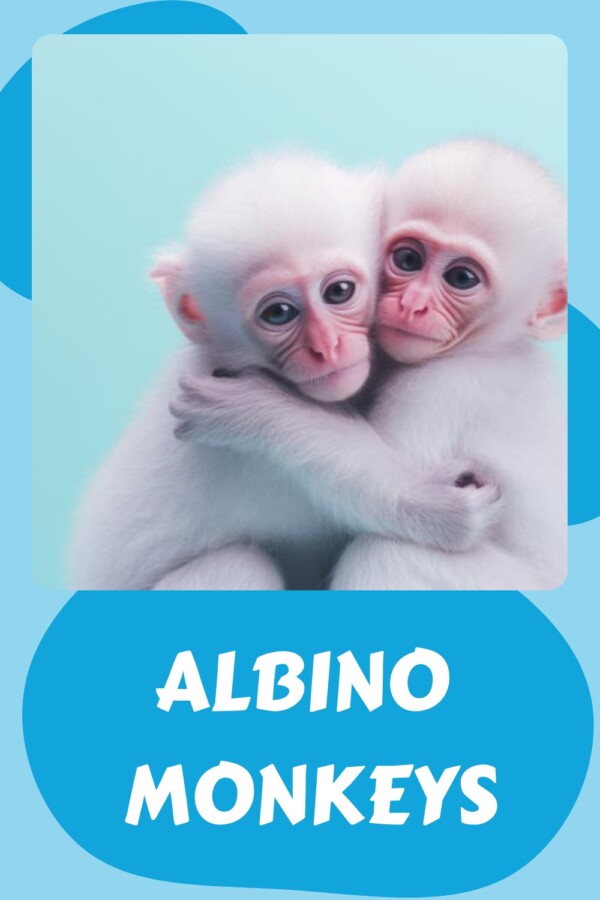
Albino monkeys are real, but they are not a separate species, and scientists do not have a reliable global count. Albinism is an inherited reduction in melanin that can affect the fur, skin, and eyes. The clearest genetically documented monkey case involves a family of rhesus macaques in which researchers identified a variant in the TYR gene. Famous pale primates such as Snowflake the gorilla and Alba the orangutan are often called “albino monkeys” online, but both are apes.
This guide separates verified evidence from repeated internet claims. It explains what causes albinism, how it differs from other pale color patterns, what health challenges may occur, and what documented primate cases can—and cannot—tell us.
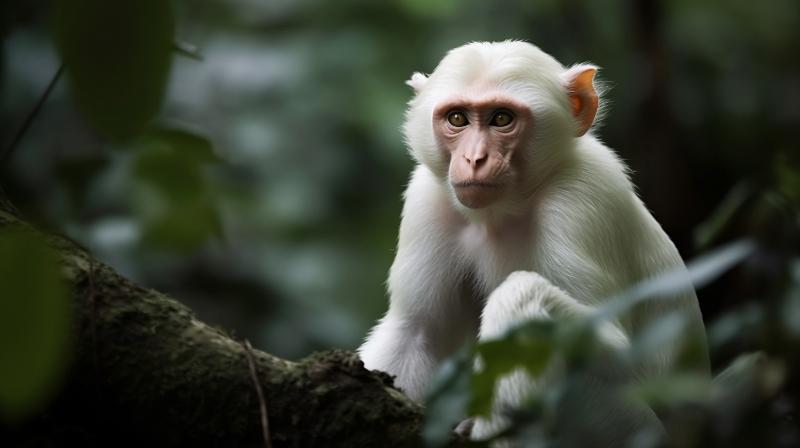
Albino Monkey Facts at a Glance
| Question | Evidence-based answer |
|---|---|
| Are albino monkeys real? | Yes. Albinism has been genetically documented in rhesus macaques. |
| Are they a separate species? | No. An albino monkey belongs to the same species as normally pigmented individuals. |
| What causes the pale coloration? | Inherited variants that reduce melanin production or distribution. The responsible gene can differ between cases. |
| Do they always have red eyes? | No. The eyes may appear pale blue, gray, hazel, pinkish, or reddish depending on residual pigment and lighting. |
| How many exist? | No scientifically reliable worldwide count or prevalence estimate is available. |
| Where do they live and what do they eat? | They use the habitat and eat the diet typical of their species; albinism does not create a separate ecology. |
| What is their lifespan? | There is no universal average. Longevity depends on the species, individual health, environment, and access to care. |
What Is an Albino Monkey?
An albino monkey is an individual monkey with a genetic condition that substantially reduces melanin, the pigment involved in the coloration of hair, skin, and eyes. It remains a member of its original species. A rhesus macaque with albinism is still a rhesus macaque, just as a normally pigmented individual is.
The term “albino monkeys” is also used loosely in search results, social media, and image captions. Some pages include gorillas, orangutans, chimpanzees, or lemurs under the label. Those animals are primates, but gorillas, orangutans, and chimpanzees are apes rather than monkeys. For a broader look at monkey groups, see our guide to the different types of monkeys.
Albinism, Leucism, and Naturally Pale Coloration
Not every white or cream-colored monkey is albino. Albinism usually involves melanin-related changes in the eyes as well as the coat and skin. “Leucism” is a broader descriptive label often used for reduced or patchy pigmentation while the eyes retain more typical coloration. Some species also have naturally pale coats, and lighting or image editing can make an animal look whiter than it is.
| Feature | Albinism | Leucism or other hypopigmentation | Normal pale coloration |
|---|---|---|---|
| Main pigment effect | Reduced melanin production or distribution | Partial, patchy, or broader reduction in pigmentation; the term is used inconsistently | Typical coloration for the species, subspecies, age, or season |
| Eyes | Often lighter and may show vision-related abnormalities | Often retain more typical pigmentation | Typical for the species |
| Best evidence | Clinical eye findings, pedigree information, or genetic testing | Careful physical description and, when possible, diagnostic testing | Comparison with verified members of the same population |
A photo can support a description of unusual coloration, but it cannot establish the genetic cause. Responsible identification requires more than white fur.
What Causes Albinism in Monkeys?
Melanin is produced through a biological pathway controlled by several genes. In oculocutaneous albinism, inherited variants disrupt that pathway and reduce pigment in the hair, skin, and eyes. MedlinePlus Genetics identifies genes associated with human forms of the condition, including TYR, OCA2, TYRP1, and SLC45A2. Primate case studies show that at least some of the same pigment-related genes can be involved in other species.
In a peer-reviewed study of a rhesus macaque family, two affected monkeys were homozygous for a TYR variant identified as S184TER. The offspring of one affected macaque carried one copy, and the variant was not found in 93 control animals. The researchers concluded that the variant caused the albino phenotype in that family.
This finding does not mean every albino monkey has the same variant. Albinism is genetically heterogeneous, and the underlying cause must be evaluated case by case.
How Rare Are Albino Monkeys?
No scientifically reliable global count of albino monkeys exists. Published research documents individual animals, families, or isolated cases rather than a worldwide census. That makes a universal “one in X” prevalence figure impossible to defend with the available evidence.
Several factors make the condition difficult to quantify:
- There is no international registry for albinism in wild or captive monkeys.
- Many reported sightings are based only on photographs and are never clinically or genetically confirmed.
- Different monkey species may have different causal variants and different detection rates.
- Unusually visible captive animals are more likely to be reported than animals in remote wild populations.
- Leucism, age-related color changes, illness, camera exposure, and edited images can be mistaken for albinism.
The most accurate description is therefore “rarely documented,” not a precise numerical estimate.
What Do Albino Monkeys Look Like?
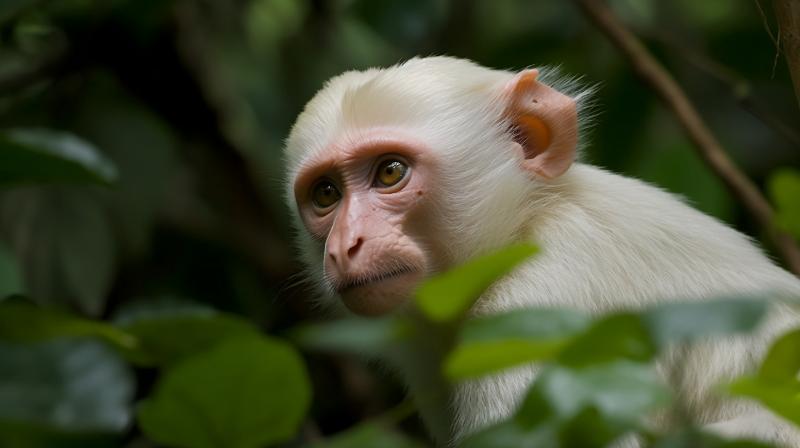
Appearance varies with the species and the genetic variant. Possible signs include white, cream, or very pale fur; pink or lightly pigmented skin; pale irises; and sensitivity to bright light. Some animals may retain more pigment than the popular stereotype suggests.
Albino monkeys do not necessarily have vivid red eyes. A reddish or pinkish appearance can result when little iris pigment masks underlying blood vessels, but eyes may also look blue, gray, hazel, or simply lighter than normal. Camera flash and color correction can exaggerate the effect.
Health and Survival Challenges
The health effects of albinism are not identical in every monkey. They depend on the gene involved, the amount of residual pigment, the species, and the animal’s environment. Evidence is strongest for visual abnormalities and light sensitivity; broad claims about lifespan, predator mortality, or social rejection are much less certain.
Vision and Light Sensitivity
Melanin contributes to normal eye development and visual function. Oculocutaneous albinism can be associated with reduced visual acuity, involuntary eye movements, eye misalignment, and photophobia. These effects are summarized in the GeneReviews overview of albinism, and the genetically studied gorilla Snowflake was specifically reported to have photophobia and reduced visual acuity.
For a wild monkey, impaired vision could make navigation, foraging, or threat detection more difficult. The extent of that disadvantage is individual, however, and has not been quantified across all monkey species.
Skin and Ultraviolet Exposure
Melanin helps absorb ultraviolet radiation. Human medical evidence shows that people with oculocutaneous albinism have a higher risk of sun damage and skin cancer after long-term exposure. It is reasonable for veterinarians and wildlife carers to take reduced pigmentation seriously, but species-wide skin-cancer rates for albino monkeys have not been established.
In managed care, appropriate responses may include access to shade, enclosure design that reduces excessive direct sun, regular skin and eye examinations, and enrichment suited to the individual’s vision. These decisions should be made by qualified veterinary and animal-care teams rather than inferred from coat color alone.
Camouflage, Behavior, and Social Response
A pale animal may be easier to see against dark vegetation, which could reduce camouflage in some habitats. That does not prove that every albino monkey experiences higher predation or a shorter life. Habitat structure, group vigilance, species behavior, and human pressures can matter as much as coloration.
Claims that monkey groups automatically reject albino individuals are also too broad. Primates use visual signals, but social responses vary by species, group, age, health, and prior familiarity. Strong conclusions require direct behavioral observation, not assumptions based on appearance.
For more context on survival traits, see how animals adapt to their environment.
Where Do Albino Monkeys Live and What Do They Eat?
Albinism does not create a separate habitat or diet. An affected monkey lives within the geographic range and ecological setting of its species, from forests and grasslands to rocky areas or human-modified environments, depending on the monkey involved. Our overview of animal habitats explains how those environments shape food, shelter, and behavior.
The same principle applies to food. An albino monkey generally eats what other members of its species eat, which may include fruit, leaves, seeds, insects, gums, or other foods. Albinism alone does not require a universal special diet. In captivity, any dietary change should address the individual animal’s health rather than its color.
Documented Albino Primates
Verified cases differ sharply in the strength of their evidence. The table below separates a genetically documented monkey family from famous ape cases that frequently appear in searches for albino monkeys.
| Subject | Primate group | Evidence | What is documented | What the case does not prove |
|---|---|---|---|---|
| Rhesus macaque family | Monkey | Peer-reviewed genetic study | Two affected macaques were homozygous for the TYR S184TER variant; offspring were carriers, and the variant was absent from 93 controls. | A worldwide prevalence rate, a standard appearance for every case, or a universal lifespan. |
| Snowflake | Western lowland gorilla; an ape | Genome sequencing and clinical description | A causal SLC45A2 variant, white hair, light eyes, pink skin, photophobia, reduced visual acuity, and almost 40 years at Barcelona Zoo. | That Snowflake was a monkey or that his longevity represents all albino primates. |
| Alba | Bornean orangutan; an ape | Conservation rescue documentation and contemporary reporting | White hair, blue eyes, pale skin, and light sensitivity were reported after her 2017 rescue. The Borneo Orangutan Survival Foundation described her as the first albino orangutan it had encountered. | A peer-reviewed genetic diagnosis or a population-level prevalence estimate. |
The rhesus macaque study is the strongest direct evidence for the keyword topic because it concerns monkeys and includes family genetics. Snowflake’s genome study is valuable for understanding albinism across primates, while Alba’s 2017 rescue is best treated as a documented conservation case rather than a genetic study.
Do Albino Monkeys Have a Shorter Lifespan?
There is no scientifically established average lifespan for albino monkeys as a group. Any single number ignores major differences between species, habitats, visual impairment, UV exposure, predation, disease, and veterinary care.
Some risks associated with low pigmentation could affect survival, especially when they impair sight or increase sun damage. However, a rare phenotype is not automatically fatal. Snowflake lived at Barcelona Zoo for almost 40 years, although he was a gorilla and his case cannot be used as a monkey-wide average.
Claims that albino monkeys generally live fewer than ten years are not supported by a robust, species-wide dataset. The honest answer is that longevity must be evaluated for the individual and its species.
Conservation and Ethical Observation
Albinism is a trait, not a conservation status. An albino monkey belongs to the same population and species as its normally pigmented relatives. Its conservation needs therefore begin with the same fundamentals: secure habitat, protection from illegal capture and trade, healthy social groups, and evidence-based wildlife management. Understanding what a species is helps separate an individual color variation from a threatened taxon.
Rare coloration can attract attention, so observation should prioritize the animal’s welfare:
- Keep a respectful distance and follow local wildlife rules.
- Do not chase, feed, bait, handle, or use flash to obtain a photograph.
- Avoid publishing an exact location when doing so could increase disturbance or capture risk.
- Report an injured animal or suspected illegal captivity to the relevant wildlife authority or accredited rescue organization.
- Describe a pale animal cautiously unless a qualified source has confirmed albinism.
Frequently Asked Questions
Are albino monkeys real?
Yes. Albinism has been genetically documented in rhesus macaques. It is a pigmentation condition within an existing species, not a separate kind of monkey.
How many albino monkeys are there in the world?
No reliable global count exists. There is no international registry, many sightings are unverified, and the scientific literature is dominated by individual cases or family studies rather than population surveys.
Are albino monkeys extinct or endangered?
Albinism is a genetic trait, not a species or conservation category. An albino monkey has the conservation status of its underlying species. Some monkey species are threatened, while others are not.
Do albino monkeys always have red eyes?
No. Their irises may look pale blue, gray, hazel, pinkish, or reddish depending on residual pigment, blood vessels, lighting, and camera effects. Eye color alone cannot confirm albinism.
Where do albino monkeys live?
They can occur wherever the affected monkey species lives. Albinism does not create a separate habitat, although light sensitivity and reduced camouflage may influence how an individual uses shade and cover.
What do albino monkeys eat?
They generally eat the normal diet of their species. Albinism changes pigmentation; it does not create a universal special diet. Any dietary modification in captivity should be based on an individual veterinary assessment.
How long do albino monkeys live?
There is no scientifically established average lifespan for albino monkeys as a group. Longevity depends on the species, the individual’s visual and skin health, environmental hazards, and access to care.
Was Snowflake an albino monkey?
Snowflake had genetically confirmed oculocutaneous albinism, but he was a western lowland gorilla. Gorillas are apes, not monkeys.
The Bottom Line
Albino monkeys are genuine but rarely documented individuals, not a separate species. The strongest direct evidence comes from a genetically studied rhesus macaque family. Albinism can affect pigmentation, vision, and sensitivity to bright light, yet the severity and survival consequences vary by animal.
The most responsible approach is to avoid unsupported prevalence and lifespan figures, distinguish monkeys from apes, and treat photographs as clues rather than diagnoses. Accurate reporting protects both reader trust and the animals whose unusual appearance draws public attention.
See Related: Monkeys With Red Butts: 5 Species and Why Their Rumps Turn Red