
Shark finning is the practice of slicing the fins off a captured shark — often while it is still alive — and dumping the maimed body back into the sea. Driven largely by demand for shark fin soup, finning is part of why roughly 80 to 100 million sharks are killed by fisheries each year, pushing many species toward extinction.
Every year, legal, illegal, unregulated, and unlicensed fishing activities kill millions more, putting different species of shark, ray, dogfish, and more at risk of extinction. Here we will look at some shark finning facts.
What Is Shark Finning?
Shark fins are used in traditional Chinese medicine and are a delicacy in Asia. Consequently, there is a global shark fin trade. The fins are an essential component of shark fin soup, which is popular in China, Hong Kong, and other Chinese communities worldwide. Shark populations worldwide are on the decline due to shark finning practices.
How Often Are Shark Fins Used?

There’s a lot to learn about the number of sharks slaughtered for shark fin soup. Shark fins are used to make this delicacy, which was traditionally offered to ancient Chinese emperors and other members of the ruling class.
After drying and cleaning the fin cartilage, it is mixed into a seasoned soup with other seafood or chicken broth and herbs. This meal can cost up to $100 per bowl and requires time and effort to prepare. It is commonly served at weddings and other formal occasions such as banquets. The dish’s presentation is rather aristocratic, and some even believe it brings good fortune.
When evaluated by weight, dried shark fin is one of the most expensive types of seafood on the planet, which is one of the main reasons fishers go after sharks for their fins. Dried shark fin frequently fetches upwards of $1,000 per kilogram (or $2,200 per pound).
See Related: Dusky Shark
A Brief History of Shark Finning

During the Ming Dynasty in China, about 600 years ago, shark fins were first introduced as ceremonial food. The dish was supposedly reserved for royalty, but it soon became common fare at big parties like weddings and other important events.
The practice became common in traditional Chinese culture because people thought eating shark fins would make them stronger. In traditional Chinese culture, shark fin is a unique food, like a Thanksgiving turkey. It is not often eaten, but it has significantly affected shark populations. With the enormous Chinese population, the impact of shark finning is greater than ever.
Because of the industrial revolution, shark fishing tools got better, so there were more shark fins. The amount of work and effort needed to catch sharks, which used to be very hard, got much easier. With today’s modern fishing techniques and equipment, sharks don’t stand a chance.
Since it was first made centuries ago, shark fin soup has become very popular. Even though a bowl of soup in China can cost as much as $100, the country’s fast economic growth has made it possible for millions of people to buy it regularly. This has put even more pressure on shark populations.
While it typically isn’t an everyday dish, you can still find shark fin soup at wedding banquets, big parties, and business events in China. A widespread myth is that shark fin soup is actually required for events like weddings, birthday parties, and Chinese New Year celebrations.
With shark numbers in decline, awareness among Chinese consumers has improved sharply. After retired NBA star Yao Ming fronted a multi-year WildAid campaign, prices and sales of shark fins in China fell by an estimated 50 to 70 percent, and in one WildAid survey 85 percent of consumers said they had given up shark fin soup within the previous three years.
Awareness campaigns are the reason most of those consumers gave for quitting. In WildAid’s surveys, the large majority of respondents who stopped eating shark fin soup cited public-awareness efforts, and support for protecting sharks has continued to grow across urban China.
As businesses that sell shark fins look for new ways to make money and sell their products, the market has moved away from China. Wild Aid thinks that Thailand is an important new market for shark fins. Some of the other essential places globally are Macau, Singapore, Taiwan, Indonesia, and Vietnam.
Why Is Shark Finning Bad?
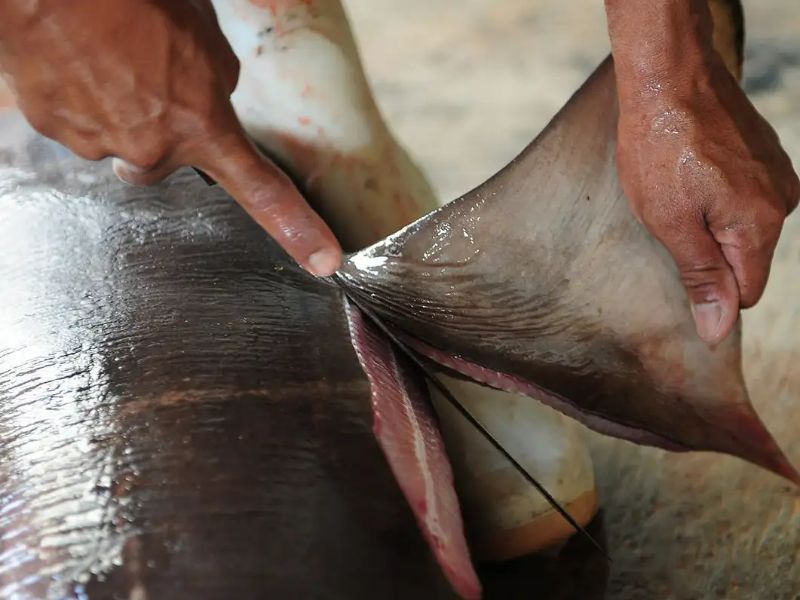
Fining sharks need to be stopped. It’s utterly barbaric. Each year, millions of sharks are killed so that their fins can be used to make soup. Typically the shark, ray, or dogfish will be landed, its fins cut off and the animal thrown back into the sea to die. This random killing for the sake of fins is putting many shark species on the verge of extinction.
If that wasn’t enough of a reason why shark finning is bad, it gets worse. Without sharks, there is a real risk; the entire oceanic ecosystems could collapse.
See Related: Great Hammerhead Shark
Why Must We Care For Sharks?

What would happen if there was shark overfishing and every shark species died out? Is it as terrible as it seems?
It is common knowledge that sharks are a keystone species. Fish populations and health, seagrass and coral reef ecosystems, and more have all been regulated and maintained by the presence of sharks. When sharks are removed, what is known as a “trophic cascade” occurs, which results in the collapse of the entire aquatic environment. These cascades have been presented to us on several previous occasions.
Exterminating predators in Yellowstone National Park was one example of US government action with detrimental effects on the local ecosystem. By 1926, the last wolf had been eradicated, which set off a trophic cascade. The result was a trophic cascade: elk numbers surged and overbrowsed willow and aspen, which reduced beaver, songbird, and other wildlife populations until wolves were reintroduced to the park in 1995.
The physical health of our oceans controls the temperatures of the whole planet and slows down the rate of climate change. In Western Australia, tiger sharks are known to patrol the seagrass meadows. These sharks keep sea turtles, dugongs, and other species from overeating seagrass.
Tiger sharks’ superior monitoring abilities have aided in maintaining carbon sediment reserves by increasing CO2 intake, which has increased primary production. As one of the largest and most significant carbon stores on the planet, marine sediments are critical to halting climate change.
Even though seagrass only covers 0.2 percent of the ocean floor, it stores about 10 percent of all the carbon that the ocean can hold. Seagrass is a resource that, despite its little, packs a powerful punch.
If sharks are overfished, then this all comes crumbling down.
Is Shark Finning Illegal?

Since the year 2000, the United States and most other nations have banned the act of finning in their coastal waters. The United States went further on December 23, 2022, when the Shark Fin Sales Elimination Act made it illegal nationwide to buy, sell, possess, or transport shark fins, with only narrow exceptions — backed by civil penalties of up to $100,000 per violation.
In U.S. waters, the Shark Finning Prohibition Act of 2000 and the stronger Shark Conservation Act of 2010 require sharks to be landed with their fins naturally attached, closing the loophole that once let boats keep only the fins. Regional fisheries bodies such as the International Commission for the Conservation of Atlantic Tunas (ICCAT) apply similar fins-attached rules to their longline tuna and swordfish fleets, according to NOAA Fisheries.
Enforcing these rules against illegal sellers is difficult, but it is a major start. The International Union for Conservation of Nature (IUCN) lists more than a hundred shark and ray species as threatened. And in November 2022, CITES (the Convention on International Trade in Endangered Species of Wild Fauna and Flora) took a historic step: member nations added all 54 species of requiem sharks plus hammerheads to Appendix II, bringing the majority of the global fin trade under trade regulation for the first time.
CITES was founded in 1973, but gaps remain. There are still limited consequences for small boats and countries that don’t recognize CITES or other agreements concerning shark fin commerce. Sharks need to be protected while also managing national and international fisheries and local efforts to reduce the consumption of shark fins.
See Related: Great White Shark
Can Shark Fins Be Sold Legally?

The commerce in shark fins occurs on a large, international scale. Before 2022 only about 14 U.S. states plus several territories had banned the shark fin trade; the federal Shark Fin Sales Elimination Act now bans it across all 50 states. Even so, policing the vast global trade beyond U.S. borders remains difficult.
Major fin-consuming markets still source fins from nations like China, India, and Indonesia that do not restrict the practice of shark finning. There are currently very few rules worldwide that govern the selling of shark fins. In nations with regulations against shark finning, shark fins can be sold legally. However, the source of the fin and the technique by which the shark was killed may still be illegal.
To comply with these agreements, the shark carcass must be brought to the port alongside the shark itself, or if it has been severed, it must adhere to a predetermined ratio of fins to the body.
This ratio is so high in specific locations, such as the EU, that it enables the capture of a more significant number of sharks than what would be indicated by the fin weight alone. For example, most whale sharks are processed in Hong Kong before being re-exported to mainland China and other countries such as the United States.
Fins that are sold in their dried form lack any documentation regarding the location of the shark’s capture, the species of shark, or whether or not the shark was lawfully harvested or finned on the high seas.
The majority of dried shark fins are barely distinguishable from one species to the next. Once it is sold in stores or placed in bowls, most customers will not be aware of the origin of the fin or whether or not it was obtained through legal or illegal means.
See Related: Whale Hunting
Where Is Shark Finning Legal?
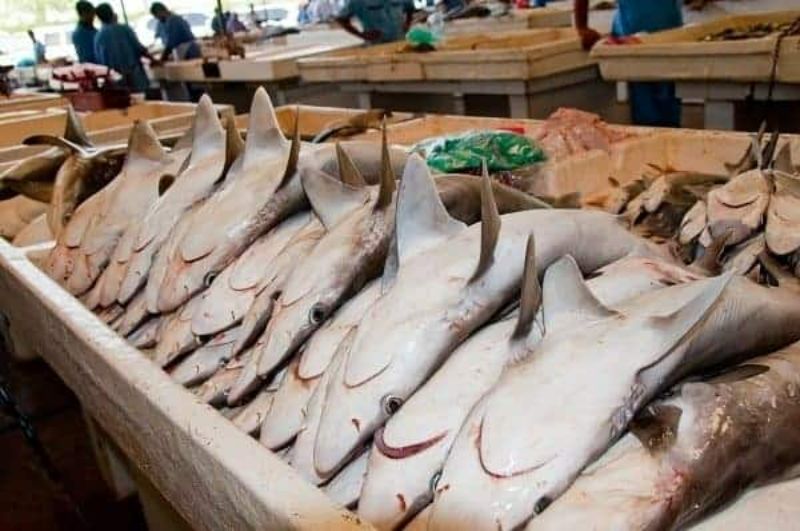
Hong Kong is the biggest major importer of shark fins around the globe and accounts for roughly half of the trade that takes place in global trade.
A DNA study of Hong Kong’s Sheung Wan and Sai Ying Pun markets (Fields et al., 2018) identified at least 76 shark and ray species in the fin trade — roughly one-third of them listed as threatened by the IUCN, including hammerhead, silky, thresher, and oceanic whitetip sharks.
Importance in Terms of Ocean Health
Large sharks, such as the great white shark, have an essential part to play at the very top of the marine food chain since they are apex predators. When these top predators are removed, an imbalance known as a trophic cascade is created, which leads to a reduction in abundance and a worsening of the ecosystem’s health.
Without them, there is a risk that the entire food chain would be disrupted, which will severely influence the whole environment, including the fish that people like eating.
Vulnerability of Sharks
Shark overfishing and the demand for shark fins lead to a steep decline in large shark populations. Compared to other kinds of fish, members of this genus of aquatic animals develop slowly, reach maturity at an advanced age, and have a low reproductive rate. Because of these features, they are particularly susceptible to people’s exploitation.
Final Thoughts
The practice of finning sharks concerns both the environment and animal welfare. The technique is not only incomprehensibly cruel, but the broader impact it produces can throw the delicate balance of entire ecosystems off.
Selling shark fins is a practice that has put the whole shark population at risk of shark extinction. There is a pressing need to develop strong and effective remedies to end this trade. Even though people worldwide have tried banning shark finning, little has been done to regulate or ban the practice.
Activists for animal rights have spoken out about how to stop shark fining. Threatened species suffer significantly as a result of shark finning. Everyone must ensure that the numerous campaigns to raise awareness about shark finning and the predicament of some species are successful.
The future of the shark population is in the hands of everyone, as shark finning is a cruel act that must be stopped in any case if all aquatic life is to be saved.
FAQ
How Many Sharks Are Killed For Shark Fin Soup?
Recent research estimates that fisheries kill roughly 80 million sharks a year — about 100 million in 2019 once unidentified species are counted (Worm et al., 2024, Science). Not all are finned: demand for shark fin soup remains a major driver, but a fast-growing shark-meat trade now kills sharks as well.
Related Resources: