The great white shark (Carcharodon carcharias) is not formally classified as Endangered at the global level. The species is listed as Vulnerable on the IUCN Red List, which means it still faces a serious risk of decline if threats such as bycatch, trade, and habitat pressure are not reduced.
That answer needs context. In everyday language, people often call any at-risk animal “endangered.” In conservation science, Endangered is a specific category. Great white sharks are one category below Endangered, but they are not “safe.” Their slow growth, late maturity, long migrations, and accidental capture in fishing gear make recovery difficult.
This guide explains the great white shark’s current conservation status, where it lives, what it eats, why population estimates are uncertain, and what can actually help protect this famous ocean predator.
Key Takeaways
- Great white sharks are Vulnerable, not formally Endangered. Vulnerable still means the species faces a high risk of extinction in the wild if threats continue.
- There is no reliable worldwide population count. Regional trends vary, and scientists still have major gaps in abundance data.
- Great white sharks are fish, not marine mammals. They belong to the cartilaginous fish group that includes sharks, rays, and skates.
- Main threats include bycatch, fishing pressure, shark products, habitat impacts, and some shark-control programs.
- They are apex predators with an important ecological role. Protecting them helps support healthier marine food webs.
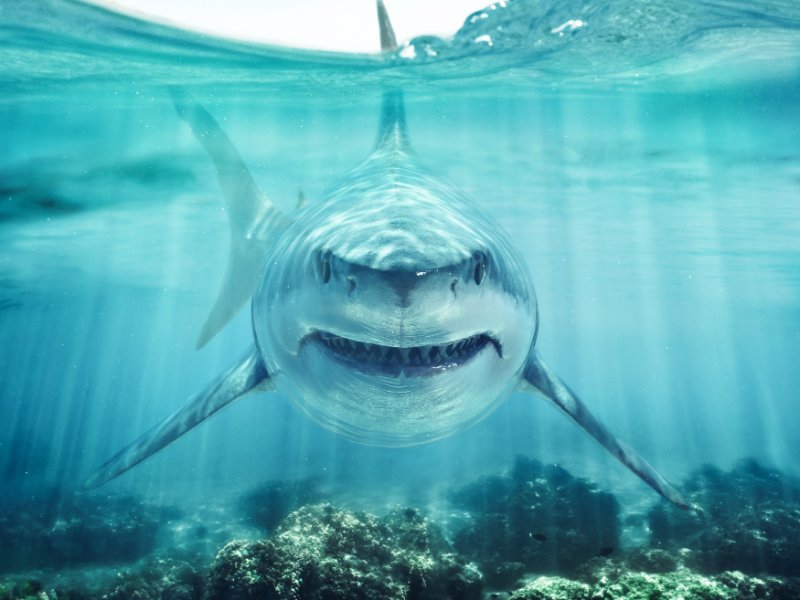
Great White Shark Quick Facts
| Category | Great White Shark Facts |
|---|---|
| Scientific name | Carcharodon carcharias |
| Common names | Great white shark, white shark, white pointer, great white |
| Animal group | Cartilaginous fish |
| Family | Lamnidae, the mackerel shark family |
| Global conservation status | Vulnerable on the IUCN Red List |
| Estimated global population | Unknown; no reliable single worldwide count |
| Range | Temperate and subtropical seas worldwide |
| Typical habitat | Coastal waters, continental shelves, island areas, and offshore pelagic zones |
| Adult size | Often 11 to 16 feet long, with the largest individuals reaching about 20 to 21 feet |
| Maximum weight | Can exceed 4,000 pounds in large adults |
| Lifespan | More than 70 years |
| Main diet | Fish, rays, smaller sharks, squid, seals, sea lions, dolphins, porpoises, sea turtles, and carrion |
| Main threats | Bycatch, overfishing, trade in shark products, habitat impacts, and fear-driven killing |
Great White Shark by the Numbers
Most great white shark pages repeat the same handful of round numbers. The table below lists only figures that come from a named scientific source, with the source attached to each one, so you can check them yourself. Where researchers disagree, both figures are shown rather than averaged.
| Measure | Verified figure | Source |
|---|---|---|
| IUCN Red List status | Vulnerable (not Endangered) | IUCN Red List |
| Maximum length | About 21 feet (6.4 m) | NOAA Fisheries |
| Length at birth | About 4 feet (1.2 m) | NOAA Fisheries |
| Teeth | About 300, in up to 7 rows | Smithsonian Ocean |
| Median cruising speed (juveniles) | 0.6 m/s (about 2.2 km/h, 1.3 mph) | Anderson et al., PLOS ONE, 2022 |
| Fastest speed in that 56,657-measurement dataset | 7.7 m/s (about 28 km/h, 17 mph) | Anderson et al., PLOS ONE, 2022 |
| Age at maturity | About 26 years (males), about 33 years (females), western North Atlantic | NOAA Fisheries |
| Gestation | About 12 months, or up to 18 months | Smithsonian Ocean / CSIRO |
| Pups per litter | 2 to 12 (CSIRO reports up to 10 per reproductive event) | Smithsonian Ocean / CSIRO |
| Maximum validated age | 73 years (largest male examined) | Hamady et al., PLoS ONE, 2014 |
| Adults, eastern Australasian population | About 750 (range 470 to 1,030) | CSIRO close-kin mark-recapture |
| Adults, southern-western Australian population | About 1,460 (range 760 to 2,250) | CSIRO close-kin mark-recapture |
| Total eastern Australasian population | About 5,460 (range 2,909 to 12,802) | CSIRO close-kin mark-recapture |
| Adult survival rate, Australian populations | Above 90% per year | CSIRO |
| Unprovoked shark bites worldwide, 2025 (all species) | 65, against a 10-year average of 72 | International Shark Attack File |
| Global decline in oceanic sharks and rays since 1970 | 71% | Pacoureau et al., Nature, 2021 |
Are Great White Sharks Endangered?
No, great white sharks are not formally listed as Endangered at the global level. They are listed as Vulnerable, which is still a threatened category. A Vulnerable species is considered at high risk of extinction in the wild, but it has not crossed the higher-risk threshold used for Endangered or Critically Endangered species.
The simplest answer is: great white sharks are at risk, but “Endangered” is not their current formal global category. That distinction matters because conservation status should be accurate. Overstating the category can weaken trust, while understating the risk can make readers think the species does not need protection.
For more context on formal conservation categories, see our guide to endangered, threatened, and extinct species.
What “Vulnerable” Means
| IUCN category | Plain-English meaning | Great white shark relevance |
|---|---|---|
| Vulnerable | The species faces a high risk of extinction in the wild. | This is the current global category for the great white shark. |
| Endangered | The species faces a very high risk of extinction in the wild. | Great white sharks are not currently in this global category. |
| Critically Endangered | The species faces an extremely high risk of extinction in the wild. | This is a higher-risk category than the current great white shark listing. |
Conservation categories apply to a species based on evidence such as population trend, range, maturity age, reproductive rate, and threats. Great white sharks are difficult to count because they travel long distances, spend time offshore, and occur across many jurisdictions.
How Many Great White Sharks Are Left?
The most accurate answer is: scientists do not have a reliable global population estimate for great white sharks. You may see older figures repeated online, but a single worldwide number can be misleading. Some regional populations appear to be improving under protection, while others remain poorly understood.
NOAA Fisheries notes that many basic questions about white shark abundance and life history remain unanswered. That uncertainty is one reason conservation language should be careful: the species is not formally Endangered, but the lack of a clean global count does not mean it is secure.
The Regional Numbers That Do Exist
No global count exists, but two regions have produced defensible estimates, and both are worth knowing because they show how different the picture can be from place to place.
Australia. CSIRO, Australia’s national science agency, used close-kin mark-recapture, a genetic method that identifies parents from the DNA of sampled juveniles without ever catching an adult. It estimates about 750 adults in the eastern Australasian population (range 470 to 1,030) and about 1,460 adults in the southern-western population (range 760 to 2,250). The total eastern Australasian population, adults and juveniles together, is estimated at about 5,460 sharks (range 2,909 to 12,802). Adult survival in both populations is estimated at above 90% per year, which is high, but it is paired with very slow reproduction.
The northwest Atlantic. The white shark population off eastern North America fell by roughly 70% after the 1960s, according to the Canadian status assessment cited by the Florida Museum. Numbers have increased in recent years under protection, and 2025 brought the first Canadian shark-bite incident since 2021, a paddle boarder whose board was bitten. Canada still lists the species as endangered nationally. A rising local sighting rate is not the same thing as a recovered global population.
The wider shark picture. Pacoureau and colleagues, writing in Nature in 2021, calculated that the global abundance of oceanic sharks and rays fell 71% between 1970 and 2018, driven by an 18-fold increase in relative fishing pressure, and that three-quarters of the species in that group are now threatened with extinction. Great whites are better protected than most of those species, which is precisely why their status is Vulnerable rather than worse.
Smithsonian Ocean puts the same point plainly: in some areas great white populations have plummeted by over 70%. That is a regional statement, not a global one, and the distinction matters when you are reading a headline.
What Is a Great White Shark?
The great white shark is a large predatory fish and one of the best-known types of sharks. It belongs to the mackerel shark family, Lamnidae, along with mako sharks and porbeagle sharks.
Great whites are apex predators, meaning adults sit near the top of the marine food chain. They help shape prey behavior and can influence the balance of a marine ecosystem. They also scavenge dead whales and other large animals, moving nutrients through ocean food webs.

Size, Teeth, and Appearance
Great white sharks are among the largest predatory fish on Earth. Newborn pups are about 4 feet long. Large adults can reach about 20 to 21 feet and weigh more than 4,000 pounds, although most individuals seen by researchers are smaller.
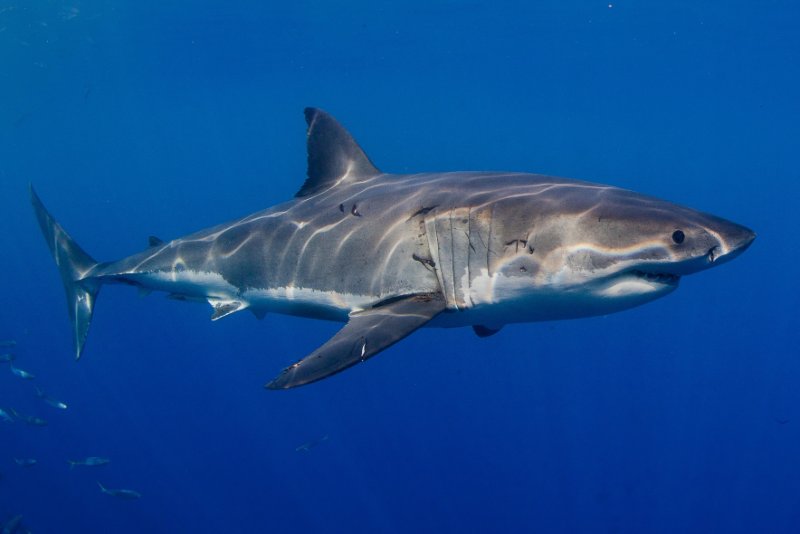
The species has a broad, conical snout, a strong torpedo-shaped body, and a crescent-shaped tail. Its coloring is a form of countershading: the top is gray, blue-gray, or brownish, while the underside is pale. From above, the darker back blends with deeper water. From below, the white belly is harder to see against sunlight.
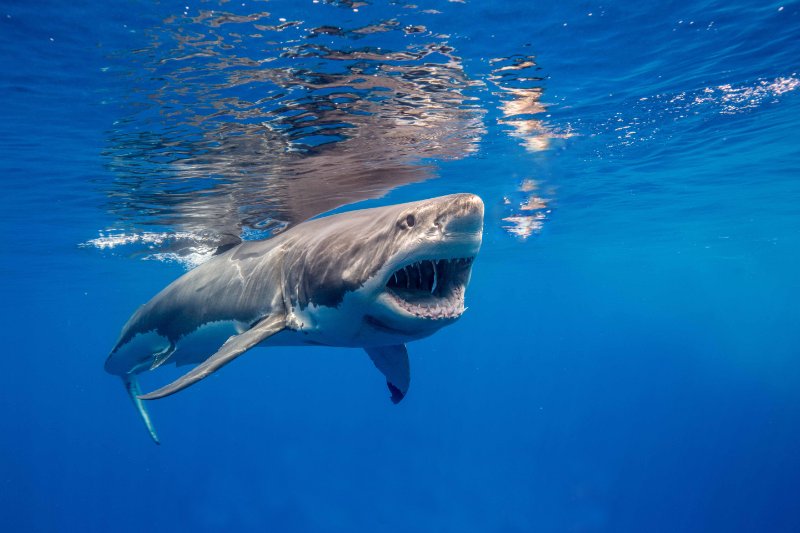
Great white sharks have rows of serrated teeth that are replaced throughout life. The visible front teeth do the cutting, while replacement teeth wait behind them. This system helps the shark keep feeding even after teeth are broken or lost.
Senses and Adaptations
Great white sharks rely on smell, vision, hearing, pressure detection, and electroreception. Specialized organs called ampullae of Lorenzini help sharks detect weak electrical fields produced by living animals. This is especially useful at close range when a shark is closing in on prey.
White sharks are also regionally endothermic. They can keep parts of their body warmer than the surrounding seawater, which supports powerful swimming and hunting in cooler waters. This does not make them mammals; it is a specialized adaptation found in a small number of shark and tuna species.
How Fast Can a Great White Shark Swim? What the Tags Actually Measured
The figure you will see almost everywhere is 35 mph (50 km/h), and it appears on reputable pages including Smithsonian Ocean. It is worth knowing where that number does and does not come from, because the published tracking data tell a more interesting story.
Anderson and colleagues, writing in PLOS ONE in 2022, used a high-resolution acoustic array to derive 56,657 individual swim-speed measurements from 17 free-swimming juvenile white sharks off southern California. The median cruising speed was 0.6 m/s, which is about 2.2 km/h or 1.3 mph — roughly a slow human walking pace. Sharks moving between areas averaged 0.98 m/s. Across the whole dataset, the highest speed recorded was 7.7 m/s, about 28 km/h or 17 mph.
Studies of larger adults record somewhat faster routine speeds. The same paper compares its results with Carey et al. (0.89 m/s), Watanabe et al. (0.94 m/s mean) and Semmens et al. (2.25 m/s, measured at a seal colony where the sharks were actively hunting). Notice the pattern: the highest published routine figure comes from sharks in hunting mode, not from cruising animals.
So the honest summary is this. A great white shark spends most of its life moving at a walking pace to conserve energy, accelerates hard for a few seconds during a predatory strike, and the fastest instantaneous speed in the largest published telemetry dataset is about 17 mph rather than 35. The popular 35 mph figure is best treated as an upper-bound estimate for a short burst, not a measured cruising speed. The same gap between a repeated record and a measured one shows up across the animal kingdom — see our guide to the fastest animals in the world for how those records are actually set.
Speed is not the great white’s main hunting advantage in any case. Its senses are: an olfactory bulb reported to be the largest of any shark, and a lateral line that can detect movement from as far as 820 feet (250 m) away, according to Smithsonian Ocean. If sensory biology interests you, compare this with the animals with the best sense of smell and the animals with the best hearing.
Where Do Great White Sharks Live?
Great white sharks live in temperate and subtropical seas around the world. They are strongly associated with coastal waters, islands, continental shelves, and areas with seals or sea lions, but adults also travel far offshore. They are not deep-sea animals: the trench faunas described in our guide to Mariana Trench animals belong to a completely different world, thousands of metres below anywhere a white shark has been recorded.
They are not freshwater sharks. Great whites are marine animals that may move through different ocean zones, but they are not known as a freshwater species.

Important Great White Shark Regions
- The northeastern Pacific, including parts of California and Mexico
- The northwestern Atlantic, including the U.S. East Coast
- South Africa, including the Western Cape region
- Southern Australia
- New Zealand
- Parts of the Mediterranean
Juvenile white sharks often use shallower nursery areas where food is available and the risk from larger predators may be lower. NOAA identifies important nursery habitat off southern California and near Long Island, New York.
What Do Great White Sharks Eat?
Great white sharks are carnivores with a diet that changes as they grow. Younger sharks eat fish, rays, smaller sharks, squid, and other manageable prey. Larger adults can take marine mammals such as seals and sea lions, and they may scavenge from whale carcasses.
Adult great whites are often associated with pinniped colonies because seals and sea lions provide dense calories. That does not mean they eat only marine mammals. White sharks are opportunistic predators, and diet can vary by region, season, and life stage.
Great whites do not deliberately hunt humans as normal prey. Most shark bites involving people are better understood as rare, high-consequence encounters rather than routine predation.
How Great White Sharks Hunt
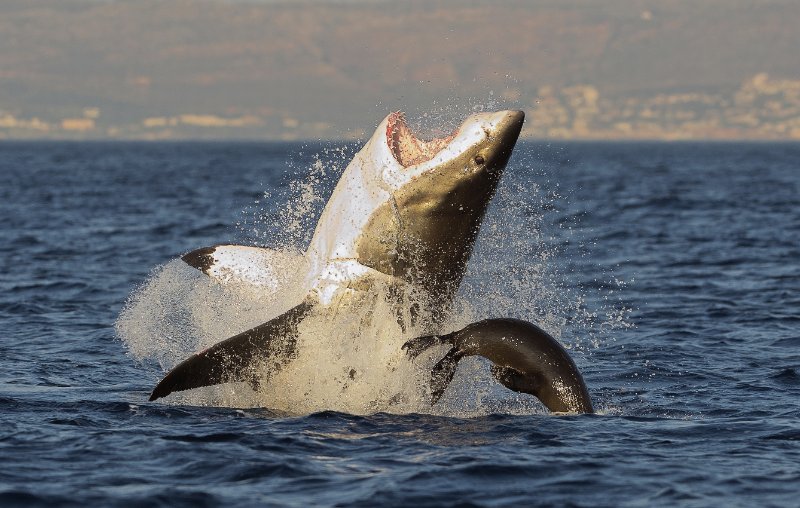
The great white’s hunting strategy depends on prey, location, and visibility. In some seal-rich areas, white sharks may attack from below with a fast vertical strike, sometimes breaching above the surface. In other situations, they patrol slowly, investigate scent trails, or scavenge.
Great White Shark Reproduction and Life Cycle
Great white sharks reproduce slowly. That is one of the biggest reasons the species is vulnerable to population decline. Males mature at roughly 26 years old, while females may not mature until about 33 years old. A fish that takes decades to reproduce cannot quickly replace individuals lost to fishing or other human-caused threats.
Great whites give birth to live young after embryos develop inside the mother. Pups are born large, usually around 4 feet long, and must hunt for themselves shortly after birth. Scientists still have important gaps in knowledge about mating, gestation, pupping frequency, and nursery use.
The species can live for more than 70 years. Long life can help individuals survive natural variation, but late maturity means recovery from human-caused losses can take many years.
Why Are Great White Sharks Vulnerable?
Great white sharks face several threats, but the most important are tied to human activity. The species is not usually targeted by large commercial fisheries in places where it is protected, but it can still be caught accidentally or killed for its body parts.
Bycatch and Fishing Pressure
Bycatch happens when fishers catch an animal they were not trying to catch. Great white sharks can become hooked on longlines or trapped in gillnets and other fishing gear. Even when released, a stressed or injured shark may not survive.
Fishing pressure is a wider shark conservation problem. A 2021 Nature study on oceanic sharks and rays found steep global declines across many oceanic shark and ray species since 1970, driven largely by increased fishing pressure. Great white sharks have stronger protections than many species, but bycatch remains a serious concern.
For more background, see our explanation of overfishing and how it affects marine animals.
Shark Products and Illegal Trade
Great white sharks have been killed for jaws, teeth, fins, and other products. International protections have reduced legal trade, but high-value wildlife products can still create incentives for illegal killing.
Shark fin demand affects many shark species. Great whites are not the only sharks harmed by this trade, but they are one of the species that can be killed for fins, jaws, or trophies. Our guide to shark finning explains why this practice is so damaging.
Shark-Control Programs
Some coastal areas have used shark nets, drumlines, or other “shark-control” measures to reduce the chance of shark bites near beaches. These programs can kill sharks and other marine animals, including rays, dolphins, turtles, and non-target shark species.
Public safety matters, but lethal shark-control gear is controversial because it can harm marine wildlife without removing all risk. Better approaches focus on surveillance, real-time alerts, public education, beach closures when needed, non-lethal deterrents, and avoiding high-risk conditions.
Habitat Impacts, Pollution, and Climate Change
Great white sharks need healthy coastal and offshore habitats. Pollution, prey decline, vessel disturbance, and coastal development can affect the food webs and nursery areas they rely on. Broader habitat loss and degradation can also affect prey species.
Climate change may shift prey distribution, ocean temperatures, and nursery conditions, but the exact long-term effects on great white sharks will vary by region. The most honest framing is cautious: climate change is a plausible pressure on white shark habitat and prey, but bycatch and fishing-related mortality remain clearer, immediate conservation concerns.
Orcas Hunt Great White Sharks, and the Sharks Flee
The great white shark is an apex predator, but it is not untouchable. The best-documented case comes from South Africa, and it has reshaped one of the most famous shark sites on Earth.
Two adult male killer whales, first recorded off Cape Town in 2015 and nicknamed Port and Starboard for their oppositely collapsed dorsal fins, have been linked to a series of white shark deaths at Gansbaai. Carcasses washed ashore with the enormous, oil-rich liver removed and the rest of the body largely intact. Towner and colleagues reported the pattern in the African Journal of Marine Science in 2022 under the title Fear at the top: killer whale predation drives white shark absence at South Africa’s largest aggregation site.
What makes the work unusual is the evidence for the sharks’ response. Combining sightings-per-sea-day records with telemetry from tagged animals, the researchers used change-point analysis to show that white sharks left Gansbaai immediately after each predation event, with some relocating east along the coast, and that sightings stayed depressed afterwards. A follow-up paper, Direct observation of killer whales preying on white sharks and evidence of a flight response, documented the predation directly, including an event in which a single orca killed a young white shark without help from its partner.
Two things follow, and both matter for how you read shark news. First, a sudden local disappearance of white sharks does not necessarily mean the population has crashed; it can mean the animals have moved because of a predator. Second, the reverse is also true, as CSIRO notes: short-term local increases or decreases in sightings are, by themselves, poor predictors of population status. Ecosystems shift, and a change in one habitat is felt across the food web.
Are Great White Sharks Dangerous to Humans?
Great white sharks can be dangerous, but shark bites are rare. The Florida Museum’s International Shark Attack File lists white sharks among the species most often confirmed in unprovoked bites, but the same source warns that identifying the shark species involved in an incident is often difficult.
Here is the whole global picture in numbers. The International Shark Attack File recorded 65 unprovoked shark bites worldwide in 2025, across all shark species, against a 10-year average of 72. Nine of those bites were fatal, compared with a 10-year average of six. The United States accounted for 38% of bites (25 incidents, one fatality, a white shark in Monterey Bay, California) and Australia for 32% of bites but 56% of the fatalities. Florida recorded 11 bites and Volusia County, often called the shark-bite capital of the world, recorded 6. Surfers made up 32% of the year’s bites.
White sharks were responsible for the majority of 2025 bites that could be attributed to a specific species, which is why they dominate the headlines. But the ISAF also stresses that most bites in its database involve unidentified species, because witnesses rarely get a clear look and closely related sharks are hard to tell apart.
For scale: the CDC reports more than 4,000 drowning deaths a year in the United States alone, and lightning is estimated to kill about 24,000 people worldwide each year. Nine shark-bite fatalities globally sits against those figures. The remarkable thing in the ISAF data is the stability — the 10-, 20- and 30-year averages for unprovoked bites differ by only four incidents, and the average number of fatalities has stayed at six across all three windows.
Meanwhile the animals themselves are in far more trouble than the people. Gavin Naylor, who directs the Florida Program for Shark Research, notes that of roughly 1,200 shark species, about 30% are categorised as endangered — in a lineage that has persisted for around 330 million years and survived two mass extinctions.
Most people face a far higher risk from drowning, rip currents, boating accidents, or other ocean hazards than from sharks. Fear-driven killing after a bite does not make beaches risk-free and can harm already vulnerable marine species.
How to Reduce Shark-Bite Risk
- Swim, surf, or dive with another person when possible.
- Avoid swimming at dawn, dusk, or night in areas known for shark activity.
- Stay away from fishing activity, bait fish, seal colonies, and murky water when possible.
- Do not enter the water with an open, bleeding wound.
- Avoid shiny jewelry that can flash like fish scales underwater.
- Leave the water calmly if sharks are seen nearby. Do not splash or panic.
If a shark bites, experts recommend defending yourself by targeting sensitive areas such as the eyes, gills, or snout. The better goal is prevention: avoid risky conditions and follow local beach warnings.
Great White Sharks and the Marine Ecosystem
Great white sharks help regulate marine food webs. By hunting seals, sea lions, large fish, and weak or injured animals, they can influence prey behavior and remove vulnerable individuals. By scavenging whale carcasses, they also help recycle nutrients.
No single predator “controls” the ocean by itself. Ecosystems are more complex than that. But removing apex predators can change food webs in ways that are hard to predict. Protecting great whites is part of protecting the wider ocean system they belong to.
How Are Great White Sharks Protected?
Great white sharks are protected in many national and international systems. In most U.S. waters, white sharks are a prohibited species, which means fishers generally cannot keep, sell, or land them. NOAA also notes that white sharks are protected internationally through agreements that regulate trade and encourage conservation cooperation.
Legal protection helps, but it does not solve every problem. Sharks still cross borders, encounter fishing gear, and depend on habitats that may fall under different rules. Effective conservation needs research, enforcement, bycatch reduction, habitat protection, and public support.
Conservation Organizations and Research
Several organizations help improve white shark research, policy, and public understanding. The Dyer Island Conservation Trust works in South Africa’s Western Cape region, where white sharks are part of a rich marine ecosystem. The Monterey Bay Aquarium has contributed to ocean education and white shark awareness. Oceana campaigns on ocean conservation issues such as overfishing and bycatch.
Good conservation work does not depend on fear. It depends on accurate data, better fishing practices, safer coexistence, and public support for policies that reduce avoidable shark deaths.
How You Can Help Protect Great White Sharks
You do not need to live near the ocean to help great white sharks. The most useful actions support science, reduce demand for shark products, and lower pressure on marine ecosystems.
- Do not buy shark jaws, teeth, fins, or other shark products. Demand keeps illegal and unsustainable trade profitable.
- Choose sustainable seafood when possible. Better-managed fisheries reduce bycatch and pressure on marine food webs.
- Support science-based conservation groups. Look for organizations that fund tagging, bycatch reduction, habitat protection, and policy work.
- Share accurate information. Great white sharks are powerful predators, but fear-based myths make conservation harder.
- Respect local ocean safety guidance. Coexistence works better when people understand real risk and avoid high-risk conditions.
- Consider a conservation career or volunteer path. Our guide to wildlife conservation jobs is a useful next step.
Final Thoughts
The great white shark is not globally classified as Endangered, but it is not secure either. Its current Vulnerable status reflects a real conservation problem: this species grows slowly, matures late, migrates across borders, and can be killed by fishing gear, trade demand, and fear-driven policies.
The most useful way to talk about great whites is with accuracy. They are not monsters, and they are not harmless symbols. They are large predatory fish with an important ecological role and a life history that makes them slow to recover from human pressure.
Protecting great white sharks means protecting the marine systems they depend on. That includes reducing bycatch, rejecting shark products, supporting ocean research, and choosing conservation policies that value both public safety and wildlife. For more practical conservation ideas, see our guide to ways to save animals facing extinction.
Other Species Profiles
Related Resources
- Types of Sharks Around the World
- What Is Shark Finning?
- What Is Overfishing?
- Ways to Save Animals Facing Extinction
FAQ
Are great white sharks endangered?
No. Great white sharks are globally listed as Vulnerable, not Endangered, on the IUCN Red List. Vulnerable still means the species faces a high risk of extinction in the wild if threats continue.
What is the conservation status of the great white shark?
The great white shark is globally classified as Vulnerable. Regional trends vary, and some populations are better protected and better studied than others.
How many great white sharks are left?
There is no reliable single worldwide population count for great white sharks. Scientists continue to study regional abundance, movement, nursery habitat, and survival rates.
How big do great white sharks get?
Large adult great white sharks can reach about 20 to 21 feet long and weigh more than 4,000 pounds, although most individuals are smaller.
Where do great white sharks live?
Great white sharks live in temperate and subtropical seas worldwide. They use coastal waters, island areas, continental shelves, and offshore habitats during different life stages.
What do great white sharks eat?
Great white sharks eat fish, rays, smaller sharks, squid, seals, sea lions, dolphins, porpoises, sea turtles, and carrion such as whale carcasses. Their diet changes as they grow.
How long do great white sharks live?
Great white sharks can live more than 70 years. Their long lifespan and late maturity make population recovery slow when adults are killed.
How fast can a great white shark swim?
Measured tracking data give a median cruising speed of about 0.6 m/s, roughly 2.2 km/h or 1.3 mph, with the fastest speed in a 56,657-measurement dataset of juvenile white sharks reaching 7.7 m/s, about 28 km/h or 17 mph (Anderson et al., PLOS ONE, 2022). The widely repeated figure of 35 mph or 50 km/h is best treated as an upper-bound estimate for a short predatory burst rather than a measured cruising speed.
Are great white sharks dangerous to humans?
Great white sharks can be dangerous, but bites are rare. Risk can be reduced by avoiding low-light conditions, fishing areas, seal colonies, murky water, and swimming alone in known shark areas.
How can people help protect great white sharks?
People can help by avoiding shark products, choosing sustainable seafood, supporting science-based conservation, reducing plastic and fishing waste, and sharing accurate information about sharks.
See Related: Dusky Shark: Is This Animal Endangered?
See Related: Southern and Northern White Rhino: Is It Endangered?