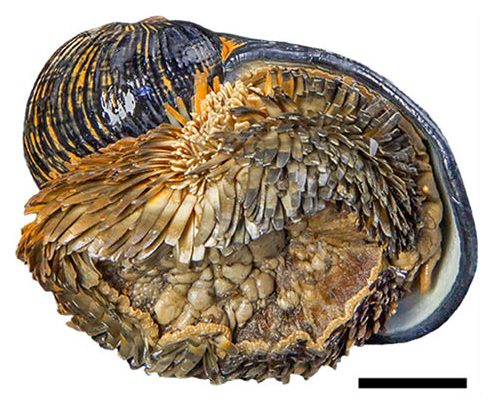
The volcano snail (Chrysomallon squamiferum) is an endangered marine gastropod found only around deep-sea hydrothermal vents in the Indian Ocean. Also called the scaly-foot snail or sea pangolin, it can coat parts of its shell and overlapping foot scales with iron sulfide. It does not live in lava or sit in 400°C (750°F) water. It occupies much cooler water where hot vent fluid mixes with the surrounding deep ocean.
The snail is equally unusual on the inside. Sulfur-oxidizing bacteria live in an enlarged esophageal gland and provide most or all of its nutrition after settlement. A large gill and a heart that occupies roughly 4% of its body volume help circulate the chemicals and oxygen needed by that partnership.
Research published in 2026 also corrected another outdated claim. Scientists have now collected scaly-foot snails from at least eight Indian Ocean vent fields, not only the three sites described in older summaries.
Last fact-checked: July 2026.
Key facts about the volcano snail
- Scientific name: Chrysomallon squamiferum.
- Habitat: Cooler diffuse-flow water beside hydrothermal vents, generally several kilometers beneath the Indian Ocean.
- Iron structures: Its shell surface and overlapping foot scales can incorporate iron sulfides, including pyrite and greigite, but the animal is not made from solid iron.
- Food source: Sulfur-oxidizing bacteria housed inside an enlarged esophageal gland.
- Known range: At least eight vent fields across three Indian Ocean ridge systems as of 2026.
- Conservation status: Endangered on the IUCN Red List, with potential seabed mining identified as a major habitat concern.
Volcano snail at a glance
| Characteristic | What the evidence shows |
|---|---|
| Scientific name | Chrysomallon squamiferum |
| Other common names | Scaly-foot snail, scaly-foot gastropod, sea pangolin, iron snail |
| Animal group | Marine gastropod in the family Peltospiridae |
| Typical documented depth | Approximately 2,400–2,900 meters (7,900–9,500 feet) |
| Adult size | Up to roughly 5 centimeters (about 2 inches) across |
| Primary energy source | Chemosynthetic, sulfur-oxidizing bacterial endosymbionts |
| Known distribution | At least eight hydrothermal vent fields on three Indian Ocean mid-ocean ridges |
| IUCN status | Endangered; assessment published in 2019 |
| Maximum survival temperature | Not established; 400°C/750°F refers to undiluted vent fluid, not the water immediately surrounding the snail |
What is a volcano snail?
The volcano snail is a deep-sea mollusk adapted to life beside chemically active hydrothermal vents. Despite its common name, it is not a terrestrial snail that lives on a volcano. It is a marine animal that spends its settled life on or near the seafloor.
Scientists first encountered the animal at the Kairei vent field in 2001. A population was later found at Solitaire, followed by another at Longqi. Researchers formally described and named the species in 2015, using Longqi as the type locality. The formal description placed it in the new genus Chrysomallon within the family Peltospiridae.
The 2015 species description identified its defining external feature: hundreds of hard, overlapping structures called sclerites around the foot. Those scales may be coated with iron sulfide, as may the shell surface. It remains the only known living animal to use iron sulfide as a substantial part of its skeletal structures.
The formal naming process also shows why a memorable nickname is not enough to establish a species. Our explanation of how scientists define and name a species covers the evidence and reference specimens used in taxonomy.
How hot can a volcano snail survive?
Direct answer: No reliable experiment has established a species-wide maximum survival temperature for the volcano snail. The often-repeated 400°C or 750°F figure describes undiluted hydrothermal vent fluid—not the temperature of the water surrounding the animal.
A NOAA hydrothermal-vent fact sheet explains that fluid emerging from some vents can exceed 400°C. It remains liquid because of the immense pressure at depth. As soon as that fluid enters the ocean, however, it mixes rapidly with near-freezing seawater.
Scaly-foot snails cluster beside black-smoker chimneys and around diffuse-flow outlets, where that mixing has already occurred. During dives at Longqi, researchers found dense populations immediately around shimmering diffuse-flow water rather than inside the hottest vent jet.
The animal’s mineralization chemistry provides another useful reference point. A 2019 JAMSTEC study reported that the snail produces iron-sulfide minerals at environmental temperatures of roughly 10–20°C (50–68°F). That does not define its complete thermal tolerance, but it demonstrates why the 750°F survival claim is misleading.
The most accurate conclusion is therefore narrower: volcano snails live close to extremely hot vent sources, but they remain in cooler mixed water. Their exact upper lethal temperature has not been established.
Where do volcano snails live?
Volcano snails are endemic to hydrothermal vents in the Indian Ocean, meaning no natural populations are known outside that region. Historically, most descriptions named three fields:
- Kairei on the Central Indian Ridge, where the animal was discovered in 2001.
- Solitaire on the Central Indian Ridge, where pale animals without the dark iron-sulfide coating were documented.
- Longqi on the Southwest Indian Ridge, the formal type locality for the species.
That three-site description is now outdated. The 2026 population-genomics study analyzed animals from eight vent fields distributed across the Southwest Indian Ridge, Central Indian Ridge, and Carlsberg Ridge. Wocan is the northernmost locality included in that research.
Hydrothermal vents function like separated islands for animals that require active vent chemistry. A suitable field may be hundreds or thousands of kilometers from the next one. Snail larvae must cross ordinary deep ocean to reach another chemically active site, and many will never encounter appropriate habitat.

Is a volcano snail’s shell really made of iron?
No. “Iron shell” is useful shorthand, but it is not a complete description. The snail has a conventional mineral component made from calcium carbonate, an organic layer, and—where local chemistry permits—an outer surface mineralized with iron sulfide. The overlapping sclerites around its foot can also receive an iron-sulfide coating.
The three-layered shell
In mineralized animals, researchers describe three principal shell layers:
- Outer mineralized layer: Iron sulfides such as greigite and pyrite may coat the exterior.
- Middle organic layer: A comparatively thick periostracum helps absorb and distribute mechanical stress.
- Inner shell layer: Aragonite, a crystalline form of calcium carbonate common in mollusk shells, provides the main rigid structure.
The shell is therefore a biological composite, not a solid metal casting. The iron-rich surface is only one part of a layered structure.
How the scales become mineralized
The snail does not simply collect ready-made iron plates from the seafloor. Research has shown that it secretes sulfur through microscopic channels in its scales. Iron ions diffuse inward from the surrounding vent water and react with that sulfur, producing iron-sulfide nanoparticles.
The sulfur may originate partly from metabolic products made by the snail’s bacterial partners. This creates an unusual two-source process: the animal supplies sulfur while the environment supplies iron. The resulting minerals can include pyrite, sometimes called fool’s gold, and the magnetic mineral greigite.
A 2020 genome study found that the animal did not need an entirely new set of genes to produce its unusual hard parts. Instead, evolution modified and redeployed an ancient molluscan biomineralization toolkit.
Why some volcano snails are white
Not every population has the same dark metallic appearance. Animals at Solitaire may remain pale because the surrounding water contains much less available iron than at fields such as Kairei. Their lack of a dark coating does not make them a separate species; genetic and anatomical evidence shows that the pale and dark forms belong to Chrysomallon squamiferum.
The scales are often described as armor, and mechanical protection may be one benefit. Researchers have also proposed that the scales help the animal tolerate vent chemistry or dispose of sulfur-rich waste from its symbiotic bacteria. Their function may therefore be both structural and physiological rather than simply defensive.
What does a volcano snail eat?
Adult volcano snails obtain most or all of their nutrition from bacteria living inside their bodies. They do not graze on plants, scrape algae from rocks, or hunt other animals in the way many familiar snails feed.
The bacterial partners live inside cells of a greatly enlarged esophageal gland. They oxidize reduced sulfur compounds from the vent environment and use the released chemical energy to build organic molecules. This process, called chemosynthesis, supports food webs where sunlight cannot reach.
The common statement that the volcano snail “does not eat” is convenient but imprecise. Its digestive system, radula, and intestine are strongly reduced, and evidence indicates that settled animals depend on their endosymbionts. The host still has to supply those bacteria with oxygen and sulfur-bearing chemicals.
Why it has such a large heart
The symbiotic bacteria are enclosed inside the snail rather than being exposed directly to vent water. The animal must move the bacteria’s raw materials through its own circulatory system.
A detailed anatomical reconstruction published in 2015 found that the heart occupies approximately 4% of total body volume. The snail also has an exceptionally large gill and extensive blood spaces. Together, these structures collect oxygen from oxygen-poor water and circulate it, along with sulfur compounds, toward the esophageal gland.
The animal’s dramatic shell and scales attract the most attention, but its oversized circulatory system may be the adaptation most essential to keeping the snail-bacteria partnership alive.
Other adaptations to life at hydrothermal vents
- No eyes: Vision offers little value in the permanent darkness of the deep sea, and the species has no eyes.
- Large gill: The gill helps extract oxygen from water that may contain little of it.
- Reduced digestive tract: Dependence on bacterial nutrition reduces the need for conventional feeding structures.
- Simultaneous hermaphroditism: Adults possess both male and female reproductive tissues, an arrangement that may improve reproductive opportunities in isolated habitat patches.
- Dispersing larvae: Researchers infer that larvae enter the water column and travel between vent fields, although direct observations of their development and survival remain limited.
- Chemical waste handling: Moving sulfur metabolites into the scales may help prevent harmful compounds from accumulating inside the body.
Why is the volcano snail endangered?
The IUCN Red List classified Chrysomallon squamiferum as Endangered in 2019. It was the first IUCN assessment to explicitly consider deep-seafloor resource development when evaluating a species.
At the time of that assessment, researchers knew the snail from only Kairei, Solitaire, and Longqi. The occupied habitat at those fields was extremely small, and two were within areas covered by International Seabed Authority exploration contracts for seafloor massive sulfides.
The 2026 discovery record is broader, but eight known vent fields do not make the species secure. Several factors still create risk:
- The snail depends on active vent chemistry and cannot simply move to ordinary seafloor.
- Individual colonies occupy small, separated habitat patches.
- Some vent fields contain genetically distinct groups that cannot be treated as interchangeable backups.
- Seafloor massive sulfide deposits near vents contain commercially interesting metals.
- Physical disturbance to a vent structure could remove habitat or change the fluid pathways that support chemosynthetic life.
Exploration is not the same as commercial mining
Descriptions of the threat sometimes imply that commercial extraction is already occurring at these Indian Ocean vents. That is not accurate.
As of July 2026, the International Seabed Authority stated that it had not approved commercial exploitation in the international seabed Area. Exploration contracts allow surveys, sampling, environmental studies, and resource assessment; they are not exploitation licenses.
At the same time, the ISA Council was still negotiating draft exploitation regulations. The mining concern is therefore prospective but concrete: the species occupies mineral-rich habitats inside or near areas being evaluated for possible future development.
The expanded range found in 2026 does not automatically change the existing IUCN classification. A formal reassessment would need to evaluate the new locality, habitat, population, connectivity, and threat data together.
What the 2026 research revealed
A 2026 Current Biology study provided the most detailed view yet of how scaly-foot snail populations are connected across the Indian Ocean.
The researchers analyzed 125 individuals from eight vent fields using approximately 14 million high-confidence single-nucleotide polymorphisms. The animals formed five major genetic groups rather than one evenly connected population.
Three findings are especially relevant to conservation:
- Dispersal has generally moved northward. Genetic models indicate that the species spread from the region near Longqi toward the northern Wocan field over approximately 200,000–400,000 years.
- Seafloor topography creates barriers. Large transform faults that offset mid-ocean ridges can interrupt the movement of larvae between otherwise suitable vent fields.
- Missing or extinct vents may have acted as stepping stones. The data are best explained partly by “ghost populations”—vent colonies that have not yet been discovered or that disappeared when their vent fields became inactive.
The Longqi–Duanqiao group and the northern Wocan population were particularly distinct. Protecting only the largest or most convenient sites could therefore leave irreplaceable genetic lineages exposed.
The practical lesson is that population count alone is not enough. Conservation planning must consider connectivity, barriers, local chemistry, and the genetic role of each vent field.
Why the volcano snail matters
The volcano snail is more than a biological curiosity. It links several major scientific questions:
- How can an animal and bacteria function as a single nutritional system?
- How can ancient genes be reorganized to produce a novel biological structure?
- How do isolated deep-sea populations exchange larvae across thousands of kilometers?
- How should environmental decisions account for species that are poorly surveyed but restricted to resource-rich habitats?
Its biology also corrects a common misunderstanding about extreme life. The volcano snail is not surviving direct exposure to boiling vent fluid. It is exploiting the narrow chemical and temperature gradient where hot, reduced fluid meets cold, oxygenated seawater. That boundary supplies both danger and the raw materials on which the snail-bacteria partnership depends.
Protecting animals such as the scaly-foot snail also protects the wider network of microorganisms and vent fauna that make deep-sea ecosystems function without sunlight. The same argument applies further down: the animals of the Mariana Trench live in the deepest habitat on Earth and are already carrying our plastic in their guts.
Frequently asked questions about volcano snails
What is a volcano snail?
The volcano snail, or scaly-foot snail, is Chrysomallon squamiferum, a deep-sea marine gastropod found only at Indian Ocean hydrothermal vents. It is known for overlapping foot scales and shell surfaces that can incorporate iron sulfide.
How hot can a volcano snail survive?
No reliable study has established a species-wide maximum survival temperature. The often-repeated 400°C or 750°F figure describes undiluted vent fluid, not the snail’s body temperature. Volcano snails live in much cooler diffuse-flow water where vent fluid mixes with deep seawater.
Is a volcano snail’s shell made entirely of iron?
No. Its shell includes an inner aragonite layer and an organic middle layer. In some populations, the outer shell surface and the scales around the foot are mineralized with iron sulfides such as greigite and pyrite.
Where do volcano snails live?
They live beside deep-sea hydrothermal vents in the Indian Ocean, usually several kilometers below the surface. A 2026 study sampled them from eight vent fields across the Southwest Indian Ridge, Central Indian Ridge, and Carlsberg Ridge.
What do volcano snails eat?
Settled volcano snails rely on sulfur-oxidizing bacteria housed in an enlarged esophageal gland. The bacteria use vent chemicals to produce organic nutrients through chemosynthesis, providing most or all of the adult snail’s nutrition.
Why is the volcano snail endangered?
It depends on small, isolated hydrothermal vent habitats that contain metal-rich deposits of interest for possible seabed mining. Habitat loss or disruption could remove entire colonies, including genetically distinct populations.
How many volcano snail locations are known?
Researchers had collected scaly-foot snails from at least eight vent fields by 2026. Older sources often state three because Kairei, Solitaire, and Longqi were the only documented sites considered in the 2019 IUCN assessment.
The bottom line
The volcano snail is not an animal that withstands direct contact with 750°F water, nor is it simply a snail with a solid-iron shell. It is a highly specialized partnership between a mollusk and sulfur-oxidizing bacteria, supported by a layered shell, mineralized scales, an enlarged gill, and an unusually large heart.
Its known range expanded from three documented vent fields to at least eight by 2026, but the new research also revealed significant genetic separation among populations. That makes protection of individual vent fields—not just the species’ total range—central to its long-term survival.