
Mariana Trench animals are not the giant sea monsters people often imagine. The best-documented life in the deepest part of the ocean includes small, soft-bodied, pressure-adapted animals such as hadal snailfish, amphipods, sea cucumbers, worms, jellies, and other invertebrates that can survive cold water, darkness, scarce food, and immense pressure.
The Mariana Trench is the deepest known ocean trench on Earth. Its lowest region, the Challenger Deep, reaches into the hadal zone, a part of the ocean roughly 6,000 to 11,000 meters deep. A 2021 study in Deep Sea Research Part I, using pressure-referenced submersible transects and now cited by NOAA, put the deepest measured point of the Challenger Deep at 10,935 metres (35,876 feet), give or take 6 metres.
At that depth the water overhead presses down at about 1,086 bar — 15,750 pounds per square inch, or roughly eight tons on every square inch, close to 1,072 times the pressure at sea level. The water sits a few degrees above freezing and no sunlight reaches it at all. Those three numbers explain most of what follows: why trench animals are small, why they are soft, and why — as the biochemistry section below explains — no fish at all has ever been found in the deepest quarter of the ocean.
This guide focuses on animals that are genuinely linked to the Mariana Trench or similar hadal environments. It also clears up a common problem: many popular “Mariana Trench animals” lists include deep-sea species that are fascinating but do not actually live on the deepest trench floor.
Key Takeaways
- The deepest part of the ocean is not lifeless. Hadal trenches support fish, crustaceans, worms, echinoderms, cnidarians, microbes, and other organisms.
- The Mariana snailfish, Pseudoliparis swirei, is one of the best-known fish from the Mariana Trench’s hadal depths.
- Amphipods are among the most important scavengers in trench food webs and are also prey for hadal snailfish.
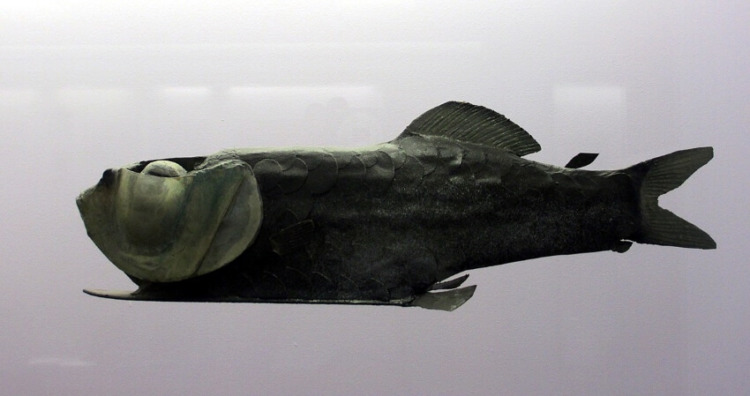
- Dumbo octopuses, barreleye fish, frilled sharks, dragonfish, and hatchetfish are real deep-sea animals, but most do not live at Challenger Deep depths.
- The most accurate answer to “what lives in the deepest part of the ocean?” is usually smaller and stranger than the myths: flexible fish, crustaceans, worms, jellies, and seafloor invertebrates built for pressure and low food.
What Lives in the Deepest Part of the Ocean?
The deepest part of the ocean is home to hadal-zone animals, including snailfish, amphipods, sea cucumbers and other echinoderms, worms, jellies, and small crustaceans. Microbes and protists also live in deep-sea sediment, although they are not animals. Research on Mariana Trench snailfish shows that hadal ecosystems include microbes, protists, worms, sponges, mollusks, echinoderms, crustaceans, cnidarians, and fishes.
The key is precision. “Deep sea” does not always mean “deepest part of the ocean.” Many famous deep-sea creatures live hundreds or thousands of meters down, but the Mariana Trench drops much farther. That difference matters when identifying true deep-sea creatures from the hadal zone.
| Animal or animal group | Where it fits | Why it matters |
|---|---|---|
| Mariana snailfish | Confirmed Mariana Trench hadal fish | One of the best-documented vertebrates from extreme trench depths |
| Hadal amphipods | Confirmed hadal trench crustaceans | Important scavengers and prey in trench food webs |
| Sea cucumbers and other echinoderms | Hadal and abyssal seafloor animals | Help process organic matter on the deep seafloor |
| Polychaete worms | Deep-sea and hadal invertebrates | Part of the small-animal community that survives in sediment and on the seafloor |
| Deep-sea jellies and cnidarians | Deep water and some hadal environments | Show how gelatinous animals can thrive where hard skeletons are less useful |
| Dumbo octopus | Deep sea, not usually the Challenger Deep floor | A popular deep-sea animal that needs careful depth context |
| Barreleye fish and frilled shark | Deep sea, but far above the deepest trench | Often mislisted as Mariana Trench animals despite shallower depth ranges |
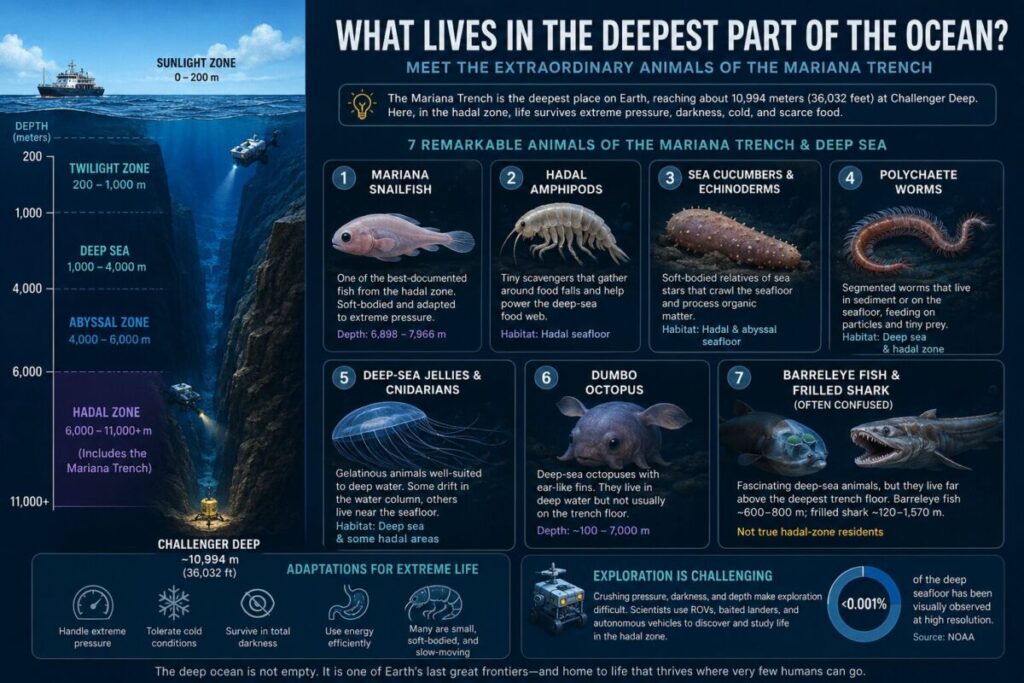
What Is the Hadal Zone?
The hadal zone is the part of the ocean from roughly 6,000 to 11,000 meters deep. It includes the world’s deepest ocean trenches, including the Mariana Trench. As a type of ecosystem, it is shaped by three extreme forces: pressure, darkness, and food scarcity.
It is also far smaller and far more fragmented than most people picture. Hadal habitat covers only about 1–2% of the global seafloor by area — a combined total of more than 800,000 square kilometres — yet it spans the deepest 45% of the ocean’s vertical range. Researchers count roughly 47 separate hadal habitats worldwide: 27 subduction trenches, 13 troughs and 7 trench faults. Because those trenches are physically isolated from one another, each one can evolve its own animals, and the Mariana Trench’s residents are not simply the same species found everywhere else at depth.
Pressure increases with depth. In the deepest trenches, animals cannot survive by simply being “stronger.” Instead, many have flexible tissues, reduced skeletons, specialized proteins, and body chemistry that keeps cells working under pressure. The result is a community of animals that often look fragile at the surface but are well suited for life far below it.
Verified Depth Records in the Hadal Zone
Deep-sea depth claims circulate widely and are often wrong by kilometres. These are the records that are documented in the peer-reviewed literature or by the research institutes that made the observation.
| Record | Depth | Animal / feature | Where & when |
|---|---|---|---|
| Deepest point of the ocean | 10,935 m (±6 m) | Challenger Deep seafloor | Mariana Trench; revised depth published 2021 |
| Deepest fish ever filmed | 8,336 m | A juvenile Pseudoliparis snailfish | Izu-Ogasawara Trench, Japan, 15 August 2022 |
| Deepest fish ever caught | 8,022 m | Pseudoliparis belyaevi | Japan Trench, 20 August 2022 |
| Deepest fish observed in the Mariana Trench | 8,178 m | Mariana snailfish, Pseudoliparis swirei | Mariana Trench, 18 May 2017 (JAMSTEC/NHK) |
| Deepest Mariana snailfish physically collected | 7,966 m | Pseudoliparis swirei | Mariana Trench; species described 2017 |
| Predicted biochemical depth limit for any fish | ~8,200 m | Set by TMAO chemistry, not by pressure alone | Modelled from hadal snailfish tissue, 2014 |
| Deepest quarter of the ocean | 8,400–11,000 m | No fish of any kind recorded | Invertebrates and single-celled life only |
7 Mariana Trench Animals and Deep-Sea Creatures to Know
The first five examples below are the strongest answer to what lives in or near hadal trench environments. The final two are included because readers often search for them as “Mariana Trench animals,” but their real depth ranges need context.
1. Mariana Snailfish
The Mariana snailfish, Pseudoliparis swirei, is one of the clearest examples of a true Mariana Trench animal. It was described in 2017 from individuals collected in the trench at depths of 6,898 to 7,966 metres, making it one of the deepest documented vertebrates with reliable collection data. Its known depth range extends to about 8,076 metres, and in May 2017 JAMSTEC and NHK filmed one at 8,178 metres — the deepest fish ever recorded inside the Mariana Trench itself.
Two things are worth noting about those numbers. First, the snailfish’s deepest confirmed sighting still sits roughly 2.75 kilometres above the Challenger Deep floor — so even the trench’s champion vertebrate does not live at the bottom. Second, the world record has since moved elsewhere: in August 2022 a juvenile Pseudoliparis snailfish was filmed at 8,336 metres in the Izu-Ogasawara Trench off Japan, and days later two Pseudoliparis belyaevi were collected at 8,022 metres in the Japan Trench — the deepest fish ever physically caught. Those trenches are warmer than the Mariana and sit under more productive surface water, so more food sinks into them.
This pale fish does not look like a typical predator. It has soft tissues, thin bones, transparent skin, and a body built for pressure rather than speed. Yet in its habitat, it can sit near the top of the local food web. Stomach-content research found many small crustaceans, especially amphipods, in Mariana snailfish specimens.
Because it is a fish, the Mariana snailfish is also a useful reminder that fish are animals. In the deepest ocean, vertebrates are rare compared with invertebrates, which makes hadal snailfish especially important to scientists.
2. Hadal Amphipods
Amphipods are small crustaceans that often look like curved shrimp. In the Mariana Trench and other hadal trenches, they are among the most important scavengers. Many gather around baited landers, feeding on organic material that sinks from above or arrives as carrion.
These animals matter because the deep ocean gets very little fresh food. There is no sunlight for photosynthesis at these depths, so much of the food web depends on “marine snow,” dead organisms, and occasional larger food falls from the upper ocean. Amphipods help move that energy through the hadal ecosystem.
3. Sea Cucumbers and Other Echinoderms
Sea cucumbers are echinoderms, the same broad animal group that includes sea stars and brittle stars. In deep-sea habitats, sea cucumbers crawl across sediment and feed on organic particles. Their soft bodies are better suited to deep pressure than rigid, air-filled structures would be.
Not every sea cucumber belongs to the Mariana Trench specifically, but echinoderms are part of the broader hadal animal community. They are also a useful example of why the deepest ocean is not dominated by large, fast predators. Much of the action happens slowly, close to the mud, where animals search for scarce food.
4. Polychaete Worms
Polychaete worms are segmented marine worms found across many ocean habitats, including deep-sea environments. In hadal systems, worm-like animals can live in sediment, feed on small particles, or prey on tiny organisms. They rarely get the attention that fish and octopuses do, but they are part of the basic structure of deep-sea food webs.
These animals are also a good example of how animals adapt to extreme environments. Success in the trench is less about size and more about energy efficiency, pressure tolerance, and finding food in a place where meals are unpredictable.
5. Deep-Sea Jellies and Cnidarians
Jellyfish-like animals and other cnidarians occur throughout the deep ocean. Their soft, gelatinous bodies are well matched to deep water, where rigid structures can be costly and pressure is intense. Some drift through the water column, while others live closer to the seafloor.
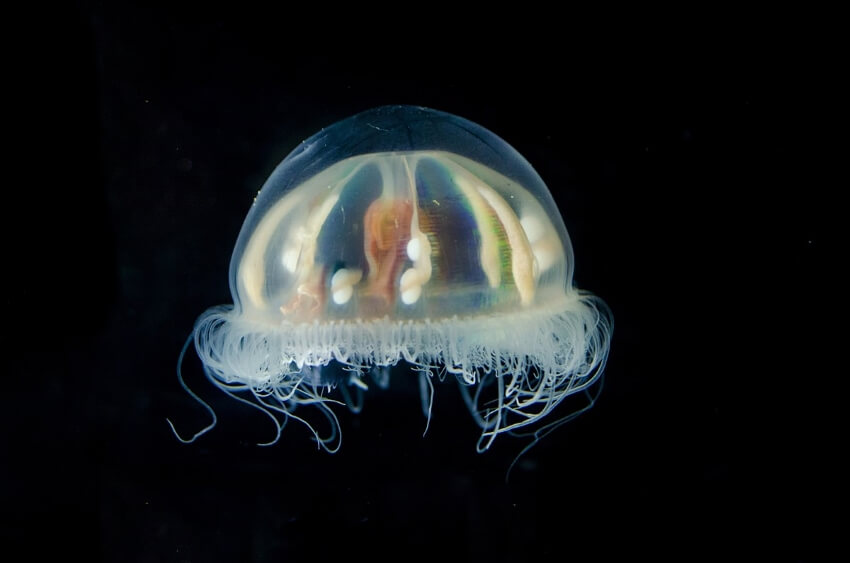
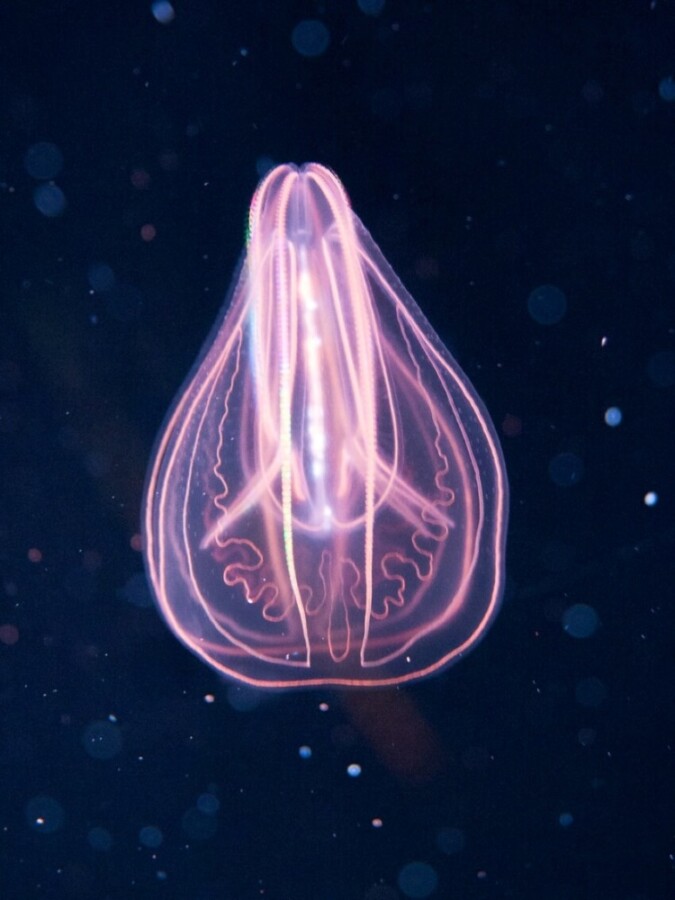
Comb jellies are not true jellyfish, but they are often grouped with jellies by casual readers because of their transparent bodies and drifting movement. Their rows of cilia can scatter light in rainbow-like bands. Some comb jellies are active predators and may eat smaller plankton or even other comb jellies.
6. Dumbo Octopus
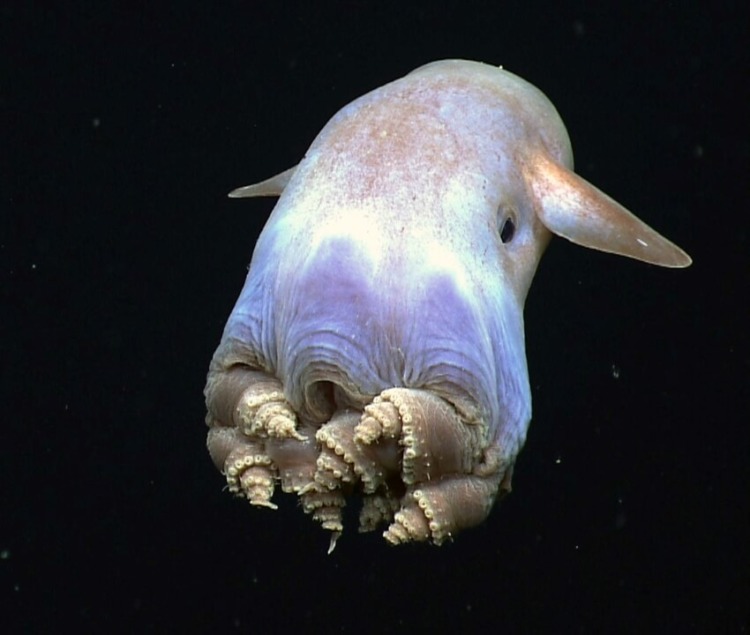
Dumbo octopus is the common name for octopuses in the genus Grimpoteuthis. They are famous for ear-like fins that help them swim through deep water. According to Oceana, dumbo octopuses live in deep seas around the world and can occur from about 100 to 7,000 meters deep.
That makes them deep-sea animals, but not a perfect answer for the very bottom of the Challenger Deep. They are still worth including because they show how cephalopods can adapt to darkness and depth. Unlike many shallow-water octopuses, dumbo octopuses lack an ink sac, which is less useful in a pitch-black habitat.
7. Barreleye Fish and Frilled Shark
Barreleye fish and frilled sharks are often included in deep-ocean articles because they look unusual and live below the sunlit surface. They are real deep-sea animals, but they are not good examples of animals living in the deepest part of the Mariana Trench.
The barreleye fish, Macropinna microstoma, is known for a transparent head and rotating tubular eyes. MBARI places it at about 600 to 800 meters, in the twilight zone of the North Pacific. That is deep, but it is far above the hadal zone.
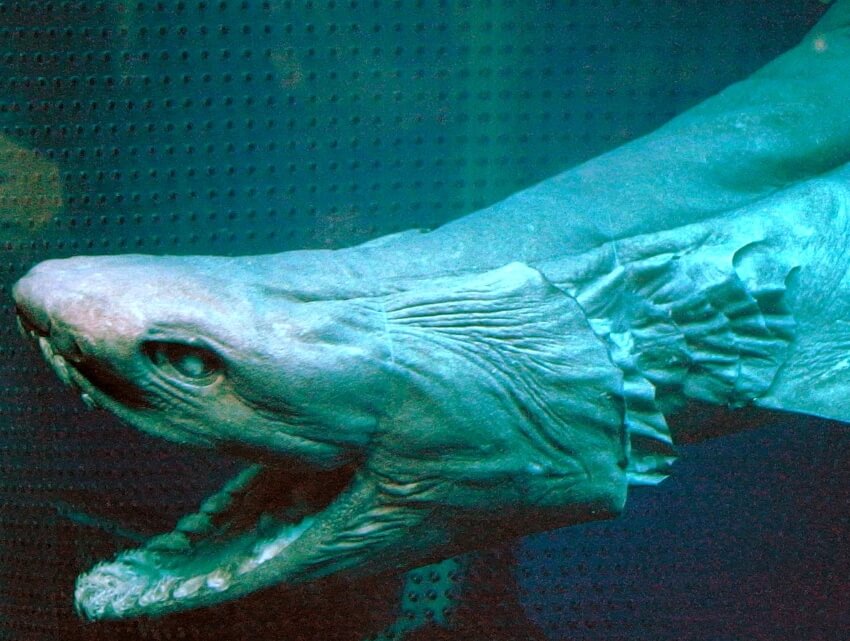
The frilled shark is another animal that needs context. It has an eel-like body, frilled gill slits, and many needle-like teeth. FishBase lists the frilled shark mostly around 120 to 1,280 meters, with records to 1,570 meters. That makes it a deep-water shark, not a hadal trench-floor animal. For a more familiar shark comparison, see our guide to the great white shark.
The Trench Floor’s Strangest Residents Are Not Animals At All
Ask what dominates the deepest trench sediment and the honest answer is a group most people have never heard of: xenophyophores. These are giant single-celled organisms — amoeba-like protists that build a fragile shell out of sediment grains they glue together. Individual cells routinely exceed 10 centimetres (4 inches) across, which makes them among the largest single cells known to science.
Scripps Institution of Oceanography researchers imaged them in abundance during dropcam surveys of the Mariana Trench, including at Challenger Deep depths — deeper than any xenophyophore had previously been recorded. They matter here for two reasons. Their shells create physical structure on an otherwise featureless mud plain, giving small invertebrates somewhere to shelter and feed. And because they trap particles from the water, they concentrate heavy metals including lead, uranium and mercury to levels that would be lethal to most life, which suggests unusual tolerance to contamination.
They are not animals, and this guide does not count them as one. But any honest answer to “what lives at the bottom of the Mariana Trench?” has to include them, because at the very deepest depths the single-celled organisms are the ones that are actually there.
How Animals Survive in the Mariana Trench
They Do Not Fight Pressure With Armor
At hadal depths, pressure is not something animals can simply push back against. Many successful hadal animals have soft tissues, flexible bodies, reduced bones, or body chemistry that helps proteins and membranes keep working. The Mariana snailfish is a strong example: it has thin, incompletely hardened bones and other traits linked to pressure adaptation.
They Rely on Senses Other Than Sight
No sunlight reaches the deepest trench. Some animals rely on smell, touch, vibration, or chemical cues. Others may use bioluminescence in higher deep-sea zones, although the hadal seafloor itself is not a glowing fantasy world. In the trench, finding food efficiently matters more than looking dramatic.
They Use Food Carefully
Food in the deepest ocean usually comes from above: dead plankton, falling particles, sinking carcasses, or material carried downslope. That makes scavengers such as amphipods especially important. It also explains why many trench animals are small, slow-moving, or built to wait for rare feeding opportunities.
Why No Fish Live at the Very Bottom of the Mariana Trench
No fish of any species has ever been recorded below about 8,400 metres, which means the deepest quarter of the ocean is a fish-free zone. That is not an artefact of nobody having looked — landers and baited cameras have been dropped repeatedly onto the Challenger Deep floor. The reason appears to be chemistry, and it is the single most interesting fact about deep-sea vertebrates.
The Molecule That Sets the Ceiling: TMAO
Pressure does not crush a deep-sea fish the way it would crush a submarine — a fish has no air space to collapse. What pressure does instead is push on individual protein molecules, deforming them until they stop working. Marine fish counter this with a compound called trimethylamine N-oxide, or TMAO. It is the same molecule that gives sea fish their characteristic smell, and it acts as a piezolyte: it stiffens the structure of the surrounding water, makes that water less compressible, and so shields proteins from being unfolded by pressure.
TMAO concentration rises steadily with depth. A 2014 study in PNAS measured it in hadal snailfish from about 7,000 metres in the Kermadec Trench and found the highest levels ever recorded in a fish — then extrapolated the trend to find where it runs out. The answer was roughly 8,200 metres.
Two Walls, Not One
Below that depth a fish would hit two problems at once. Pack in any more TMAO and its cells become saltier than the seawater around them, so water floods inwards and the fish can no longer hold its internal balance. And the sheer quantity of TMAO needed to resist the pressure would over-stabilise its proteins — leaving them too rigid to flex, and a protein that cannot change shape cannot do its job.
The prediction has held up remarkably well. The deepest fish ever filmed sits at 8,336 metres and the deepest ever caught at 8,022 metres — both within a few hundred metres of the modelled limit, and both more than two kilometres above the Challenger Deep floor. Invertebrates face no such ceiling: amphipods, sea cucumbers, worms and holothurians are recorded right down to the deepest sediment, because they solve the pressure problem with different chemistry.
Why Exploring the Mariana Trench Is So Hard
Scientists know far less about the deep ocean than they do about many land ecosystems. NOAA Ocean Exploration notes that only a tiny fraction of the ocean has been explored in detail, and direct visual observation of the deep seafloor remains extremely limited.
The obstacles are practical. Research vehicles must survive crushing pressure, cold water, darkness, long descent times, and difficult communication with ships at the surface. Much of what scientists know comes from remotely operated vehicles, autonomous vehicles, baited landers, seafloor cameras, and carefully collected samples.
That is why updated identification guides matter. NOAA’s Benthic Deepwater Animal Identification Guide uses in-situ images from ROV dives and expert review to help identify deepwater animals, including animals seen during Pacific and Marianas expeditions.
Why Mariana Trench Animals Matter
Mariana Trench animals show how life can adapt to some of the harshest conditions on Earth. They also remind us that unexplored does not mean empty. The deep ocean stores carbon, supports unusual food webs, and contains species that science is still working to describe.
Deep-sea habitats may seem protected by distance, but they are not completely isolated from human impacts. Pollution, climate-driven changes in surface productivity, bottom trawling in shallower deep-sea zones, and potential deep-sea mining can all affect fragile ecosystems. For animals that grow slowly, reproduce slowly, or live in narrow habitats, disturbance can be difficult to recover from.
Plastic Has Already Reached the Deepest Place on Earth
This is no longer a hypothetical. A 2019 study in Royal Society Open Science dissected the hindguts of 90 amphipods collected from six of the deepest trenches around the Pacific Rim — the Mariana, Japan, Izu-Bonin, Kermadec, New Hebrides and Peru–Chile trenches. More than 72% of them (65 of 90) contained at least one synthetic microparticle.
The Mariana Trench was the worst of the six. It recorded the highest average contamination of any trench sampled, at 3.3 ± 0.7 microparticles per animal, and every single specimen the team examined from the Mariana Trench carried plastic in its gut. The New Hebrides Trench, at the other end of the range, averaged 0.9.
One amphipod ended up carrying the finding in its name. In 2020, researchers led by Newcastle University formally described a new species from Mariana Trench hadal depths and called it Eurythenes plasticus, because one of the four specimens collected had a microfibre in its hindgut that was an 84% match to PET — the plastic used for drinks bottles and polyester clothing. The species was collected in 2014, before anyone had described it, and it had already eaten our packaging.
That is the part of this story that belongs on a conservation site rather than a curiosity list. The deepest, coldest, least-visited habitat on the planet is downstream of everything. Trenches act as sinks — material that sinks out of the surface ocean has nowhere further to go — so the hadal zone concentrates what the rest of the ocean sheds, including plastic pollution.
The most responsible way to talk about the Mariana Trench is with curiosity and caution. There is still a lot to discover, but the evidence we have already shows a living ecosystem shaped by pressure, darkness, chemistry, and patience.
FAQs
What animals live in the deepest part of the ocean?
The best-supported animal examples include hadal snailfish, amphipods, sea cucumbers and other echinoderms, worms, jellies, and small crustaceans. On the very deepest sediment the dominant organisms are not animals at all but xenophyophores — single-celled protists whose individual cells can exceed 10 centimetres across.
What fish lives deepest in the Mariana Trench?
The Mariana snailfish, Pseudoliparis swirei, is the deepest fish recorded in the Mariana Trench. It was described from specimens collected at 6,898 to 7,966 metres, and JAMSTEC filmed one at 8,178 metres in May 2017. The world record belongs to another trench: a juvenile Pseudoliparis snailfish filmed at 8,336 metres in the Izu-Ogasawara Trench in August 2022.
Can anything live at the bottom of the Mariana Trench?
Yes, but not fish. Amphipods, sea cucumbers, worms, single-celled xenophyophores and microbes have all been documented on the deepest trench floor. Fish are absent below about 8,400 metres — roughly 2.5 kilometres above the Challenger Deep seafloor — because the TMAO chemistry that protects their proteins from pressure stops working at around 8,200 metres.
Do dumbo octopuses live in the Mariana Trench?
Dumbo octopuses are deep-sea animals and some species live several thousand meters below the surface. However, they should not be treated as the main animals living on the Challenger Deep floor unless a specific record is verified.
Why are many Mariana Trench animals small or soft-bodied?
Soft, flexible bodies can be better suited to high pressure than rigid or air-filled structures. Food is also scarce at hadal depths, so many animals are built for efficiency rather than size.
Why is the Mariana Trench hard to explore?
The trench is extremely deep, dark, cold, and high-pressure. Research vehicles need specialized engineering, and scientists often rely on ROVs, autonomous vehicles, baited landers, and seafloor cameras to observe or collect animals safely.
Final Thoughts
The deepest part of the ocean is not empty, but it is also not packed with giant monsters. The real Mariana Trench animals are more interesting: soft fish with pressure-adapted bodies, scavenging amphipods, seafloor invertebrates, worms, jellies, and other organisms that survive where light never reaches.
As exploration improves, scientists will almost certainly identify more species and refine what we know about hadal ecosystems. For now, the clearest answer is this: life in the Mariana Trench is small, specialized, and built for one of Earth’s most demanding environments.
Related Resources
- What to Know About the Mariana Trench
- Cool Sea Creatures Found in the Deep Ocean
- How Animals Adapt to Their Environment
- Types of Ecosystems Around the World
- Longest-Living Animals on Earth
See Related: what the blobfish actually looks like underwater — its famous “ugly” photo is a decompression artefact, not the living animal.