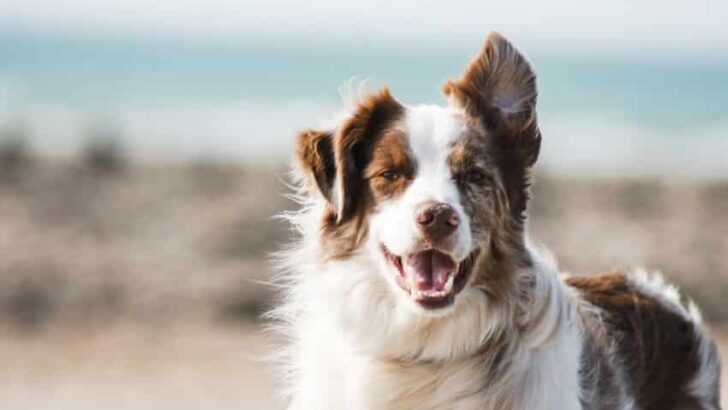
The African elephant has the best sense of smell of any animal ever measured by gene count: its genome carries roughly 2,000 working olfactory receptor genes, about five times more than a human and more than twice as many as a dog. By the other measure — how faint a scent an animal can actually act on — the bear leads, with a nose estimated at about seven times more sensitive than a bloodhound’s and roughly 2,100 times more sensitive than a human’s.
If you want to know which animals are this, keep reading because we have prepared a great list of animals that dominate for having the best sense of smell.
That split is why “which animal smells best?” has two defensible answers, and this page gives both. Humans carry about 396 functional olfactory receptor (OR) genes — fewer than a rabbit’s 768, a dog’s 811 or a cow’s 1,186. Those counts come from the genome comparison by Niimura, Matsui and Touhara published in Genome Research in 2014, which remains the standard reference for cross-species OR repertoires.
A large OR repertoire is not the same thing as a sensitive nose. Gene count tells you how many different odour molecules an animal can in principle tell apart; detection threshold tells you how little of a molecule it needs. Bears win the second contest despite carrying fewer OR genes than an elephant, because sensitivity also depends on nasal surface area, airflow and how much brain is wired to the signal. Keep that distinction in mind as you read the list below — and see the comparison table first.
How Scientists Actually Rank a Sense of Smell
Two numbers do most of the work in this field. The first is the count of functional olfactory receptor genes in an animal’s genome. The second is a behavioural detection threshold — the smallest concentration of a target odour an animal will reliably respond to in a controlled test. The two rankings do not agree, and popular “best nose” lists usually mix them without saying so.
| Animal | Functional OR genes (approx.) | Times the human count |
|---|---|---|
| African elephant | 1,948 | 4.9x |
| Rat | 1,207 | 3.0x |
| Cow | 1,186 | 3.0x |
| Opossum (reported) | ~1,200 | ~3.0x |
| Mouse | 1,130 | 2.9x |
| Chinese softshell turtle (reported) | ~1,100 | ~2.8x |
| Horse | 1,066 | 2.7x |
| Dog | 811 | 2.0x |
| Guinea pig | 796 | 2.0x |
| Rabbit | 768 | 1.9x |
| Human | 396 | 1.0x |
| Chimpanzee | 380 | 0.96x |
| Macaque | 309 | 0.78x |
One caveat worth stating plainly: primates, including humans, sit near the bottom of the gene table, but humans outperform dogs on some specific odours in laboratory tests. “Worse overall” is not the same as “worse at everything.”
List of Animals with the Best Sense of Smell
Let’s get into our list of animals with some amazing smell sensors.
1. Bear
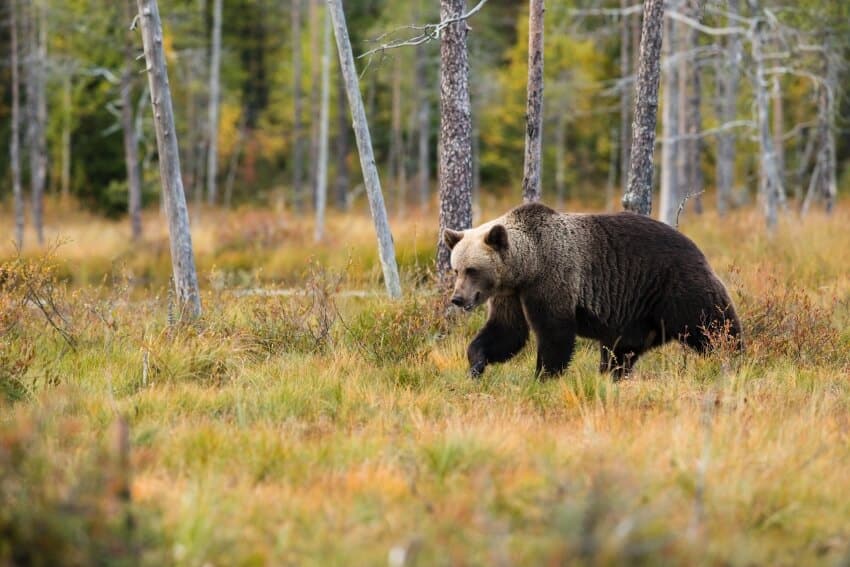
Bears are among the great animals that can smell the best. Their sense of smell is estimated at roughly 2,100 times more sensitive than a human’s. A bloodhound, the benchmark tracking dog, is usually put at about 300 times a human’s — so a bear is reckoned to be about seven times better again than a bloodhound. Older versions of this article had those two figures the wrong way round.
The olfactory bulb region of a bear’s brain is roughly five times larger than the equivalent structure in a human brain — not five times larger than the whole human brain, a comparison that gets garbled constantly. That extra processing capacity is why bears out-track every other land mammal tested on faint scent, even though an elephant carries more receptor genes. This kind of ability makes bears scary and fascinating at the same time.
Bears have enormous noses, each containing thousands of smell receptors. As a result, they are ranked first among the species with the best sense of smell in the world.
Due to their exceptional ability and sharp sense of smell, bears are widely reported to detect a carcass from as far as 20 miles away. Treat that number as a field estimate rather than a laboratory result: it comes from wildlife-agency and guiding literature, not from a controlled threshold study.
When camping or in the woods, especially when bringing food appealing to bears, a bear’s nose will pick up the scent of that food long before you see the bear. Nasal surface area is the reason: a bear’s olfactory epithelium is roughly a hundred times the area of a human’s, spread through a long, convoluted snout.
If you do not store your food in an odor-proof plastic bag, keeping a bear away from it will be quite challenging in this situation.
See Related: Animals that Start with X
2. Shark
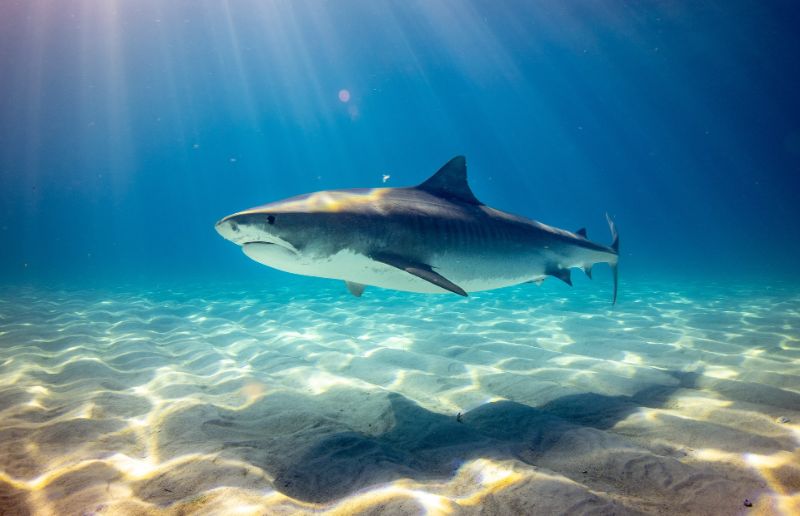
When considering which animal has the best sense of smell, the sharks are among those on the list. This predatory fish leans heavily on smell. In some shark species the olfactory bulbs are unusually large relative to total brain mass — the often-repeated “two-thirds of the brain” figure applies at best to a handful of species and is not true of sharks in general. Smithsonian Ocean reports that the great white shark has the largest olfactory bulb of any shark.
These sharks are formidable predators because they can detect blood and other prey odours at extraordinarily low concentrations. The popular claim that a shark smells a single drop of blood a mile away is a myth: odour does not travel that way underwater. What a shark actually does is detect a plume at concentrations around one part per billion and then swim upstream along it, using the tiny time difference between its two nostrils to steer.
In addition to using its keen sense of hearing to seek food, the shark uses its powerful sense of smell. This species’ nostrils are on the bottom of its snout, either side of its mouth.
They are aware of their surroundings by hearing and their excellent sense of smell, which is made possible by the shark’s amazing ability and body structure, allowing water to flow continually over its nostrils.
A useful way to picture the real sensitivity: roughly one part per billion is about a drop of blood dispersed through a large swimming pool — genuinely remarkable, and still nothing like a mile of open ocean. Distance depends entirely on the current carrying the plume.
See Related: Types of Sharks Around the World
3. Elephant
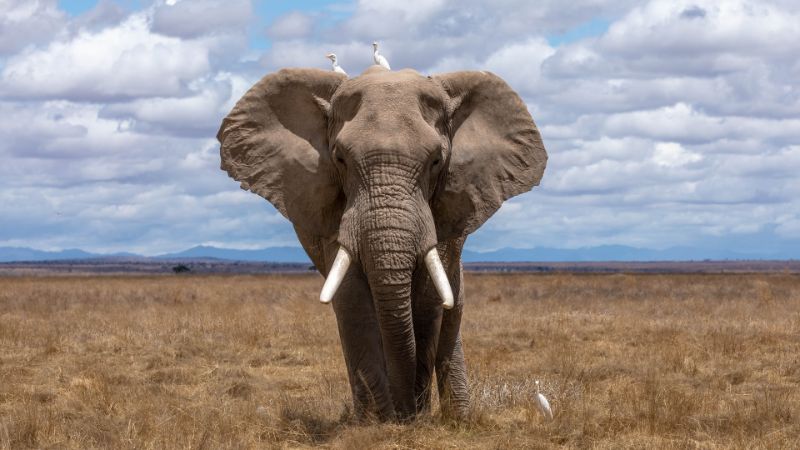
Elephants are on the list when it comes to animals with the best sense of smell. By gene count it is the record holder. The 2014 Genome Research analysis found 1,948 functional olfactory receptor genes in the African elephant — the largest OR repertoire characterised in any animal, more than twice a dog’s 811 and about five times a human’s 396.
Elephants are widely said to find water from up to 12 miles (about 19 km) away, and that figure is repeated everywhere — but it is worth being honest about its status. A 2021 study in Scientific Reports confirmed that African elephants can locate water by smell alone at short range, while noting that the evidence for kilometre-scale detection in the wild is still thin. The controlled finding is solid; the 12-mile headline is not. According to previous research, African elephants can discern between odor molecules with exceedingly minute structural changes that humans and other primates cannot detect.
Their nostril is located at the tip of the trunk and is responsible for breathing, smelling, and obtaining water from the environment. Elephants’ sense of smell is constantly used, making them among the best animals. Their trunk is always used to detect new smells and information.
See Related: International Elephant Foundation
4. Snake
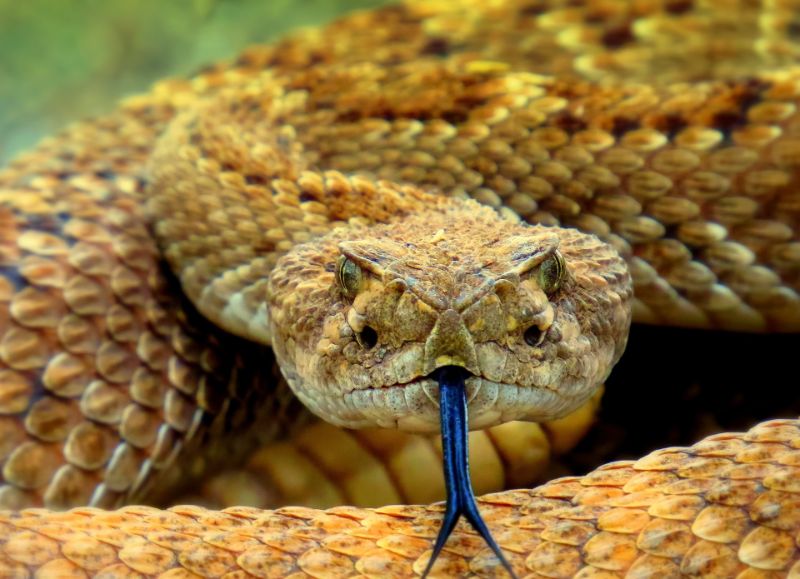
Are you wondering which animals have the strongest sense of smell? Snakes are definitely among these animals. Their remarkable ability to sense smell keenly makes them fascinating.
Snakes do have nostrils and can breathe through them, but most of their scent work is done by the tongue and a paired chemical sensor in the roof of the mouth called the vomeronasal, or Jacobson’s, organ. The forked tongue collects odour particles from the air and ground and delivers them to that organ — which is why a snake flicks its tongue constantly.
The fork matters. Because the two tips sample slightly different points in space, a snake reads a left-right difference in scent strength and can follow a trail directionally — the same stereo trick a shark uses with its two nostrils. That is how a snake tracks wounded prey it never saw move.
These animals use their tongues to detect all kinds of scents in the air, which allows them to identify a smell and locate prey or to know where danger is lurking. Like sharks, snakes use their keen sense of smell to be aware of their surroundings and survive.
See Related: Animals With the Best Hearing in the World
5. Dogs
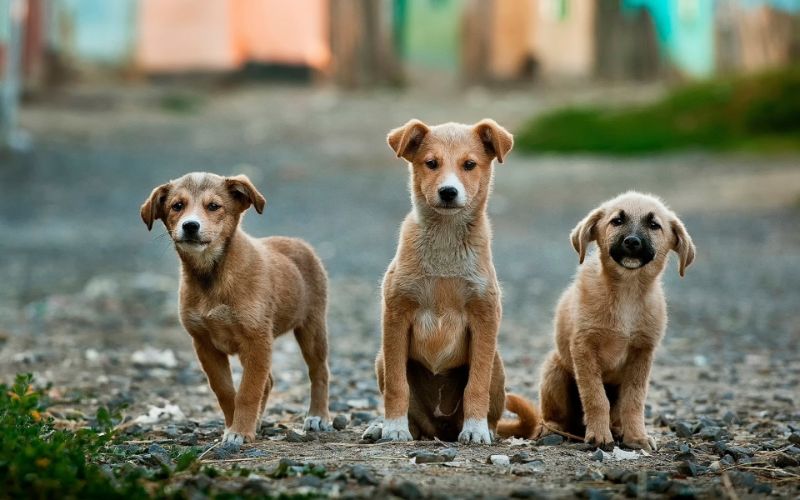
Dogs have powerful noses, making them among the animals with an amazing sense of smell. Generally speaking, dogs are considered good smellers, as police and military service dogs are trained to detect explosives.
Dogs carry about 811 functional olfactory receptor genes, roughly twice the human count, and around 300 million scent receptors in the nose against 5–6 million in ours. Depending on the breed and the odour, that works out to a sense of smell somewhere between 10,000 and 100,000 times more acute than a human’s. The bloodhound, the breed used as the tracking benchmark, is conventionally quoted at about 300 times a human on a scent trail — a different measurement from raw threshold, which is why the two numbers look inconsistent.
The share of a dog’s brain given over to processing odour is roughly 40 times greater than the equivalent share in a human brain — proportionally, not in absolute size. These animals are drawn to odors that are new, novel, and intriguing to them.
Dogs have an extremely delicate and powerful sense of smell because of their keen sense of smell, which dogs are trained to use to detect bombs and drugs. They can also track down individuals based on the smell of their clothing and discover bodies.
See Related: The Smartest Animals on Earth
6. Kiwi
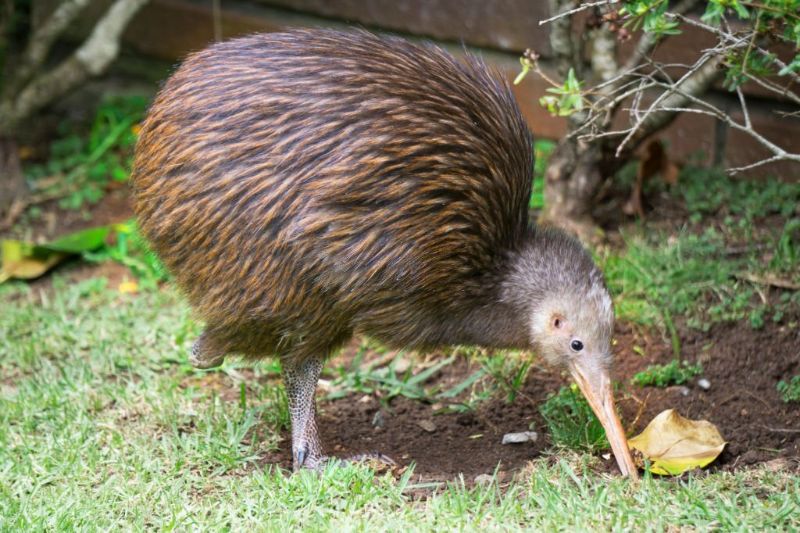
Small but with an incredible sense of smell. The kiwi’s olfactory bulb is the second largest of any bird relative to forebrain size, behind only the condor. It is why it is among the animals with the best sense of smell.
Because Kiwis cannot fly and their food is on the ground, they have developed an acute sense of smell.
Kiwi are almost alone among birds in having nostrils at the very tip of the bill rather than at its base. That single anatomical quirk lets the bird probe leaf litter and soil and sniff at the same time, and it is how a kiwi finds earthworms it cannot see or hear. Anatomical work on Apteryx mantelli published in Brain, Behavior and Evolution found the kiwi to be a clear outlier for olfactory investment among the bird species compared.
See Related: Amur Leopard
7. Cows
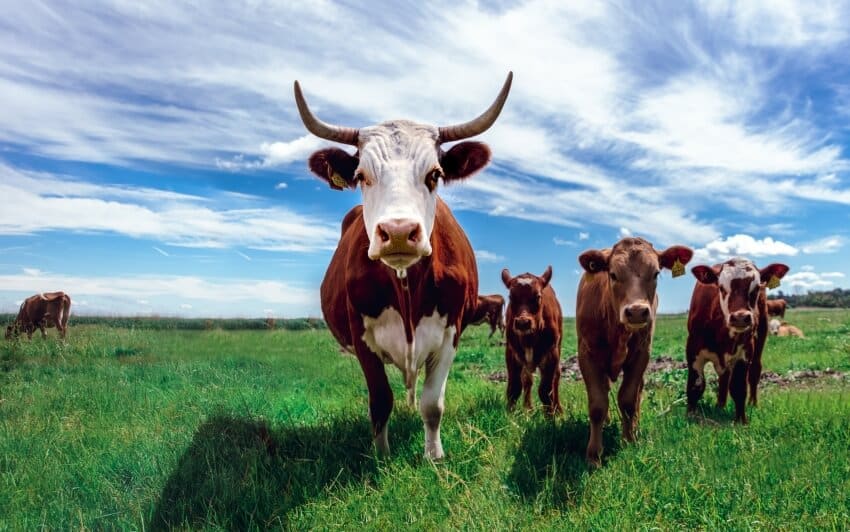
Animals with the best sense of smell include huge, tamed, cloven-hooved herbivores like cows. Cattle carry about 1,186 functional olfactory receptor genes — three times the human count and more than a dog’s.
Cattle are commonly said to pick up scent from five or six miles off. That figure comes from ranching and extension literature rather than controlled testing, so treat it as a working field estimate; what is well documented is that cattle use smell to detect predators, identify herd-mates and assess feed before tasting it.
Aside from possessing a keen sense of smell, cattle are also equipped with outstanding hearing capabilities. Even though the cows’ primary senses were sight and hearing, their excellent sense of smell also benefited them in understanding what was going on in their environment.
See Related: Types of Habitats Around the World
8. Moth
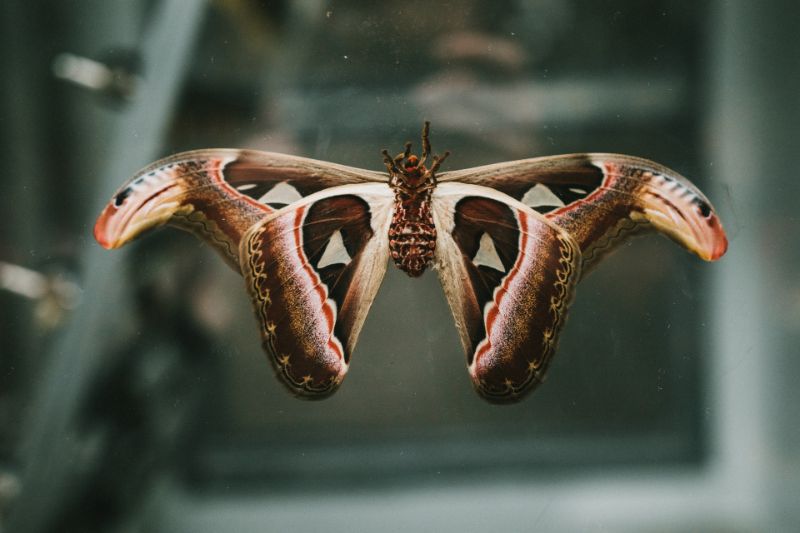
The male silkmoth (Bombyx mori) is the best-documented nose in the insect world, and it earns the place for a specific reason. Its target odour, bombykol, was the first sex pheromone ever chemically identified — Adolf Butenandt’s team isolated it in 1959, and needed roughly half a million female moths to extract enough of it to work with. A male responds to bombykol at vanishingly low concentrations, in the region of a few molecules arriving at the antenna.
Male moths do this with feathery antennae rather than a nose. The branched, comb-like structure carries many thousands of scent-sensing hairs called sensilla and acts as a molecular sieve, combing pheromone out of moving air far more efficiently than a smooth surface could.
Their antennae detect scent components as they fly rather than utilizing their nostrils to smell them as most would normally do. A single scent is detected by their highly developed sense of smell, which has evolved to detect only the scent of female moths.
See Related: The Fastest Animals in the World
9. Rat
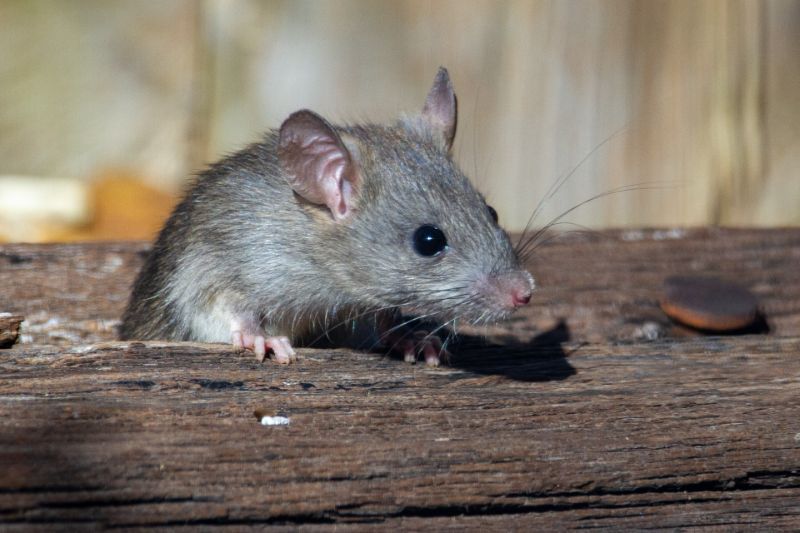
If you’re looking for answers about which is the best, rat or mice, in terms of sense of smell, Rats beat the mice. Rats are among the animals with the best sense of smell.
Rats are generalist feeders and use smell to test unfamiliar food before eating it, which is part of why they are so hard to poison — a rat samples a tiny amount, waits, and avoids anything that made it ill. Cats, by comparison, carry a smaller repertoire of roughly 700 olfactory receptor genes and are far choosier eaters, but they are not poor smellers.
Rats carry 1,207 functional olfactory receptor genes — three times the human count and the second-largest repertoire in the 2014 Genome Research comparison, behind only the African elephant. An earlier version of this article claimed rats have smell receptors in the skin on the back of the neck. That is not true and has been removed; olfactory receptors sit in the nasal epithelium and in the vomeronasal organ.
When rats smell, the fragrance particles travel to their vomeronasal organ, where they process them. Rats also use this organ to detect and distinguish between individuals of the same rat species by detecting pheromones.
See Related: The Strongest Animals in the World
10. Horses
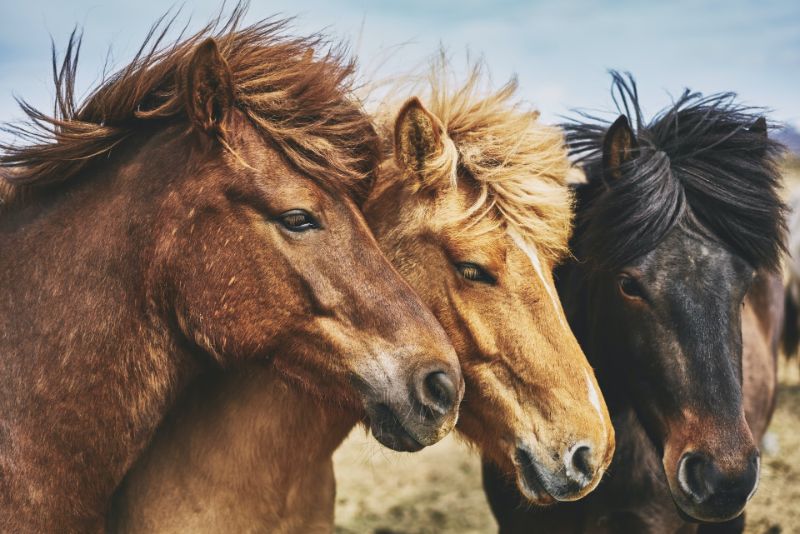
Horses carry about 1,066 functional olfactory receptor genes, more than a dog and well ahead of a human. Although their sense of smell is not as good as a dog’s when it comes to scent detection, they have a far better sense of smell than humans.
Through this skill, horses can distinguish between predators and other horses, and the anatomy of their nasal cavities has provided horses with a relatively big nasal cavity to use. Furthermore, due to the large size of the horse’s head, there are a disproportionately large number of receptors.
Horses also show the flehmen response: head raised, upper lip curled back, holding a scent against the opening of the vomeronasal organ to read it properly. It looks like a laugh and is actually a chemical analysis. When they inhale a scent they are intrigued by, their flexible nostrils flare. It is similar to how dogs learn about one another by sniffing one another’s backsides, although horses are less straightforward when meeting for the first time.
See Related: Types of Horses Around the World
11. Opossums
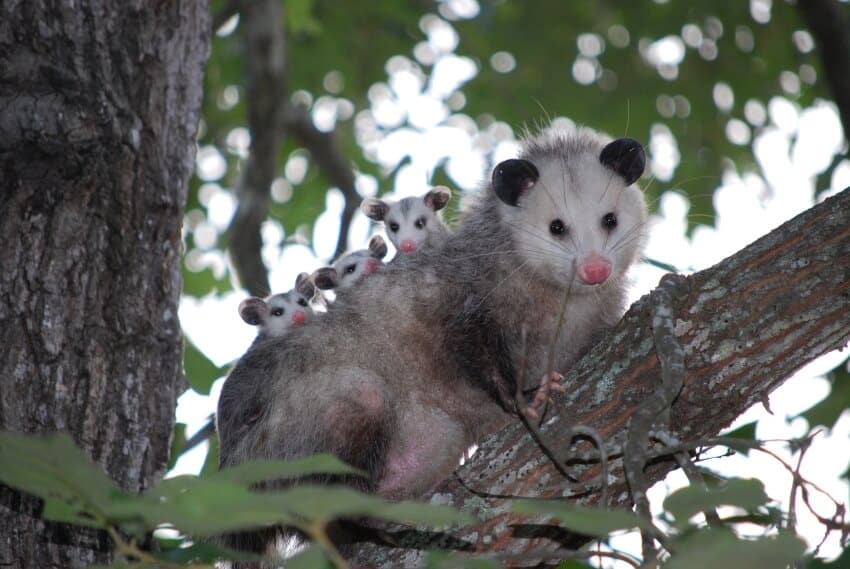
Opossums are marsupials, which means they are mammals with a keen sense of smell. Their development is similar to that of kangaroos and koalas, with part of it taking place in the mother’s womb and the rest in her pouch.
Because of its limited vision and hearing, its sense of smell and its excellent touch take precedence over these senses.
Opossums have been reported to carry roughly 1,200 functional olfactory receptor genes — about three times the human count of 396, and comparable to a rat or a cow. That repertoire, rather than eyesight or hearing, is what a foraging opossum actually navigates by.
Some notorious foragers are frequently observed sniffing in gardens and grounds in search of a food source.
A high sense of smell helps opossums adapt to their surroundings, allowing them to survive in urban environments.
Aside from its incredibly keen olfactory capabilities, this animal is also recognized for having an exceptionally powerful immune system, which allows it to defend itself against illnesses and toxicity from the venom of the snakes it preys on.
See Related: What Is a Species?
12. Chinese softshell turtle
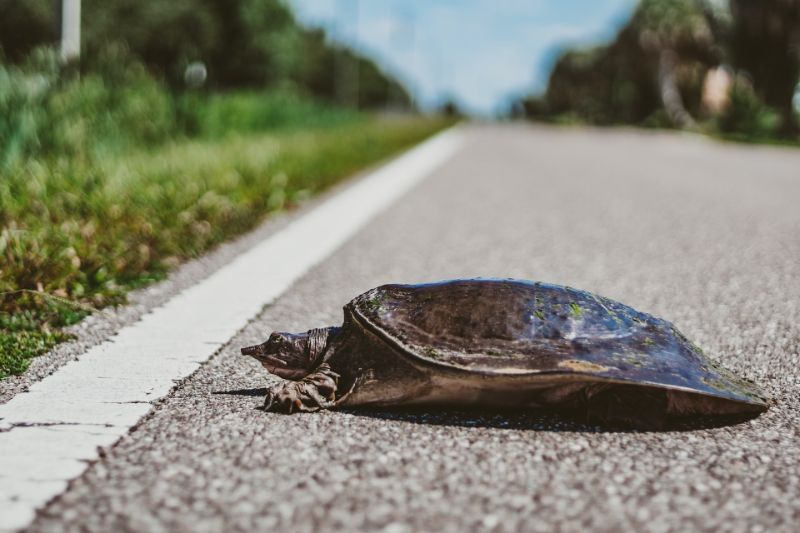
The Chinese softshell turtle (Pelodiscus sinensis), also called the Asiatic soft-shelled turtle, is native to eastern China, Taiwan, Korea, Japan and parts of Vietnam, and has been introduced well beyond that range through the food trade. It is listed as Vulnerable on the IUCN Red List, driven overwhelmingly by harvesting for human consumption.
Its place on this list comes from an unusually large olfactory receptor repertoire for a reptile — roughly 1,100 genes have been reported for the species, in the same range as a cow. Softshell turtles also excrete urea through the mouth and rinse it away in water, an adaptation tied to the same well-developed oral and nasal chemistry.
The Chinese softshell turtle is established outside its native range in the United States, including Hawaii, where it is treated as introduced. On size, an earlier version of this article said the species reaches a maximum of 13 feet. That is a unit error for 13 inches: females top out at about 33 cm (13 in) of carapace length and males at roughly 27 cm (11 in). It is a dinner-plate-sized animal, not a bus-sized one.
These olive-colored turtles may have dark markings on their bodies and a long-looking snout. This animal uses its exceptional sense of smell to capture prey and determine whether there is a predator or incoming harm in its surroundings.
So Which Animal Really Has the Best Sense of Smell?
If the question means which animal can distinguish the widest range of odours, the answer is the African elephant, on 1,948 functional olfactory receptor genes. Nothing measured so far comes close.
If it means which animal can act on the faintest trace of a scent, the answer among mammals is the bear, at roughly 2,100 times human sensitivity. Among all animals, the strongest documented case is the male silkmoth, which responds to a specific pheromone at a few molecules per antenna — but only to that one molecule, which is a very different kind of ability.
The honest summary is that “best sense of smell” is not one contest. Breadth, sensitivity and specialisation are three separate axes, and the winner changes depending on which one you pick. Any list that names a single champion without saying which axis it used is skipping the interesting part.
FAQs
What animals have the best sense of smell?
There are two defensible answers. By olfactory receptor gene count, the African elephant leads every animal measured, with about 1,948 functional OR genes against 396 in a human and 811 in a dog. By behavioural sensitivity – how faint a scent an animal can act on – the bear leads, estimated at roughly seven times a bloodhound and about 2,100 times a human.
Dogs sit between the two, with a sense of smell usually put at 10,000 to 100,000 times more acute than a human’s depending on breed and odour. Rats, cattle, horses and opossums all carry roughly three times the human gene count.
Do dogs have a sense of smell?
Yes, and by a wide margin. Dogs carry about 811 functional olfactory receptor genes and roughly 300 million scent receptors in the nose, against 5 to 6 million in a human. Across breeds and odours that translates to a sense of smell about 10,000 to 100,000 times more acute than ours. The bloodhound, the breed used as the tracking benchmark, is conventionally quoted at around 300 times a human on a scent trail, which is a different measurement from a raw detection threshold.
Additionally, dogs’ sense of smell is used in various ways, such as search and rescue operations, medical detection, and tracking.
Can animals smell better than humans?
Most mammals tested do outperform humans, but not all animals do, and the gap is narrower than the folklore suggests. Humans carry 396 functional olfactory receptor genes, fewer than a rabbit’s 768 or a dog’s 811, and our olfactory bulb is small relative to brain size. On certain specific odour molecules, though, controlled tests have found humans matching or beating dogs. Worse on average is not the same as worse at everything.
Do elephants have a better sense of smell than dogs?
On gene count, yes. The African elephant has about 1,948 functional olfactory receptor genes, more than twice a dog’s 811 and the largest repertoire found in any animal so far, according to the 2014 Genome Research comparison by Niimura, Matsui and Touhara. On detection distance the picture is less settled: elephants are widely said to smell water from 12 miles away, but controlled work has only confirmed short-range olfactory water detection, so treat the 12-mile figure as a field claim rather than a measured result.
Related Resources
- Animals that Start With V
- Ways to Save Animals Facing Extinction
- War and the Effect on Wildlife
- Fastest Animals in the World
Keep exploring the animal kingdom: discover why lions are called the king of the jungle and which animal has two feet but can’t walk.
Keen senses are just one animal superpower — see which are the smartest animals on Earth.