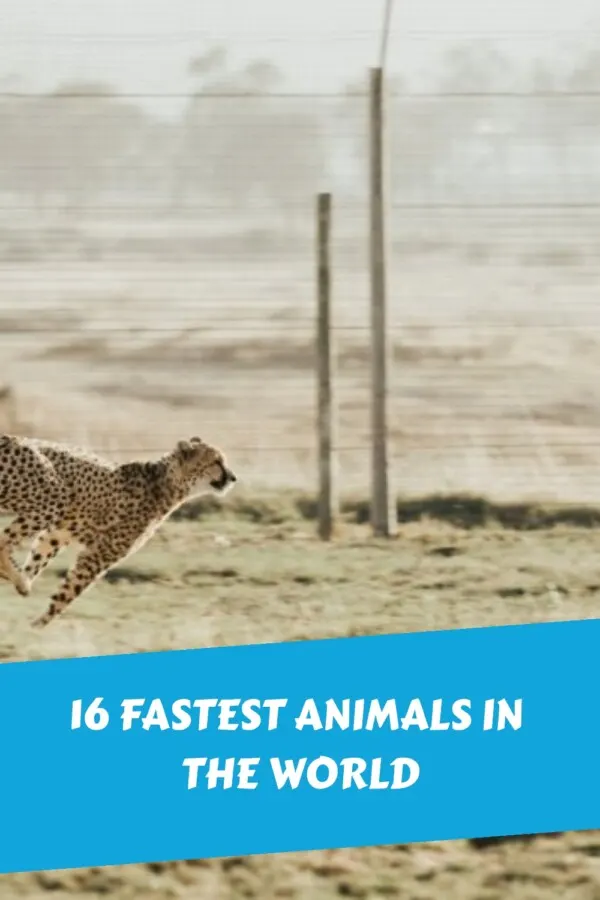
The fastest animal in the world is the peregrine falcon, which reaches more than 320 km/h (200 mph) in a hunting dive and holds a Guinness World Records mark of 389 km/h (242 mph). The fastest land animal is the cheetah, measured at 93 km/h (58 mph) in the wild. For comparison, Usain Bolt’s peak speed over 100 m is about 44.7 km/h (27.8 mph) — slower than every land animal on this list.
Animal speed records are messier than most lists admit. A falcon’s dive is powered by gravity, the albatross record was set riding an Antarctic storm, and the famous “fastest fish” figures come from mid-20th-century fishing estimates that modern biomechanics has since overturned. Every number below is attributed, and where a figure is disputed or has been debunked, this list says so rather than repeating it.
Fastest Animals in the World
The list below is numbered in the order the animals are profiled. This table ranks the same animals by their best-supported top speed, so you can see at a glance which figures hold up and which ones are estimates.
| Rank by speed | Animal | Best-supported top speed | How the speed is achieved |
|---|---|---|---|
| 1 | Peregrine falcon | 389 km/h (242 mph) record dive; 320 km/h (200 mph) typical stoop | Gravity-assisted hunting dive |
| 2 | White-throated needletail | Commonly cited at 169 km/h (105 mph) — not independently verified | Powered level flight |
| 3 | Mexican (Brazilian) free-tailed bat | 160 km/h (100 mph) ground speed | Powered level flight, aircraft-tracked |
| 4 | Male horsefly | Estimated up to 145 km/h (90 mph) — disputed | Mating pursuit |
| 5 | Grey-headed albatross | 127 km/h (79 mph) sustained over 8 hours | Storm-assisted dynamic soaring |
| 6 | Pronghorn | 97 km/h (60 mph) burst; 72 km/h (45 mph) over 2–3 km | Running |
| 7 | Cheetah | 93 km/h (58 mph) measured in the wild; 98 km/h (61 mph) captive record | Running |
| 8 | Springbok | 88 km/h (55 mph) | Running |
| 9 | American quarter horse | 88 km/h (55 mph) over a quarter mile | Galloping |
| 10 | Blue wildebeest | Around 80 km/h (50 mph) | Running |
| 11 | Sperm whale | Bursts around 35 km/h (22 mph) | Swimming |
| 12 | Black marlin | Physically capped at 36–54 km/h (22–34 mph) | Swimming |
| 13 | Marlin (striped and blue) | Same physical cap as the black marlin | Swimming |
| 14 | Sailfish | About 30 km/h (19 mph) measured | Swimming |
| 15 | Big brown bat | No reliable maximum published | Powered level flight |
| 16 | Frigatebird | About 16 km/h (10 mph) cruising | Soaring — an endurance record holder, not a speed one |
Two entries earn their place for the wrong reason, and both are corrected below: the sailfish and the black marlin are still described almost everywhere as the fastest fish in the sea at speeds no fish can physically reach, and the frigatebird is a soaring specialist that appears on speed lists it has no business being on.
1. Peregrine Falcon
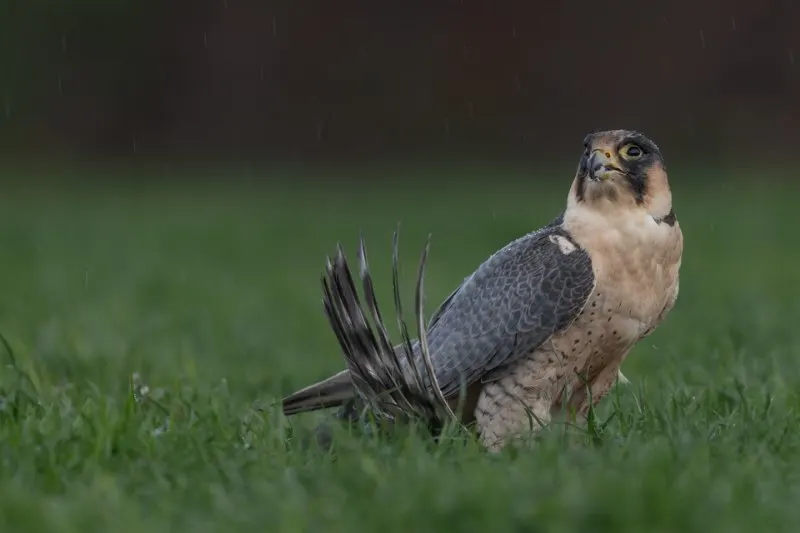
The peregrine falcon is the fastest animal on Earth, and the record is not close. In a hunting stoop it folds its wings and drops, routinely exceeding 320 km/h (200 mph). The Guinness World Records mark of 389.46 km/h (242 mph) was set in 1999 by a trained falcon named Frightful, released from a light aircraft at 17,000 ft by falconer Ken Franklin. That is roughly a third of the speed of sound, not the speed of sound itself — sound travels at about 1,235 km/h (767 mph) at sea level.
It is worth separating the two numbers that get muddled on almost every speed list. The 320–389 km/h figure is the dive. In ordinary powered level flight a peregrine is far more modest, cruising at roughly 65–90 km/h (40–55 mph) — quick for a bird, but slower than a golden eagle in its own stoop and nowhere near the dive figure. The dive is not muscle power; it is a controlled fall, with the falcon using body shape to manage drag while hunting.
See Related: These 13 Animals Have the Best Hearing in the World
2. World’s Fastest Land Animal: Cheetah
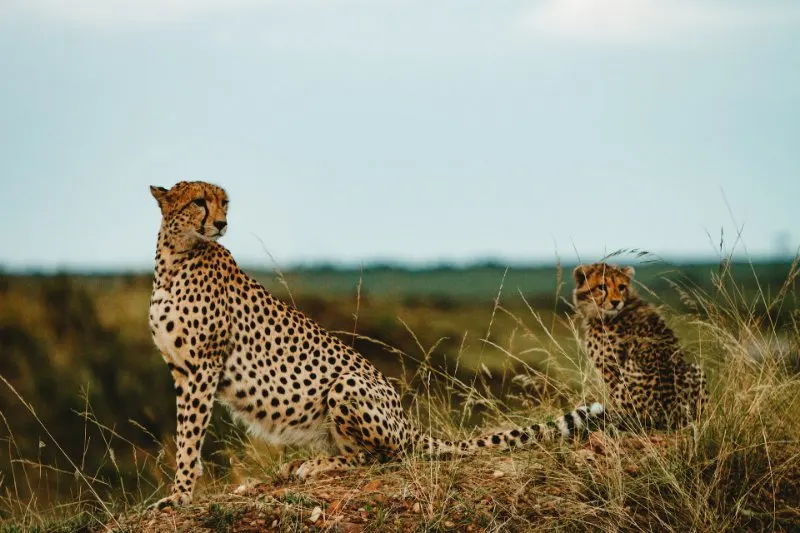
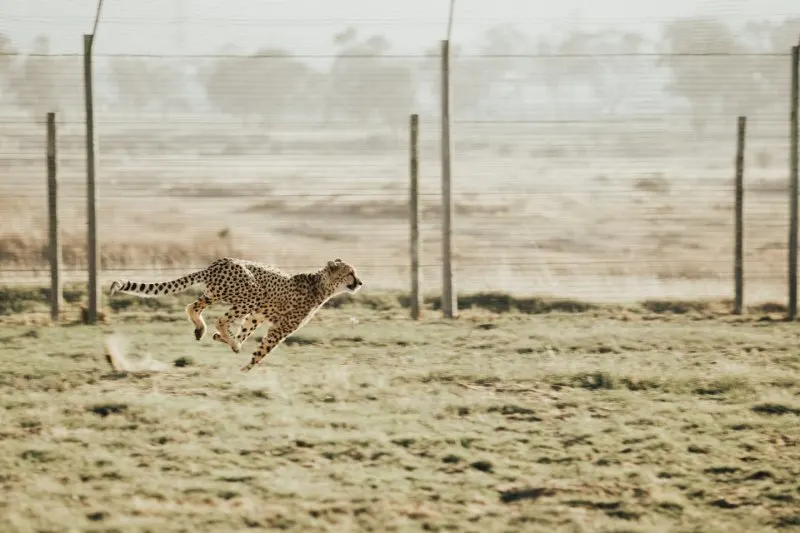
The cheetah is the fastest animal on land, but the widely repeated “70 mph” is not a measurement. When Alan Wilson’s team at the Royal Veterinary College fitted wild cheetahs in Botswana with GPS and motion-sensing collars and recorded 367 hunting runs, the fastest run they logged was 25.9 m/s — 93 km/h, or 58 mph (Nature, 2013). Most runs were well under 72 km/h (45 mph), and the average was closer to 50 km/h (31 mph). The fastest cheetah ever timed was a captive female, Sarah, at Cincinnati Zoo, who covered 100 m in 5.95 seconds in 2012 — a peak of about 98 km/h (61 mph).
The Wilson study also overturned the popular explanation of how cheetahs hunt. Outright speed was a poor predictor of success; grip, deceleration and turning force decided the outcome. Cheetahs slow sharply in the final strides to match a swerving gazelle or deer, and their semi-retractable claws work like sprint spikes. They are also daylight hunters with excellent vision — a horizontal band of receptors across the retina gives them a wide, sharp strip of the horizon — rather than the poor-sighted, smell-led ambush predators they are sometimes described as. Cheetahs stalk to within roughly 60–70 m, then sprint; they do not ambush from cover the way lions do.
See Related: How Do Animals Adapt To Their Environment?
3. Pronghorn Antelope
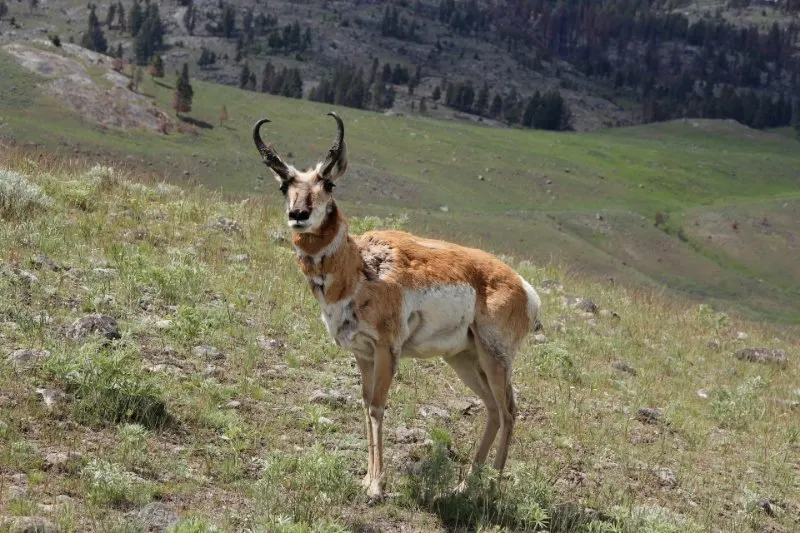
The pronghorn is the fastest land animal in North America and, more importantly, the fastest long-distance runner on Earth. Its burst speed of about 97 km/h (60 mph) is recorded on flat, dry lake beds; on ordinary ground 80 km/h (50 mph) is nearer the mark. What no other fast land animal can match is the endurance: a pronghorn can hold roughly 72 km/h (45 mph) over a 2–3 km course, while a cheetah’s sprint is spent in 30–45 seconds.
That stamina is an evolutionary leftover. Nothing alive in North America can pressure a pronghorn at speed — not wolves, not cougars — and biologists generally read it as an adaptation to the American cheetah Miracinonyx, which went extinct roughly 12,000 years ago. The pronghorn has not slowed down; its predator disappeared. Despite the name, it is not a true antelope either: it is the only surviving member of the family Antilocapridae, and it sheds the outer sheath of its horns every year.
See Related: Wolves Size Comparison: How Big Do Wolves Actually Get?
4. Springbok
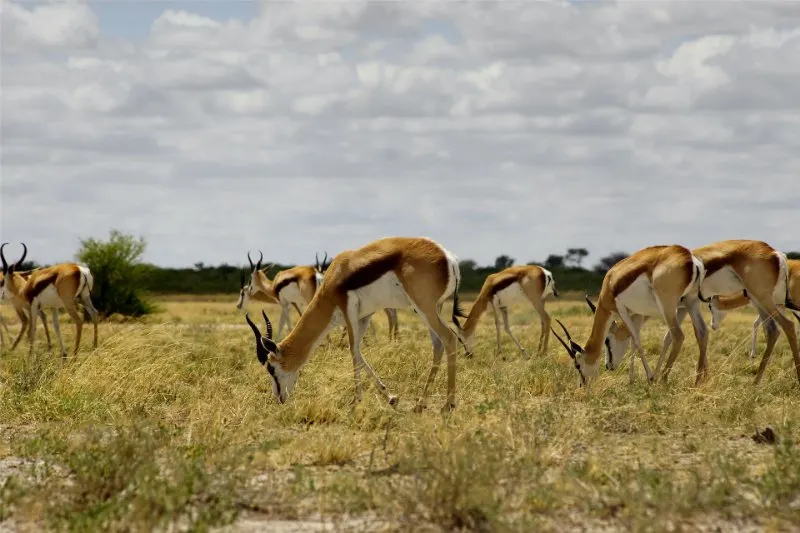
The springbok is a small southern African antelope with a top speed of about 88 km/h (55 mph), which puts it among the fastest mammals on land — behind only the cheetah and the pronghorn. Like both of those, it runs on anaerobic energy, so the top speed is a sprint measured in tens of seconds rather than a pace it can hold.
Springbok are also extraordinary jumpers. The behaviour they are named for — pronking, a stiff-legged bounce with the back arched and all four feet leaving the ground — carries them up to about 2 m (6.6 ft) into the air. Biologists disagree about what it is for; the leading explanations are that it signals fitness to a pursuing predator, or that it warns the rest of the herd. It is performed in the open, in full view of lions, leopards and cheetahs, which is exactly why the fitness-signal explanation is taken seriously.
Springbok are not solitary. They are herd animals, historically famous for trekbokken — mass migrations across the Karoo so large that 19th-century accounts describe herds taking days to pass. Living in a herd is itself an anti-predator strategy: many eyes, and a confusing scatter of identical bounding targets when lions or cheetahs commit to a chase.
See Related: Hirola Antelope: Why Is It Endangered?
5. Sailfish
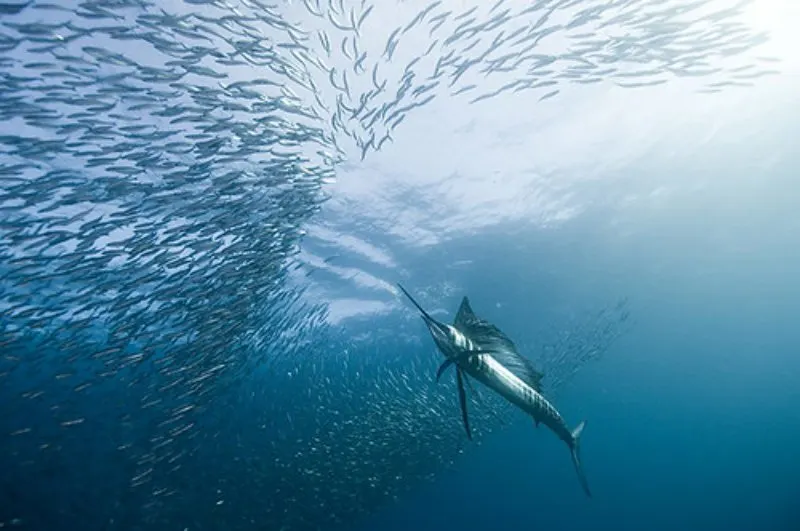
The sailfish is the animal most often called the fastest fish in the sea, usually at 110 km/h (68 mph). That figure does not survive measurement. In 2016 Morten Svendsen and colleagues estimated maximum swimming speeds from muscle contraction time and stride length (Biology Open) and put the sailfish at 8.3 m/s — about 30 km/h, or 19 mph. They also showed why the old numbers are impossible: above roughly 10–15 m/s (36–54 km/h), water cavitates around the fins, and the collapsing bubbles would damage the fin tissue. The limit is set by the physics of water, not by the fish’s muscle.
Where did 68 mph come from? From a sport-fishing trial at the Long Key Fishing Camp in Florida, run at some point between 1910 and 1925, in which a hooked sailfish stripped 300 ft (91 m) of line off a reel in three seconds — equated to 67.7 mph (109 km/h). Guinness World Records still lists it, and notes that no definitive evidence from the trial survives. It measured a panicked fish pulling against a boat, not a fish swimming, and it has been repeated ever since. Sailfish are genuinely spectacular — they raise the huge sail-like dorsal fin to herd baitfish and slash through the shoal with the bill — but the speed record was never theirs.
Their dorsal fins also give them an edge over other marine animals; when traveling at high speeds these fins act like wings do for birds when flying low over land – they keep them stable while moving quickly through water (think about how difficult it is trying not only move forward but stay level if you’re running full speed).
This allows sailfish a unique advantage since they can use one fin more efficiently than most other fish while still maintaining stability even though they don’t have swim bladders like other species do.
See Related: The Different Types of Habitats Around the World
6. Grey-Headed Albatross
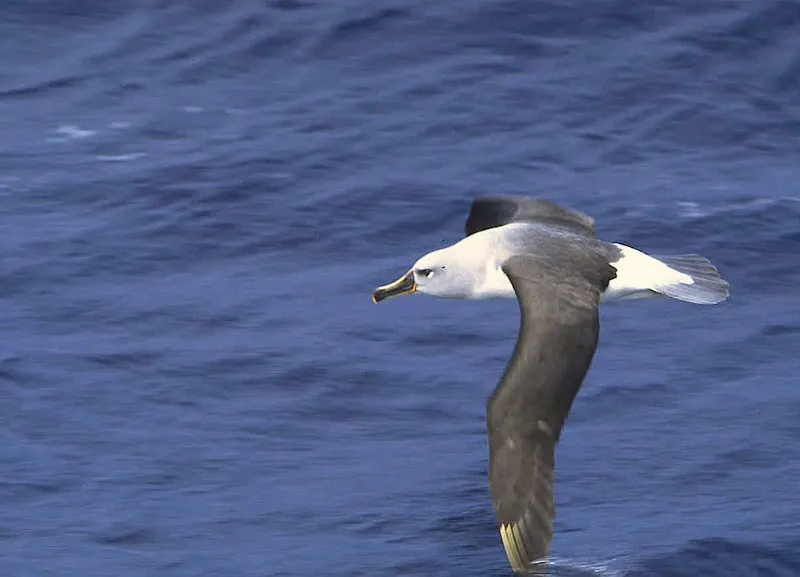
The grey-headed albatross, a 2.2 m (7.2 ft) wingspan seabird of the Southern Ocean, holds what Guinness World Records treats as the fastest sustained horizontal flight of any bird: a mean ground speed of 127 km/h (79 mph) held for more than eight hours. The record was documented by Paulo Catry, Richard Phillips and John Croxall of the British Antarctic Survey (The Auk, 2004), tracking a bird returning to its nest on Bird Island, South Georgia, through an Antarctic storm. Much of that speed came from the tailwind. No bird flies at supersonic speed — that is 1,235 km/h (767 mph), roughly ten times the albatross record and three times the peregrine’s dive.
The technique behind it is dynamic soaring: the albatross repeatedly climbs into the faster-moving air above the waves, turns downwind, and dives back into the slower air in the wave troughs, harvesting energy from the wind gradient on every cycle. It can cover hundreds of kilometres a day this way while barely flapping, which is how it conserves energy over an ocean with nowhere to land. It feeds mainly on squid, taken at the surface at night, along with fish and krill — and, like other seabirds, it is badly affected by longline fisheries, which is why the species is listed as Endangered by the IUCN.
See Related: Mariana Trench Animals
7. Sperm Whale
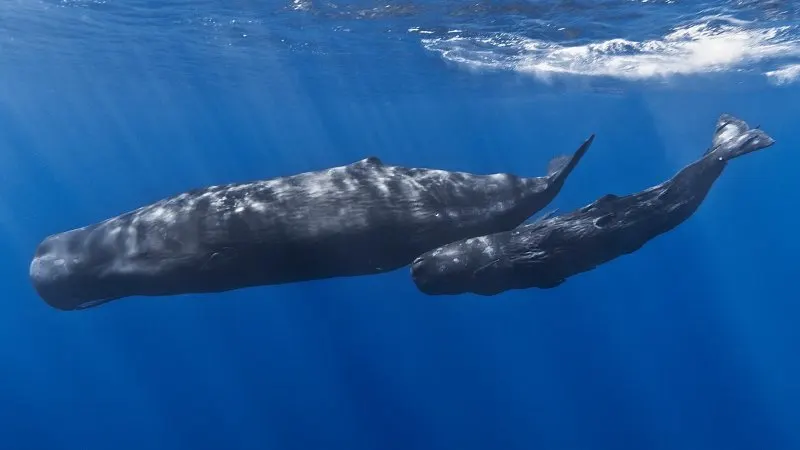
The sperm whale is not the fastest whale, and it is worth correcting that outright. Its ordinary cruising speed is about 7–11 km/h (4–7 mph), with bursts in the region of 35 km/h (22 mph). The fastest of the great whales is the fin whale, nicknamed the greyhound of the sea, at up to about 40 km/h (25 mph), and the fastest cetacean of any kind is the short-beaked common dolphin at roughly 60 km/h (37 mph), with orcas close behind at about 56 km/h (35 mph). The sperm whale is, however, the largest toothed predator alive — the fin whale, not the sperm whale, is the second-largest animal after the blue whale.
What the sperm whale trades speed for is depth. It routinely dives beyond 1,000 m (3,280 ft) and has been recorded below 2,000 m, holding its breath for up to about 90 minutes while hunting deep-water squid in complete darkness using the most powerful biological sonar known. Adults have essentially no predators; orcas will target calves, which is why sperm whale groups form a defensive rosette around the young. Krill is not on the menu — that is a baleen-whale food, and sperm whales are squid and fish specialists.
See Related: Fun, Interesting Facts About Whales
8. Blue Wildebeest
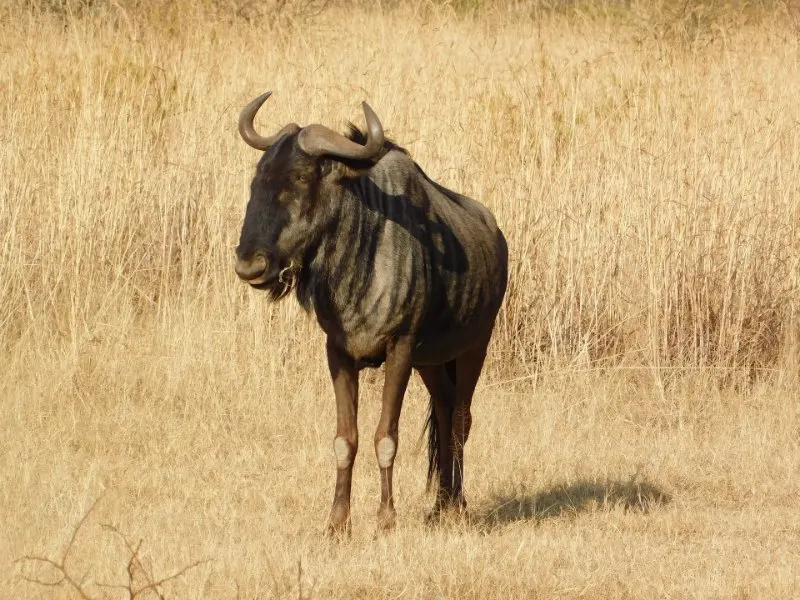
The Blue Wildebeest is a large antelope that can be found in the savanna and grasslands of east and south Africa. This species has been classified as “near threatened” by the IUCN due to habitat loss due to human activity.
Like many other animals on this list, blue wildebeest are built to run, reaching around 80 km/h (50 mph). Speed alone is not what keeps them alive, though: roughly 1.3 million wildebeest take part in the Serengeti–Mara migration, a roughly 800 km annual circuit, and the sheer size of the herd is the defence. Predators can only take so many, and the synchronised calving season floods the plains with calves in a few weeks — a wildebeest calf is on its feet within minutes of birth and running with the herd the same day.
9. Marlin
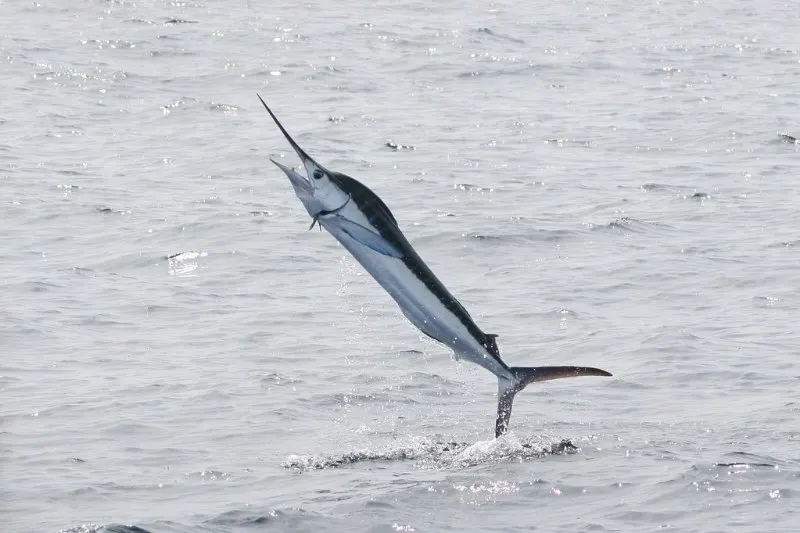
Marlins — striped, blue and white — are large, highly migratory billfish found across tropical and subtropical oceans, and they are genuinely among the fastest swimmers in the sea. As with the sailfish, though, the headline numbers you will see quoted for them (80–110 km/h) come from hooked-fish line-strip estimates rather than measurement, and the same cavitation ceiling of roughly 36–54 km/h (22–34 mph) applies to every large predatory fish. Fast for a fish is not fast the way a falcon is fast — water is about 800 times denser than air, and that difference sets the whole scale.
Marlins are widely sought after by sport fishermen who use hook-and-line methods to capture them during their annual migrations in temperate waters worldwide (North America, South America, Africa).
Several species have been overfished or are threatened with extinction due to heavy demand for sport fishing or as bait for commercial fishermen.
See Related: Are Fish Endangered? What You Need to Know
10. Frigatebird: The Bird That Does Not Belong on a Speed List
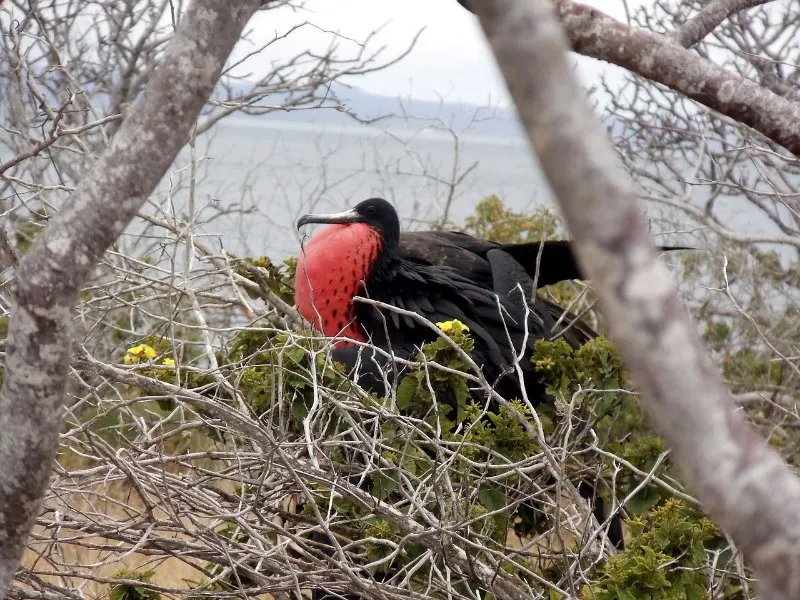
Frigatebirds appear on almost every “fastest animals” list, and they should not. Tracking studies of great frigatebirds put their ordinary foraging flight at roughly 16 km/h (10 mph) — slower than a person on a bicycle. They are on this list because what they actually hold is a far stranger record, and it gets mislabelled as speed.
Frigatebirds have the lowest wing loading of any bird — the least body mass per unit of wing area — which makes them extraordinarily efficient soarers and hopeless flappers. Henri Weimerskirch’s team tracked great frigatebirds across the Indian Ocean and found they stay airborne for up to two months without landing (Science, 2016), riding thermals under cumulus clouds in a roller-coaster pattern and climbing to 4,000 m, where they sleep on the wing in short bursts. They cannot land on water — their feathers are not waterproof — so for a juvenile frigatebird, staying up is not a feat, it is the only option.
This is a useful correction to keep in mind for the rest of the list. “Fastest” is not one record but several — fastest dive, fastest powered level flight, fastest sprint, fastest sustained pace, fastest relative to body size, and longest time spent moving without stopping. Animals that are famous for one are constantly credited with the others. For a genuinely fast bird in level flight, see the golden eagle and other large raptors, or the owls, which trade speed for near-silent flight.
See Related: 15 Animals that Start with X
11. Black Marlin
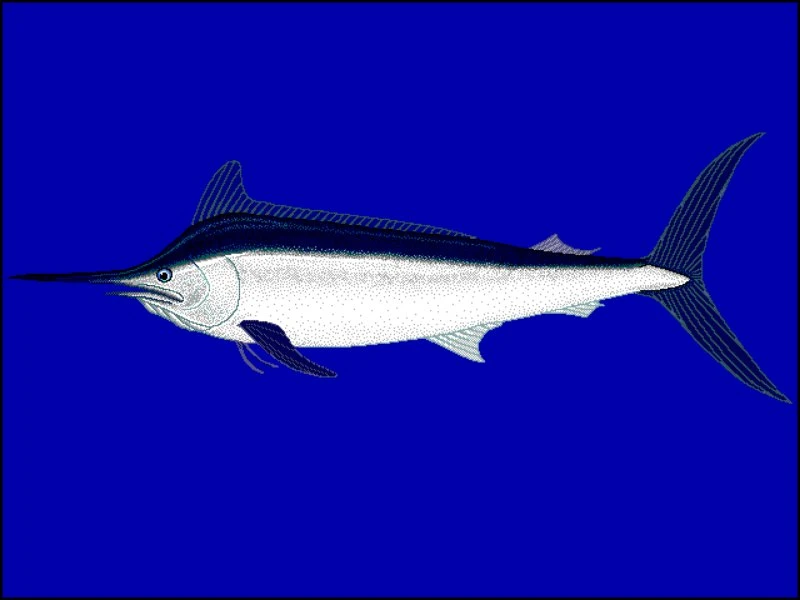
The black marlin is the fish most often named the fastest in the sea, on the strength of an old estimate of 129 km/h (80 mph). Like the sailfish figure, it comes from line stripped off a reel rather than from a swimming fish, and the same cavitation ceiling of about 36–54 km/h (22–34 mph) applies. What is not in dispute is the size: black marlin are Indo-Pacific billfish reaching over 4.5 m (15 ft) and 750 kg (1,650 lb), among the largest bony fishes in the ocean. Note that they are an Indo-Pacific species — the Atlantic has blue and white marlin instead.
The name “black marlin” refers specifically to one species within this family of fish, but can also refer more generally to any member of these fish groups which have black bodies and white bellies.
Black marlins live primarily off tropical reefs at depths ranging from 15–200 m (50-656 ft), although they may occasionally be found at greater depths during migrations or when feeding on squid or other deep-water prey items such as tuna or wahoo.
However, their preferred habitat is along nearshore shallow waters where they hunt for small tuna schools that feed on baitfish aggregated over coral reef tops by small predators such as barracuda.
See Related: Fun and Interesting Devilfish Facts
12. Big Brown Bat
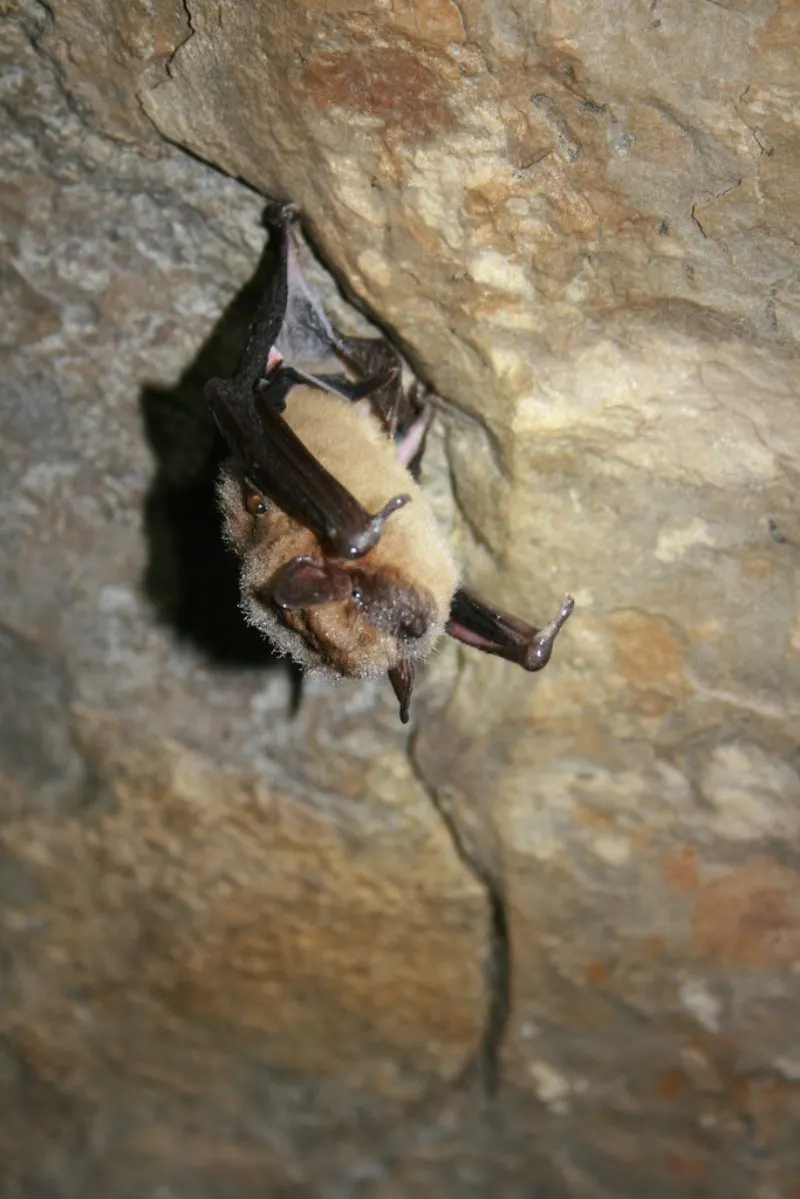
The big brown bat is one of the most widespread bats in North America and a strong, steady flier, though no reliable maximum speed has been published for it — a useful reminder that “fast” and “measured” are different things. It is neither the largest bat in North America (the western mastiff bat is bigger) nor the only one that hibernates: the little brown bat, tricolored bat and Indiana bat all hibernate through winter, and it is precisely in those hibernacula that white-nose syndrome has killed millions of bats since 2006.
Big brown bats are long-lived for their size, but not that long-lived: the documented maximum is about 19 years, while the average individual lives only two or three. That is still remarkable — a mouse of similar body mass lives two or three years at most, and the gap between bat and rodent lifespan is one of the standing puzzles in ageing research. They prefer to roost in buildings and trees rather than caves, which is why this is the bat most people in North America actually encounter, and a single one can eat its own body weight in insects on a summer night.
13. Mexican Free-Tailed Bat
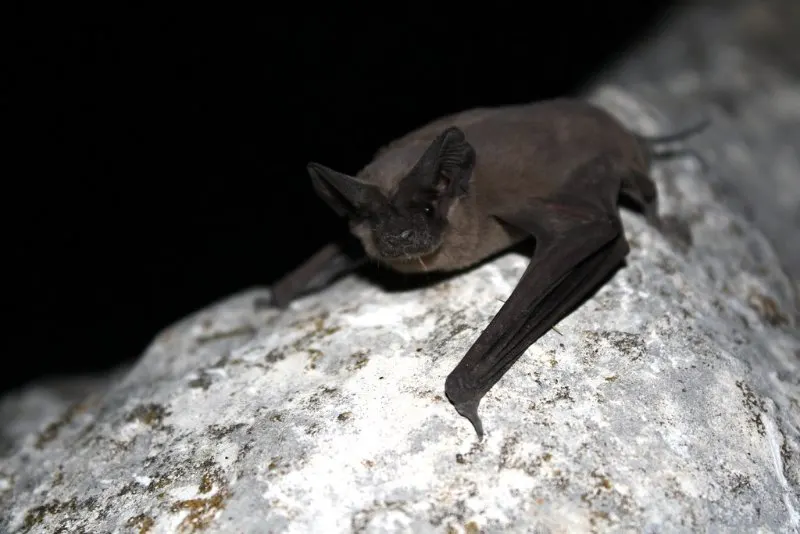
The Mexican free-tailed bat — the same species as the Brazilian free-tailed bat, Tadarida brasiliensis — is the fastest animal in powered level flight ever measured. In 2016 Gary McCracken’s team at the University of Tennessee, working with the Max Planck Institute for Ornithology, glued half-gram radio transmitters to seven bats leaving Frio Cave in Texas and tracked them from a light aircraft. All seven hit close to 100 km/h; one reached about 160 km/h (100 mph) (Royal Society Open Science, 2016). That is faster than any bird has been recorded flying under its own power — the peregrine’s greater speed comes from diving, and the albatross’s from a storm.
The bat that did it weighs about 12 g — roughly two US quarters — on a wingspan of some 30 cm (12 in). Long, narrow, swept-back wings are the reason: the same high-aspect-ratio shape that makes a fighter jet fast makes this bat fast, at the cost of manoeuvrability. Colonies in Texas and northern Mexico can number in the millions, and they climb to 3,000 m to intercept migrating moths, which is also why they are found near lakes and rivers where insects concentrate.
14. White-Throated Needletail Swift
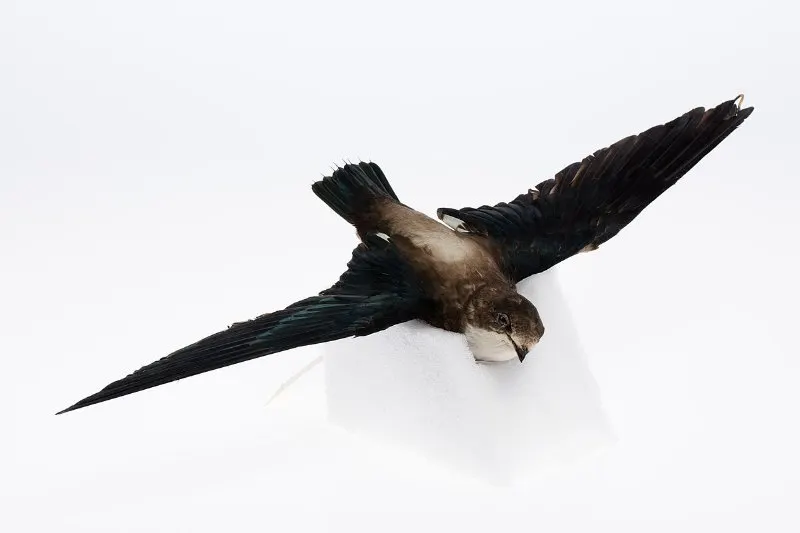
The white-throated needletail is routinely called the fastest bird in level flight, at 169 km/h (105 mph). It is worth being honest about that number: it is repeated everywhere and has never been independently verified with modern tracking, which is why Guinness World Records gives its level-flight title to the grey-headed albatross instead. Needletails are unquestionably fast — heavy-bodied, scythe-winged swifts built for it — but 105 mph should be read as a long-standing claim rather than a measurement.
Needletails breed in central and eastern Asia and migrate to Australia, and like other swifts they do almost everything on the wing: feeding, drinking, mating and sleeping. Common swifts, a close relative, have been tracked staying airborne for ten months at a stretch. If you want the fastest bird overall the answer is still the peregrine, and for level flight the honest answer is that the record depends on whether you count a tailwind. See also our guide to the different types of birds and their flight styles.
See Related: Is a Bird a Consumer? Here’s What to Know
15. Fastest Insect: Male Horsefly
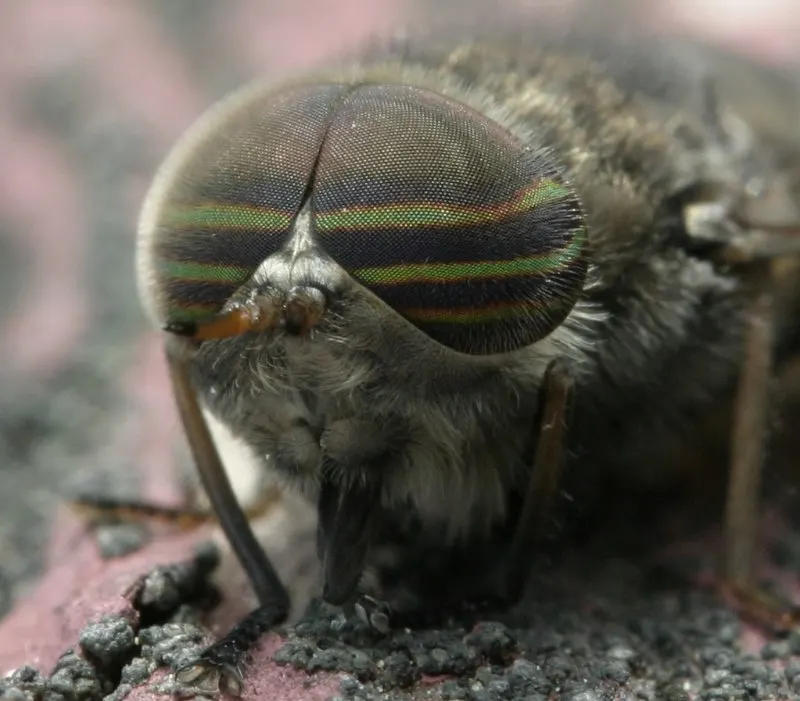
The fastest insect title usually goes to a male horsefly of the genus Hybomitra. University of Florida entomologist Jerry Butler got a male Hybomitra hinei wrighti to chase a plastic pellet fired from an air rifle and calculated it was travelling at least 145 km/h (90 mph). Other entomologists are sceptical — the fly may have been drafting behind the pellet, and it is a single observation — so treat it as the best available estimate rather than a record. Male horseflies fly this hard for one reason: intercepting a female in mid-air before a rival does.
By a different measure the title belongs elsewhere entirely. The Australian tiger beetle Rivacindela eburneola runs at 1.86 m/s — only 6.7 km/h (4.2 mph) — but that is 171 body lengths per second, and it runs so fast relative to its eyes that it is effectively blinded mid-sprint and has to stop to relocate its prey. For context on the wider group, see our guides to types of beetles and the question of whether insects are animals at all.
16. American Quarter Horse
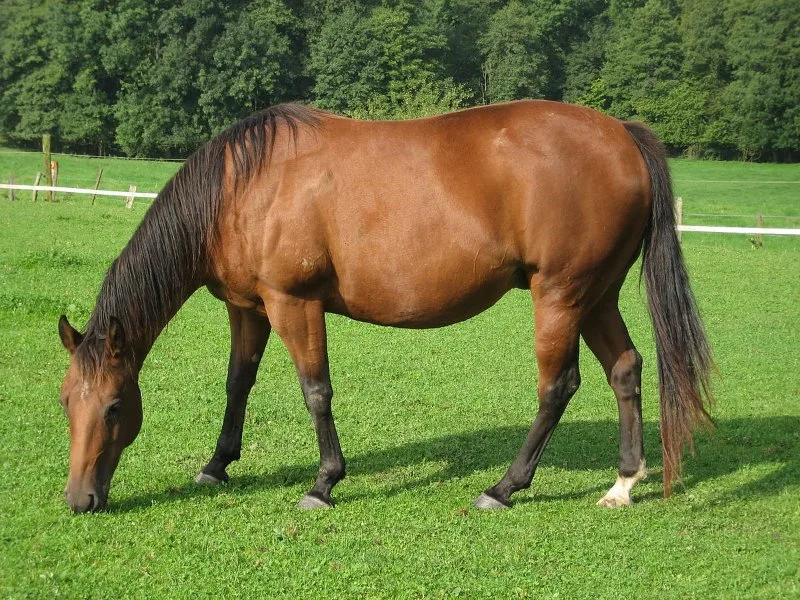
The American quarter horse is the fastest horse over a short distance, clocked at about 88 km/h (55 mph) — and it is the only animal on this list that is fast because humans made it so. The breed is named for the quarter-mile sprint it was developed to win in colonial America, and it out-accelerates the Thoroughbred over that distance while losing to it over a mile. Wild horses such as Przewalski’s horse, the last truly wild horse species, top out considerably lower.
Quarter horses are popular for their agility, strength, and speed, and are used in a variety of different horse races. They necessarily don’t have a very high burst speed compared to some of these other fastest creatures mentioned in this list but once they get going to a cruising speed, look out!
These horses have a lot of muscle mass in their hindquarters, which allows them to run quickly and efficiently. They also have a very low center of gravity, which keeps them stable when they’re running at high speeds. Quarter horses are a very versatile breed and can be used for a variety of activities, including racing, ranch work, and pleasure riding.
See Related: Do Bulletproof Animals Exist? Here’s What You Need to Know
What Features Make Animals Fast?
Speed is not one adaptation but a package, and the same three or four solutions keep reappearing in unrelated animals. Stride length comes from long limbs and, in cheetahs, a spine that flexes and extends like a bow so the whole body lengthens each stride. Stride frequency comes from light lower limbs — a pronghorn’s leg is mostly tendon below the knee, so there is very little mass to swing. Muscle fibre type decides how long the speed lasts: fast-twitch fibres burn glycogen and creatine phosphate without oxygen, which is why a cheetah sprint is over in 30–45 seconds. And in the air, wing shape does the work — the long, narrow, swept wings of a free-tailed bat or a needletail are the biological version of a jet’s planform.
The medium matters as much as the animal. Air is roughly 800 times less dense than water, which is why the fastest flier is four times quicker than the fastest swimmer, and why no fish can approach the speeds that get quoted for them. Gravity matters too: every genuine 300 km/h-plus animal record is a dive, not powered flight. And endurance runs on entirely different machinery from sprinting — the pronghorn has an oversized heart, windpipe and lung volume for its body size, which is why it can hold 72 km/h (45 mph) for kilometres while a cheetah, the better sprinter, cannot.
The Fastest Animal Relative to Its Body Size
Rank animals in kilometres per hour and the big, powerful ones win. Rank them in body lengths per second and the answer changes completely.
The winner is a mite roughly the size of a sesame seed. Paratarsotomus macropalpis, the Southern Californian mite, runs at 322 body lengths per second. Scaled up to human size that is the equivalent of running at about 2,090 km/h (1,300 mph) — roughly Mach 1.7. It also does this across sun-baked concrete at surface temperatures that would kill most arthropods. The previous holder, the Australian tiger beetle, manages 171 body lengths per second. The cheetah, for all its 93 km/h, scores 16.
This is not a novelty statistic. It is a consequence of scaling: muscle force grows with cross-sectional area (length squared) while body mass grows with volume (length cubed), so small animals have enormous power relative to their weight and can cycle their limbs far faster. It is the same reason an ant can carry many times its own body mass and an elephant cannot jump. If you compare animals on the more familiar measure of absolute speed instead, the cheetah wins on land and nothing living beats a stooping falcon.
Could a Human Outrun Any of These Animals?
No — not one of the land animals on this list. Usain Bolt’s peak speed during his 9.58-second 100 m world record was about 44.7 km/h (27.8 mph), and he held it for roughly a fifth of a second. The slowest land animal on this list, the blue wildebeest, is nearly twice as fast, and it can keep going.
Humans do have one genuine advantage, and it is the pronghorn’s advantage too: endurance. Over marathon distances in the heat, trained human runners beat horses often enough that Wales has held an annual Man versus Horse Marathon since 1980, which humans have won twice. Sweating over a large area of bare skin is an unusually effective cooling system, and it is why persistence hunting was possible at all. On any distance under a few kilometres, though, a person loses to every animal in the table above.
It is also worth remembering that these speeds exist because of predators and prey pushing each other, and that removing one side of that relationship has consequences. The pronghorn still runs from a cheetah that vanished 12,000 years ago. For more on how animals fit their surroundings, see our guides to the types of habitats that shape them and to the most graceful animals in the world.
Conclusion
The short answer to “what is the fastest animal in the world” is the peregrine falcon at 389 km/h (242 mph) in a dive, the cheetah at 93 km/h (58 mph) on land, and a sesame-seed-sized mite if you measure by body length. The longer answer is that half the numbers in circulation — the 68 mph sailfish, the 80 mph marlin, the supersonic albatross, the 70 mph cheetah — are estimates that hardened into facts through repetition. Where a figure on this page is disputed, we have said so and given the study behind it. Every one of these animals is fast because something was chasing it, or because it was chasing something, which is worth remembering when a species disappears from an ecosystem and its pursuers keep the adaptation. For more on the animals that live at the extremes, keep exploring.
FAQs
What is the fastest land animal in the world?
The cheetah is the fastest land animal in the world. The fastest speed ever recorded from wild cheetahs is 93 km/h (58 mph), measured with GPS collars on 367 hunting runs in Botswana and published in Nature in 2013; the captive record is 98 km/h (61 mph), set by a cheetah named Sarah at Cincinnati Zoo in 2012. The frequently quoted 70 mph is not a measurement. Cheetahs accelerate from 0 to 96 km/h (60 mph) in about three seconds, and most hunts are decided by grip and turning ability rather than top speed.
Which is the fastest-flying bird?
The peregrine falcon is the fastest bird and the fastest animal on Earth, but the speed comes from its dive rather than powered flight. A hunting stoop routinely exceeds 320 km/h (200 mph), and the Guinness World Records mark is 389 km/h (242 mph). In ordinary level flight a peregrine cruises at roughly 65 to 90 km/h (40 to 55 mph). For sustained level flight the record belongs to the grey-headed albatross at 127 km/h (79 mph), held for more than eight hours in an Antarctic storm.
What are the fastest animals in the ocean?
The sailfish and the black marlin are the fish usually named as fastest, at 68 mph and 80 mph respectively, but both figures come from line being stripped off a fishing reel rather than from measured swimming. A 2016 study in Biology Open estimated the sailfish maximum at about 30 km/h (19 mph) and showed that no large predatory fish can exceed roughly 36 to 54 km/h (22 to 34 mph), because water cavitates around the fins above that speed and would damage them. The fastest animals in the ocean are marine mammals: the short-beaked common dolphin reaches about 60 km/h (37 mph) and the orca about 56 km/h (35 mph).
Related Resources
- Five-Letter Animals to Know Around the World
- Animals That Start With The Letter M
- Most Comfortable Animals in the World