- Status: Vulnerable (IUCN)
- Known as: Red-Crowned Crane, Japanese Crane.
- Estimated numbers left in the wild: About 3,050 mature individuals (roughly 2,800–3,300).
Description
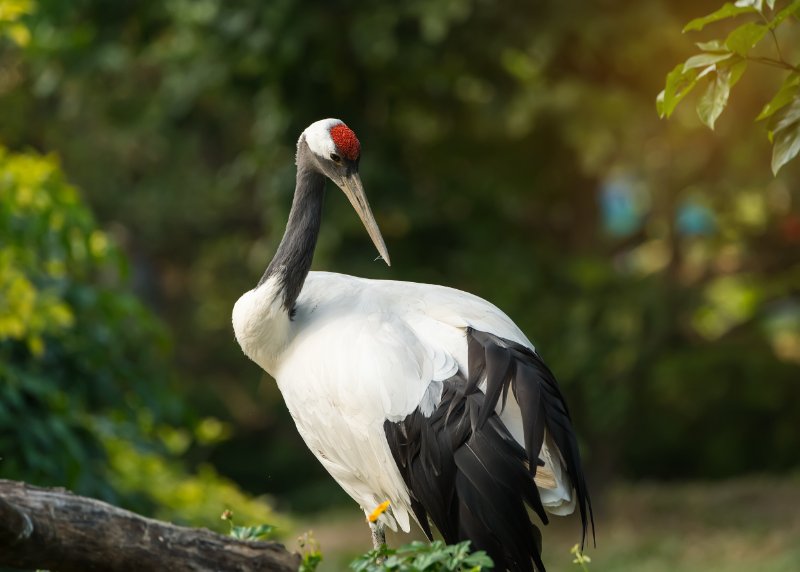
The red-crowned crane (Grus japonensis), also called the Japanese crane or Manchurian crane, is a large East Asian crane and one of the rarest crane species in the world — on average the heaviest crane on Earth. The IUCN lists it as Vulnerable, with roughly 2,800–3,300 mature individuals remaining. It is threatened by habitat loss, pollution, human disturbance and hunting.
Red-crowned cranes are found in the mountains of East Asia, including South Korea, China and Japan. They live on lowland plains near rice paddies during winter, but migrate to alpine areas with marshlands for mating purposes during summer.
Red-crowned cranes are among the rarest cranes on Earth. Recent surveys estimate roughly 2,800–3,300 mature individuals left in the wild (about 3,050 birds), divided between a migratory mainland population in Russia, China and Korea and a non-migratory population on Hokkaido, Japan.
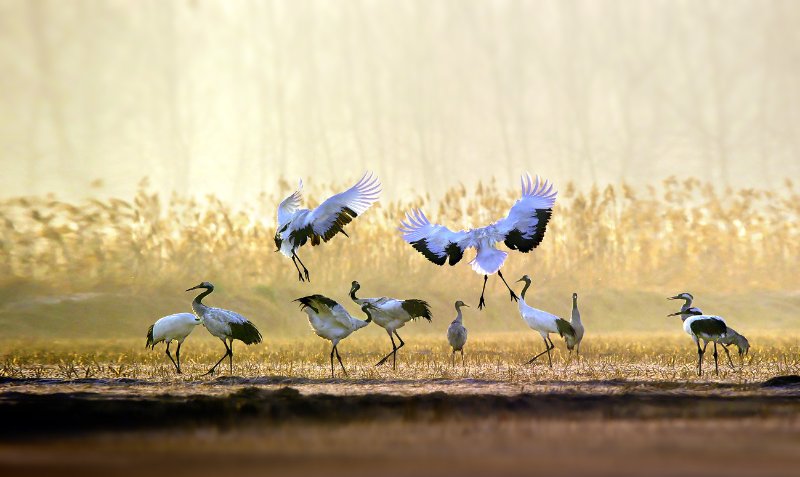
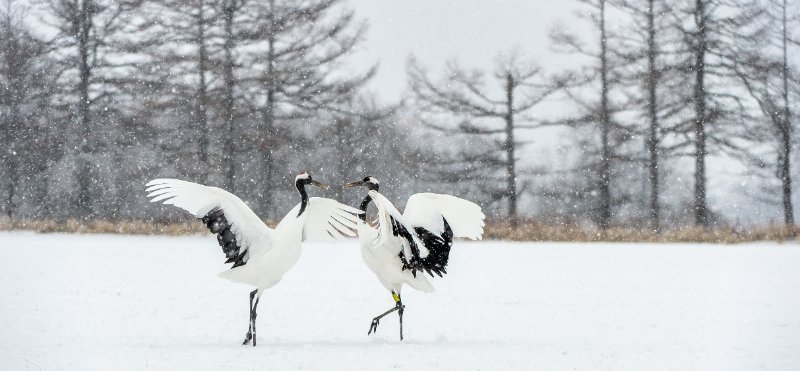
Their mating rituals consist of jumping, bowing and dancing while holding out their wings. When pairing up, the male and female will engage in courtship feeding. The red-crowned crane is listed as a Vulnerable species by the International Union for Conservation of Nature (IUCN).
During migrations to their mating grounds, they are threatened by habitat loss through reforestation, pollution from agricultural chemicals that contaminate their food and human disturbances in their habitats.
High levels of heavy metal pollutants like mercury, lead and cadmium have been found in the blood and feathers of red-crowned cranes.
The red-crowned crane is also threatened by hunting for sport, food and to make traditional medicines from the bones.
See Related: Animals that Start with X
Appearance
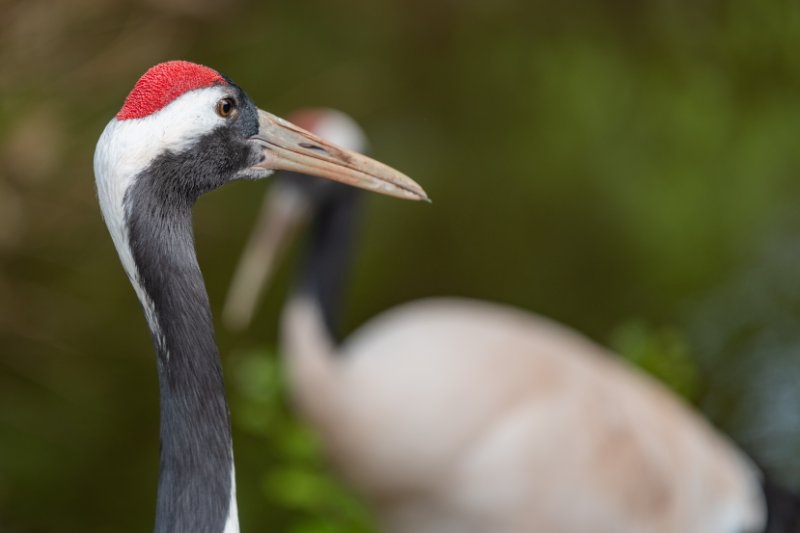
One of the world’s largest cranes, the red-crowned crane and also known as the Japanese crane is a striking bird that stands 1.6 meters tall (5 feet) and has a wingspan of up to 2.5 meters (8 feet).
Males and females look alike, though males average slightly larger and heavier. Their long, greenish-gray bill is well suited to probing wetland mud and shallow water for food.
Adults are almost entirely snow-white, with a black neck and black secondary wing feathers that form a “bustle” over the tail when the bird stands, plus a bare patch of red skin on the crown. Juveniles are a mix of gray, cinnamon and white.
They have a long, tall body with enormous wingspan that rises up as you get closer to the bird. Their neck is long and thin, but their head is small in comparison with their body. They blend well in with Eurasian winter surroundings, which include forests and fields covered in snow.
These cranes weigh about 7 to 10 kilograms on average (roughly 15 to 22 lb); the usual maximum is around 10.5 kg, and only exceptionally large males reach 15 kg (33 lb). On average, the red-crowned crane is the heaviest crane species in the world.
The red-crowned crane is a graceful bird, with mostly white feathers, a black tail and neck, and a red crown of feathers on top of the head, giving it its name. Crane chicks are dull yellow in color, with pinkish legs.
Red-crowned cranes fly with their necks outstretched, not retracted like many waterfowl. When they walk, red-crowned cranes hold their head in a horizontal position; when in flight or frightened they raise it upwards to an angle.
Distribution and Habitat
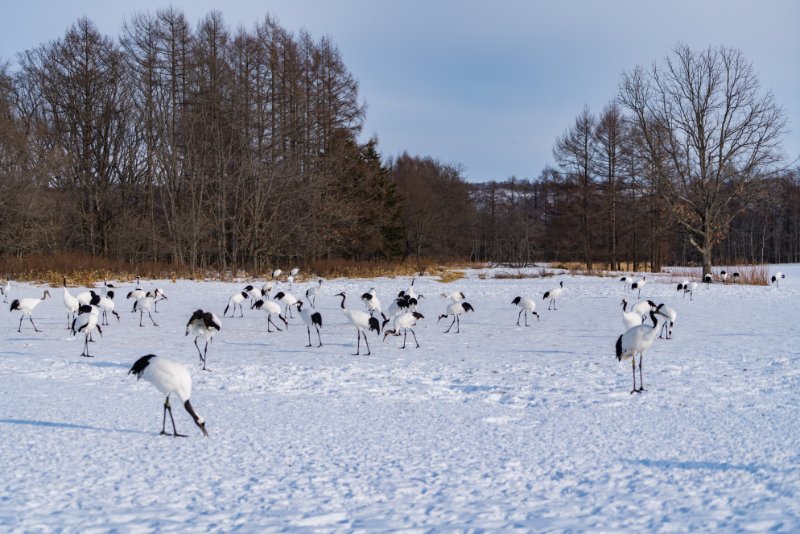
The red-crowned crane lives in eastern Russia, Japan (particularly Northern Japan), China, North Korea and South Korea.
They prefer open lowland wetlands and marshes for feeding. The migratory population breeds in far-eastern Russia (the Amur River basin around Lake Khanka), Northeast China and occasionally northeastern Mongolia, while a separate non-migratory population lives year-round on Hokkaido, Japan.
In autumn the migratory birds fly south to winter on the Korean Peninsula and in east-central China, returning north to breed in March and April. They nest in shallow, still wetlands and marshes rather than on dry uplands.
The red-crowned crane nests in still wetland areas, where it scrapes a shallow depression on the ground with its feet. Habitat loss due to farmland irrigation is endangering their habitat.
Diet
Red-crowned cranes live in freshwater wetlands and various types of tidal flat, depending on the season.
They are omnivores, but because they have been unable to obtain food in recent years, they have had to consume rice from paddy fields and grain from human sources. They also eat parsley, carrots, reed buds, acorns, and a variety of other plants straight.
The meat of various kinds is also important to this crane. Eels, carp, gobies, and other fish are taken frequently, stabbed with the crane’s beak in the same manner as a feeding heron. Crabs, snails, and large insects are eaten when present.
These cranes will also kill and eat the young of other water birds, as well as small mammals and birds.
Breeding
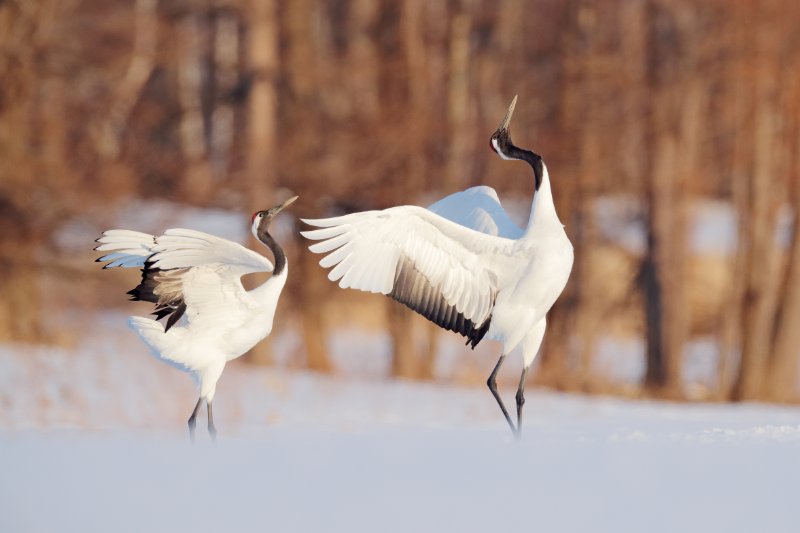
The family group is the largest social organization of these birds most of the time.
Breeding season for red-crowned cranes start with nesting in the spring, laying two eggs in a large nest set in wetland surroundings. The birds attack anything that approaches their nest.
When the young cranes are three months old, they accompany their parents while looking for food in the wetlands. They are able to fly by autumn. In the wild, red-crowned cranes typically live up to about 30 years; in captivity they can reach 60 to 65 years.
Location
The red-crowned crane can be found in Japan, Russia, China, Mongolia, North Korea, and South Korea, with the greatest concentrations in the DMZ between the two Koreas.
Populations in Japan are non-migratory, while the others migrate seasonally.
Red-crowned cranes like other cranes favor wetlands, freshwater marshes, rivers, mudflats, grassy tidal flats, and paddy fields.
Communication and perception
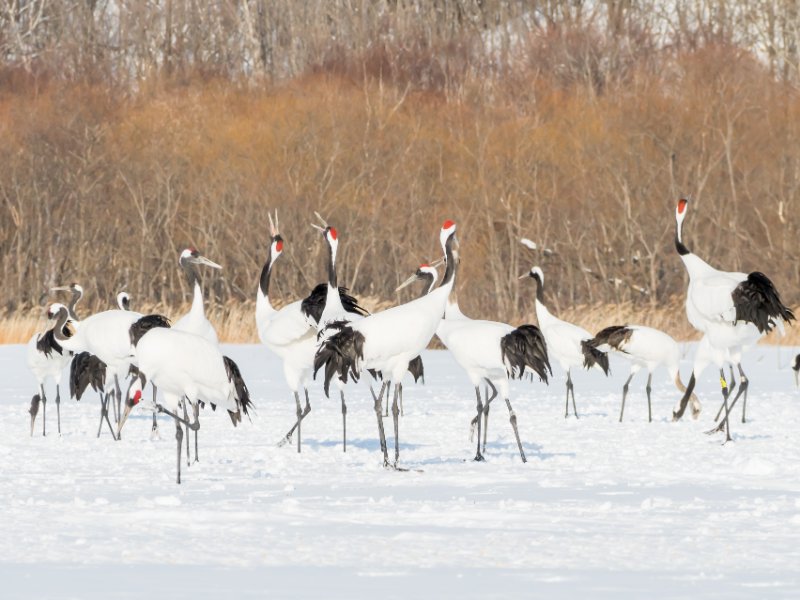
The courtship dance is an elaborate series of bows, bounces, and leaps to show interest. The dancing is quite lovely and helps strengthen the connections between male and female pairs. They also have a contact call that informs other birds that they’re in the area.
Their unison call — a duet performed by a bonded pair with heads thrown back — is one of the loudest and most far-carrying of any crane, helping mates coordinate and defend their territory.
A crane can also signal aggression by expanding the patch of bare red skin on its crown. Red-crowned cranes use contact calls to alert other birds when taking off or coming in to land.
When flying they tend to be silent, but they will make a call when taking off and landing. They communicate with contact calls or with their trumpeting call.
The Japanese Cranes
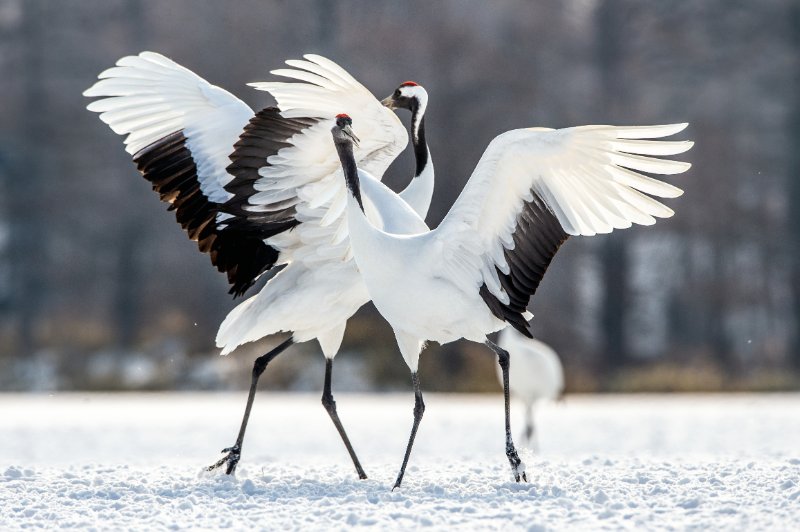
Japanese cranes have had a significant influence on Japanese culture. A Japan crane is featured in Japan Airlines’ logo.
Cranes may be seen on paintings, hand fans, and even folk tales! I adore a classic Japanese ballad. In Hokkaido, it is said that indigenous people perform traditional crane dancing.
If you want to see red-crowned cranes, go to Kushiro Marsh!
Japan’s resident Hokkaido population — once down to just a few dozen birds in the early 1900s — has recovered to well over 1,000 cranes thanks to decades of winter feeding by local farmers. During the breeding season, which is usually between mid-February and late March, it’s possible for visitors to see both at the Kushiro Marshland Crane Conservation Center in Kushiro.
They can be seen by a 15-minute walk from a visitor center where you can learn about the species and watch a video of their life cycle.
This is then followed up by an hour-long tour on one of three air-conditioned buses, with commentary in Japanese and English.
Manchurian Crane
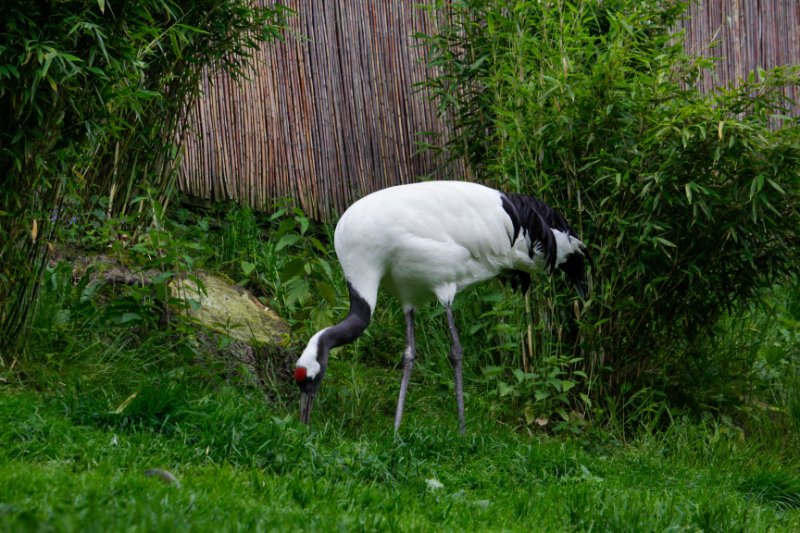
“Manchurian crane” is simply another common name for the red-crowned crane — not a separate species. The name comes from Manchuria, part of the bird’s mainland breeding range, and refers to the very same species (Grus japonensis) described above.
Because this one species carries three interchangeable names — red-crowned crane, Japanese crane and Manchurian crane — it is sometimes mistaken for three different birds, but all three names describe exactly the same crane.
These cranes prefer shallow wetlands, wet grassland and paddy fields, and the resident Hokkaido birds can be seen year-round around the Kushiro Marsh in eastern Japan.
The bird’s bare red crown is what gives it its name. In spring, pairs perform long, leaping courtship dances that show off their plumage and strengthen the bond between mates.
Far from being small, the red-crowned crane is one of the largest cranes on Earth, standing about 150–158 cm (5 ft) tall with a wingspan of 220–250 cm (over 7 ft), and on average it is the heaviest crane species.
They move in small groups, but they gather for large flocks when migrating or on wintering grounds.
See Related: Different Types of Turtles Around the World
Conservation of the Red-Crowned Crane and Japanese Crane
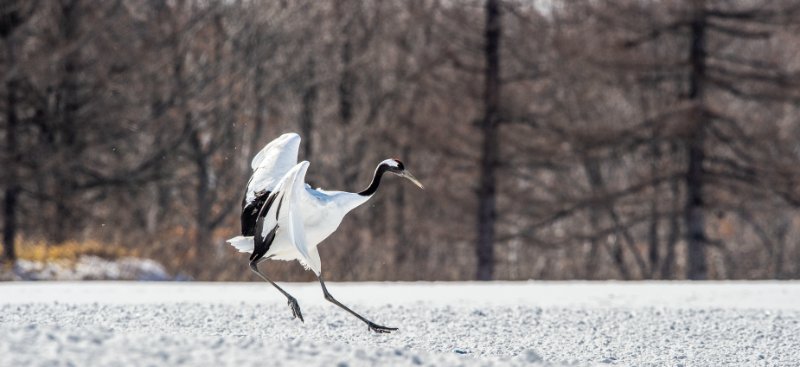
The red-crowned crane is one of the largest and heaviest crane species in the world. This bird has mostly white feathers, with a black tail and neck and crimson feathers on top of its head.
The red-crowned crane eats a wide range of foods, although due to dwindling food supplies, the bird has been feeding on rice from paddy fields and grain from human sources in recent years.
The red-crowned crane’s diet consists of eels, carp, gobies, and other fish that are stabbed with the heron’s beak in the same manner as herons do.
When insects or small animals are available, red-crowned cranes will consume snails, big aquatic invertebrates.
The red-crowned crane is classified as a Vulnerable species by the IUCN, following a long population decline driven mainly by the loss of the wetlands it needs for breeding and wintering.
See Related: Animals That Start With the Letter I
Threats
The primary danger to the red-crowned crane today is habitat loss, as human development encroaches rapidly on the wetlands that these huge birds require for breeding and wintering grounds.
Rainfall in general has been at a thirty-year low in this region; however, future rains might relieve some pressure.
New dam construction is causing wetlands to dry out, however, and everything from urban development to reed harvesting is encroaching on the birds’ habitat such as freshwater marshes.
There are also various direct risks, such as a minimal level of poaching. Some cranes may have eaten pesticide-treated grain and subsequently been poisoned or killed.
Some nesting areas have been destroyed by fires, and red-crowned cranes are frequently electrocuted while flying slowly and heavily.
See Related: Animals That Start with V
Conservation efforts and crane conservation programs
The International Crane Foundation (ICF) has been instrumental in coordinating action to protect wetlands used as breeding grounds by red-crowned cranes.
The Tancho Protection Group in Japan has also worked hard to shield the very limited habitat remaining there.
Many conservation plans are being considered, such as founding environmental groups in China, increasing the scope of wetland restoration, and controlling invasive cordgrass species.
There is a private organization in Japan called the Wild Birds Society of Japan that works to save these cranes as well as other different crane conservation programs.
It creates crane-friendly habitats and conserves the crane’s habitat, offering natural feeding grounds throughout the winter as a result.
The Teachers Guide for Tancho provides several educational activities.
See Related: What is the Goal of Wildlife Conservation?
Organizations
International Crane Foundation
The International Crane Foundation works to protect red-crowned and other cranes around the world and their habitats including the Red-Crowned Crane.
FAQ
What is a red-crowned crane?
A red-crowned crane is a rare crane species found in Asia. The red-crowned crane is an “alertness” species, indicating that their presence indicates safe human/natural contact. The red-crowned cranes are an endangered species across East Asia.
The red-crowned crane is a bird that many people want to see. But it might not be seen because it is camouflaged and likes to leave to go somewhere else.
How many red-crowned cranes are left in the world?
There are roughly 2,800 to 3,300 mature red-crowned cranes left in the wild (about 3,050 birds). The decline of this bird’s population has been correlated with the increase of industrialization and agriculture in China that led to habitat destruction.
Why is the red crowned crane endangered?
Red-crowned cranes are endangered because of habitat loss. Industrial buildings, highways, farms, mines and military areas take away the red-crowned crane’s space. Red-crowned cranes avoid these places which makes migration difficult, which also harms reproduction.
What does the red-crowned crane symbolize?
The red-crowned crane is a symbol for luck, prosperity, longevity, happiness and high rank.
In China, people used the red-crowned crane as a symbol of power and strength. The red-crowned crane is also an important symbol for early Buddhism because it knows that all creatures are brothers.
Are Japanese Cranes Migratory Birds?
Japanese cranes (red cranes) in the regions of Hokkaido stay there all year. But red-crowned cranes go from place to place because they need weather change and to find a mate. Japanese cranes don’t think about moving from Hokkaido because the weather and habitat is good.
Other Species Profiles
Related Resources
- Endangered Species in California
- Most Endangered Plants in the World
- Endangered Species in Florida
- World’s Largest National Parks
- Wildfowl Wetlands Trust
See Related: Black Crowned Crane: Why Is It Endangered?
See Related: Monkeys With Red Butts: 5 Species and Why Their Rumps Turn Red