The RTS Home Accents 50-Gallon Flat-Back Rain Barrel is the best overall rain barrel for most homes. It combines a space-saving rigid body, brass spigot, screened inlet, overflow connection, and the option to link additional barrels. For a lower-profile utility design, the 55-gallon FreeGarden RAIN has a higher spigot that is easier to use with watering cans. For seasonal storage, the VINGLI 50-Gallon Collapsible Rain Barrel is lighter and folds down when empty.
The right choice depends on more than capacity. A useful rain barrel also needs a secure screen, controlled overflow, a stable base, convenient spigot height, and enough access for cleaning. This guide compares 10 current options and explains how to size, install, and maintain a rainwater collection barrel without treating roof runoff as drinking water.
Last verified: July 22, 2026. Product specifications and availability can change, so confirm the current listing before buying.
Affiliate disclosure: Our Endangered World may earn a commission from qualifying purchases. This does not affect the price you pay or the criteria used in this guide.
Best rain barrels at a glance
| Rain barrel | Best for | Capacity | Dimensions | Main tradeoff |
|---|---|---|---|---|
| RTS Home Accents Flat-Back | Best overall | 50 gallons | 21 × 19 × 34 in. | Low spigot works best with a stand |
| FreeGarden RAIN | Best value and watering-can access | 55 gallons | 24 × 24 × 34 in. | Utilitarian appearance |
| FCMP Raincatcher 4000 | Best complete traditional kit | 50 gallons | 24 × 24 × 32 in. | Wide, round footprint |
| MiRainBarrel Upcycled Barrel | Best upcycled barrel | 58 gallons | 21 × 21 × 41 in. | Premium price and industrial shape |
| Algreen Castilla | Best decorative rigid barrel | 50 gallons | 23 × 33 in. | Costs more than basic models |
| Good Ideas Rain Wizard 50 | Best linkable classic design | 50 gallons | 23 × 22 × 30 in. | Linking kit is sold separately |
| RTS Round Barrel with Planter | Best for a small garden | 35 gallons | 24 × 24 × 28 in. | Fills quickly in moderate rain |
| Good Ideas Rain Wizard Urn 65 | Best urn-style barrel | 65 gallons | 26 × 25 × 35 in. | Planter top adds maintenance |
| Good Ideas Impressions Bark 90 | Best high-capacity decorative barrel | 90 gallons | 29 × 29 × 44.5 in. | Large, heavy, and expensive |
| VINGLI Collapsible Barrel | Best portable or seasonal option | 50 gallons | 23.6 × 23.6 × 27.6 in. | Less rigid and shorter warranty |
How we chose these rain barrels
We compared current manufacturer specifications, included hardware, capacity, footprint, screen design, overflow control, spigot material and height, cleaning access, expandability, warranty, and current retail availability. We also reviewed recent independent testing roundups to identify recurring usability issues and the models that remain relevant.
We did not perform hands-on testing of these exact units. Rankings reflect documented features, practical tradeoffs, current availability, and the needs of a typical home gardener. Products with unclear specifications, duplicated designs, weak current availability, or no meaningful advantage were removed from the previous version of this list.
- Water control: A screened inlet and usable overflow path are essential.
- Daily usability: Brass spigots, reasonable clearance, hose compatibility, and cleaning access matter more than decorative details.
- Stability: The barrel must sit securely when hundreds of pounds of water are inside.
- Fit: Flat-back, compact, linkable, and collapsible designs solve different space and storage problems.
- Longevity: UV-stabilized rigid plastics, replaceable hardware, clear instructions, and meaningful warranties received preference.
How much rain barrel capacity do you need?
A 50- to 65-gallon barrel is a practical starting point for most home gardens, but roof area determines how quickly it fills. The University of Georgia estimates that one inch of rain yields about 0.62 gallons per square foot of collection surface before losses from first flush, evaporation, splash-out, and leaks.
Estimated gallons collected = roof area draining to the downspout × rainfall in inches × 0.623.
That means one inch of rain on only about 80 square feet of roof can theoretically fill a 50-gallon barrel. If one downspout drains several hundred square feet, a single barrel may fill during a short storm. In that case, prioritize a reliable overflow route or connect multiple barrels. For larger storage needs, compare complete rainwater collection systems rather than forcing one small barrel to do the job of a cistern.
| Roof area feeding one downspout | 0.25 in. rain | 0.5 in. rain | 1 in. rain |
|---|---|---|---|
| 100 sq. ft. | About 16 gal. | About 31 gal. | About 62 gal. |
| 200 sq. ft. | About 31 gal. | About 62 gal. | About 125 gal. |
| 500 sq. ft. | About 78 gal. | About 156 gal. | About 312 gal. |
Plan for the full weight, not the empty weight
Water weighs about 8.34 pounds per U.S. gallon. Add the barrel and stand to these approximate water-only weights, then use a level base rated for the load.
| Capacity | Approximate water weight | Practical implication |
|---|---|---|
| 35 gallons | 292 lb. | Still too heavy for a weak deck tile or loose soil |
| 50 gallons | 417 lb. | Needs a compacted, level base |
| 55 gallons | 459 lb. | Do not move once filled |
| 65 gallons | 542 lb. | Use a purpose-built stand only if rated for the load |
| 90 gallons | 751 lb. | Requires substantial support and careful placement |
Rain barrel water is not automatically safe to drink
Treat ordinary rain barrel water as non-potable. The Centers for Disease Control and Prevention advises that collected rainwater is not necessarily safe to drink without removing germs and chemicals. The U.S. Environmental Protection Agency also notes that roof runoff can pick up bacteria and chemicals from animals and roofing materials.
Use a standard garden rain barrel for landscape irrigation and other locally approved non-potable uses. If you plan to drink, cook, or bathe with collected rainwater, use a system designed for that purpose and follow local health-department guidance on testing and treatment. Review your roof material and local advice before using runoff on edible crops. Our guide to types of water pollution explains why apparently clear water can still contain contaminants.
Keep every opening screened. The CDC recommends a screen where water enters or emptying the barrel at least every 10 days to interrupt mosquito breeding. Also check the Department of Energy rainwater harvesting tool and local authorities because state or municipal rules and permit requirements can vary.
The 10 best rain barrels for water collection
1. RTS Home Accents 50-Gallon Flat-Back Rain Barrel — Best overall
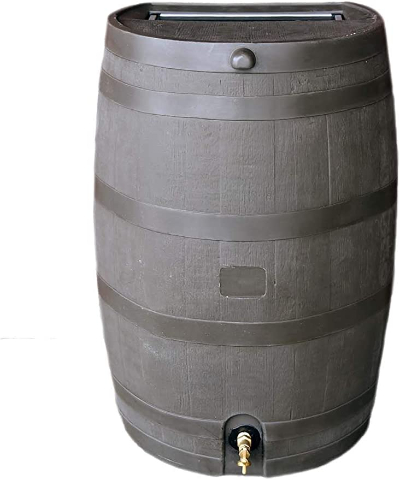
- Capacity: 50 gallons
- Material: Commercial-grade UV-stabilized polyethylene
- Dimensions: 21 × 19 × 34 inches
- Empty weight: 18 pounds
- Key hardware: Brass spigot and overflow/linking connection
The RTS Home Accents 50-Gallon Flat-Back Rain Barrel offers the best balance of capacity, compact placement, durable hardware, and straightforward expansion. Its rigid polyethylene body is only 19 inches deep, and the overflow fitting can manage excess water or connect another barrel.
The main compromise is spigot clearance. A hose connects easily, but a watering can may not fit beneath the tap unless you add a properly rated stand. That extra elevation also improves gravity-fed flow, although a rain barrel will not provide household-level water pressure.
Best for: Homeowners who want a dependable rigid barrel that fits close to a wall and can expand later.
Skip it if: You want a high spigot without buying a stand or need more than 50 gallons from one container.
Pros
- Space-saving flat-back shape
- Durable brass spigot
- UV-stabilized rigid construction
- Linkable for additional storage
Cons
- Low spigot is awkward for taller containers
- Stand is sold separately
- One barrel can fill quickly during a moderate storm
2. FreeGarden RAIN 55-Gallon Rain Barrel — Best value
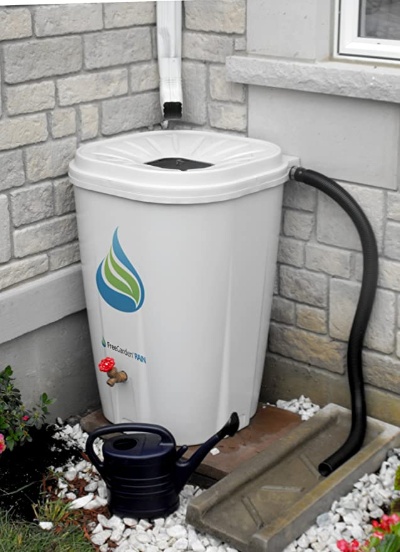
- Capacity: 55 gallons
- Material: Rigid plastic
- Dimensions: 24 × 24 × 34 inches
- Key hardware: Stainless-steel insect screen and elevated spigot
- Safety feature: Child-resistant lid and stable square footprint
The FreeGarden RAIN is a practical choice for readers who care more about function than decorative styling. Its most useful feature is the higher spigot, which reduces the need for a tall stand when filling a watering can. The square form fits against a wall or into a corner, and additional mounting points support multi-barrel layouts.
The tradeoff is appearance: it looks more like a utility container than a wooden or ceramic barrel. The 24-inch-square footprint is also not especially narrow, but the stable base is reassuring once the barrel holds roughly 459 pounds of water.
Best for: Gardeners who prioritize easy access, stability, and useful capacity.
Skip it if: A decorative barrel is part of your landscape design.
Pros
- Higher spigot accommodates many watering cans
- Stainless-steel insect screen
- Stable square footprint
- Child-resistant lid and multi-barrel options
Cons
- Plain, utility-focused appearance
- Twenty-four-inch footprint may be too wide for a narrow side yard
3. FCMP Outdoor Raincatcher 4000 — Best complete traditional kit
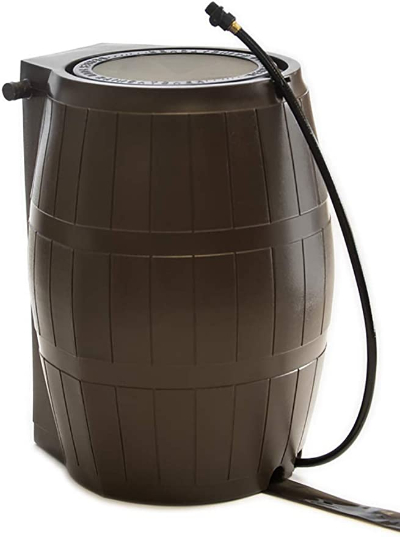
- Capacity: 50 gallons
- Material: Recycled, UV-inhibited, BPA-free linear low-density polyethylene
- Dimensions: 24 × 24 × 32 inches
- Included: Debris screen, garden hose, shutoff valve, hose clip, overflow hose, and linking kit
The FCMP Outdoor Raincatcher 4000 is the strongest package for buyers who do not want to source every accessory separately. Its flat back simplifies downspout placement, while the rear overflow hose can direct excess water away from the foundation. Side fittings make it possible to connect additional Raincatcher barrels.
The 24-inch round footprint uses more depth than the RTS flat-back model, and the exposed screen needs routine cleaning to maintain flow. Still, the included hose and linking components make it a straightforward first system for a garden or greenhouse. For more automated watering options, compare these greenhouse irrigation systems.
Best for: Buyers who want a familiar barrel shape with the main accessories included.
Skip it if: You need the shallowest possible wall clearance.
Pros
- Useful accessory package included
- Flat back and rear overflow connection
- Linkable for expanded storage
- Recycled, UV-inhibited polyethylene body
Cons
- Wider footprint than slimmer flat-back barrels
- Screen and open catch area require periodic debris removal
- Side fittings are visible
4. MiRainBarrel 58-Gallon Upcycled Rain Barrel — Best upcycled option
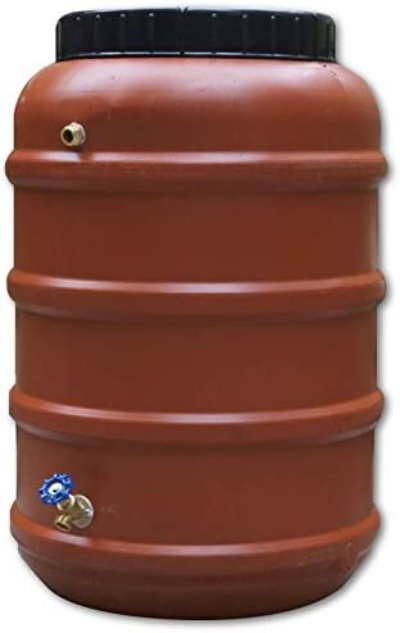
- Capacity: 58 gallons
- Material: Previously used food-grade, BPA-free HDPE drum
- Dimensions: 21 × 21 × 41 inches
- Included: Brass spigot, brass overflow valve, screened twist lid, and downspout adapter
- Warranty: Lifetime warranty stated by the manufacturer
The MiRainBarrel 58-Gallon Upcycled Rain Barrel is the clearest choice for buyers who want to reuse an existing industrial drum rather than purchase a newly molded decorative shell. The removable twist lid improves cleaning access, and both the spigot and overflow fitting are brass.
A food-grade drum describes the container’s previous use; it does not make roof runoff potable. Collected water can still pick up contaminants from the roof, gutters, air, and animals. The other tradeoffs are the tall industrial shape and a direct-sale price that can exceed many basic 50-gallon models. The environmental benefit is more credible when the barrel stays in service for years, so inspect seals and replacement parts rather than buying on recycled content alone. See our overview of plastic pollution for broader material tradeoffs.
Best for: Buyers who value reuse, removable-lid access, and durable metal fittings.
Skip it if: You want a low-cost or decorative barrel.
Pros
- Repurposes a previously used HDPE drum
- Removable twist lid improves cleaning access
- Brass spigot and configurable overflow valve
- Downspout adapter included
Cons
- Industrial appearance
- Taller than most 50-gallon barrels
- Premium price compared with basic rigid barrels
5. Algreen Castilla 50-Gallon Rain Barrel — Best decorative rigid barrel
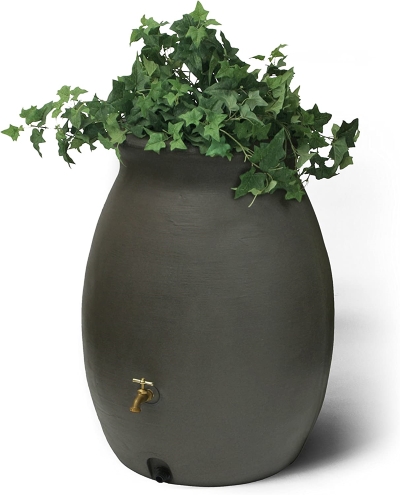
- Capacity: 50 gallons
- Material: Recyclable, BPA-free rotomolded resin
- Dimensions: Approximately 23 inches wide × 33 inches high
- Key hardware: Brass spigot, screen guard, bottom drain, and dual rear overflow/linking ports
- Warranty: Two years
The Algreen Castilla is a better decorative choice than barrels that trade useful hardware for appearance. Its pottery-style shell is rotomolded rather than assembled from thin panels, and it includes a reinforced brass-spigot connection, bottom drain, screen guard, and two rear overflow ports.
The main drawback is cost. You are paying for the molded finish and integrated system, not additional capacity. It also lacks the narrow flat back of the top-ranked RTS model, so measure the installation area before ordering.
Best for: Front yards, patios, and visible garden areas where a utility barrel would be distracting.
Skip it if: Price and compact wall clearance matter more than appearance.
Pros
- Pottery-inspired rotomolded design
- Brass spigot and reinforced fitting
- Dual rear overflow or linking ports
- Bottom drain and two-year warranty
Cons
- More expensive than plain 50-gallon barrels
- Not as shallow as a true flat-back model
- Decorative finish does not add storage capacity
6. Good Ideas Rain Wizard 50 — Best linkable classic design
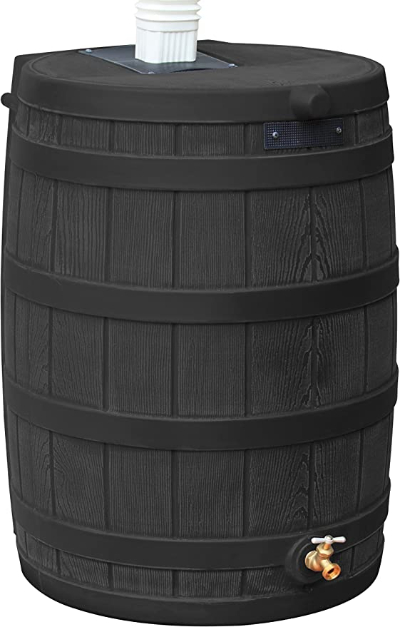
- Capacity: 50 gallons
- Material: BPA-free resin
- Dimensions: 23 × 22 × 30 inches
- Empty weight: 20 pounds
- Key hardware: Fine mesh, front overflow, connection points, and 3/4-inch brass spigot
The Good Ideas Rain Wizard 50 is a strong alternative to the RTS barrel when you prefer a shorter faux-oak design and front-facing overflow. It can connect to other Rain Wizard barrels with a separately sold linking kit, and its standard brass spigot accepts a garden hose.
Its 22-inch depth is reasonably compact but not class-leading. Budget for the linking kit if expansion is part of your plan, and consider a rated stand if you routinely fill taller watering cans.
Best for: Buyers who want a classic barrel appearance and an easy path to a multi-barrel system.
Skip it if: You want all expansion hardware included in the box.
Pros
- Flat back and compact 30-inch height
- Fine screen and front overflow
- Standard brass hose spigot
- Can link to additional barrels
Cons
- Linking kit costs extra
- Spigot clearance is limited without a stand
- A second barrel is likely for larger roof areas
7. RTS 35-Gallon Round Rain Barrel with Planter — Best for a small garden
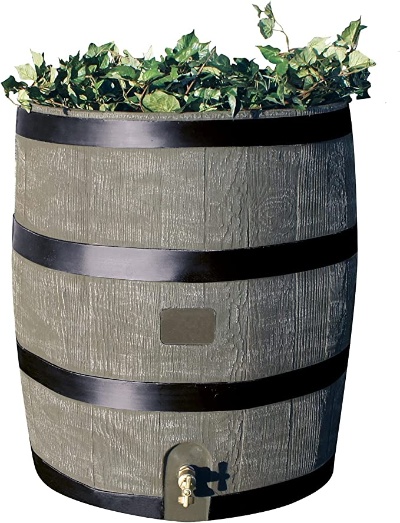
- Capacity: 35 gallons
- Material: Commercial-grade UV-stabilized polyethylene
- Dimensions: 24 × 24 × 28 inches
- Empty weight: 19 pounds
- Key features: Planter top, insect screen, brass spigot, and hose connection
The RTS 35-Gallon Round Rain Barrel with Planter suits a modest garden, patio, or downspout that serves a smaller roof section. The 28-inch height is less imposing than 50- to 90-gallon models, while the planter softens the appearance in a visible part of the yard.
Small capacity is both its benefit and limitation. Thirty-five gallons is enough for hand watering, but a quarter-inch of rain on about 225 square feet of roof can theoretically fill it. You still need a controlled overflow route, and the 24-inch diameter is not as wall-efficient as a flat-back design.
Best for: Container gardens, small beds, and compact spaces where 50 gallons would be excessive.
Skip it if: Your downspout drains a large roof area or you want maximum storage per dollar.
Pros
- Shorter, less visually dominant profile
- Integrated planter
- UV-stabilized polyethylene body
- Brass spigot and screened inlet
Cons
- Limited 35-gallon capacity
- Round footprint does not sit flush to a wall
- Planter needs drainage and seasonal care
8. Good Ideas Rain Wizard Urn 65 — Best urn-style rain barrel
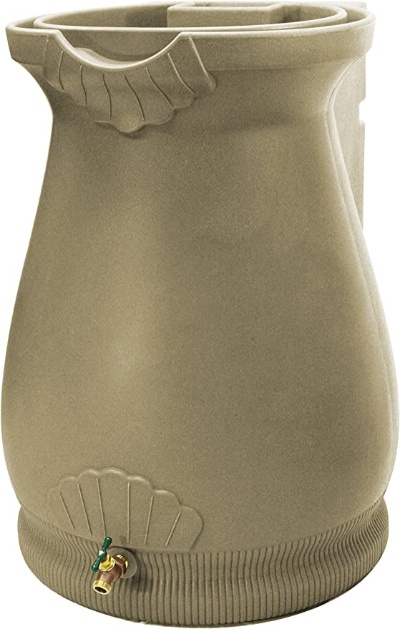
- Capacity: 65 gallons
- Material: BPA-free plastic resin
- Dimensions: 26 × 25 × 35 inches
- Empty weight: 18 pounds
- Key features: Self-draining planter, flat back, mesh screen, brass spigot, and front-routed overflow
- Warranty: One year
The Good Ideas Rain Wizard Urn 65 adds useful capacity without looking like an industrial drum. Its flat back sits close to a wall, and the integrated channel routes overflow toward the front rather than allowing it to spill behind the barrel near the foundation.
The self-draining planter is more practical than a simple recessed top, but it still needs suitable plants, drainage media, and routine care. At full capacity, the water alone weighs about 542 pounds, so choose the permanent location before filling it.
Best for: Visible patios or garden beds where appearance and 65-gallon capacity both matter.
Skip it if: You prefer a removable lid or do not want to maintain a planter.
Pros
- Attractive urn shape with flat back
- Useful 65-gallon capacity
- Self-draining planter and screened inlet
- Brass spigot and front-routed overflow
Cons
- Costs more than a basic utility barrel
- Planter adds maintenance
- Heavy and difficult to reposition once filled
9. Good Ideas Impressions Bark 90-Gallon Rain Saver — Best high-capacity decorative barrel
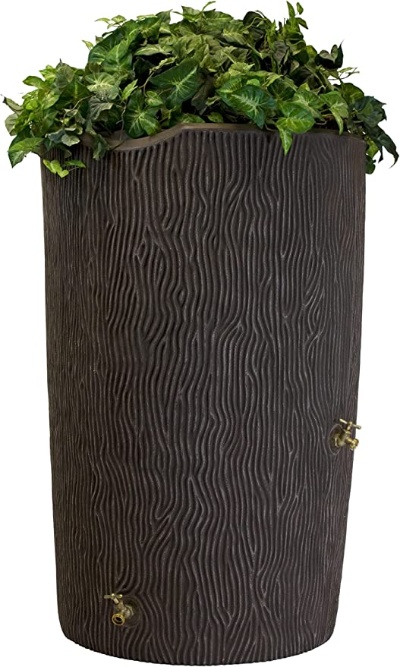
- Capacity: 90 gallons
- Material: BPA-free polyethylene
- Dimensions: 29 × 29 × 44.5 inches
- Empty weight: 35 pounds
- Key features: Planter top, integrated overflow channel, fine screen, and two brass spigots
- Warranty: One year
The Good Ideas Impressions Bark 90-Gallon Rain Saver is for buyers who need more than a standard 50-gallon barrel but do not want a utilitarian tank. The deep top can hold plants, the integrated channel directs overflow toward the front, and two spigot locations offer more flexibility for a hose and watering can.
Capacity creates the main constraints. Ninety gallons of water weigh about 751 pounds before adding the barrel, soil, plants, and stand. The 29-inch-square footprint and 44.5-inch height also demand more space, while the price is much higher than linking two basic barrels. Compare the installed cost and maintenance burden before choosing appearance over a modular system.
Best for: Large gardens and visible locations where high capacity and decorative design justify the price.
Skip it if: Your base, budget, or available space is limited.
Pros
- Large 90-gallon capacity
- Two brass spigot locations
- Planter top and bark-like finish
- Integrated overflow channel and debris screen
Cons
- Very heavy when full
- Large footprint and tall profile
- Significantly more expensive than basic barrels
10. VINGLI 50-Gallon Collapsible Rain Barrel — Best portable or seasonal option
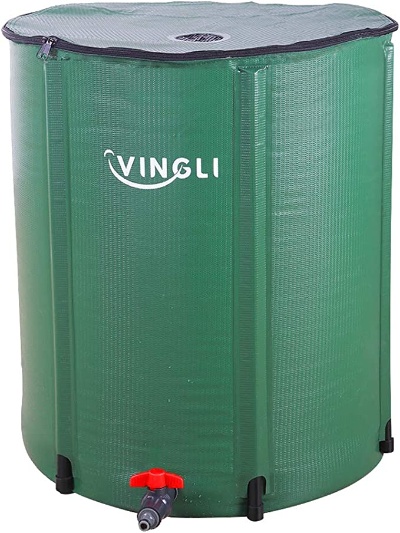
- Capacity: 50 gallons
- Material: PVC fabric with support rods
- Dimensions: Approximately 23.6 × 23.6 × 27.6 inches
- Empty weight: About 4.5 pounds
- Included: Screened top, spigot, lower drain, overflow fitting, and sealing rings
- Warranty: Three months on the current Home Depot listing
The VINGLI 50-Gallon Collapsible Rain Barrel makes sense when permanent outdoor storage is not practical. It packs down when empty, assembles without a rigid shell, and costs less than many decorative barrels. It can also serve as a temporary collector for an RV site, rental, or seasonal garden when local rules allow.
Do not confuse low empty weight with portability when filled. The manufacturer’s instructions say the barrel is a stationary design and should not be dragged or moved with water inside. A level surface is essential, the diverter is not included, and the short warranty is a meaningful disadvantage compared with rigid models. For more resilient setups, see these off-grid water systems.
Best for: Temporary, seasonal, or space-constrained use where empty storage size matters.
Skip it if: You want a permanent barrel with the stability, cleaning access, and warranty of a rigid design.
Pros
- Folds down when empty
- Very light before filling
- Screen, spigot, drain, and overflow fitting included
- Lower purchase price than many rigid barrels
Cons
- Less rigid and stable than molded polyethylene
- Must not be moved while full
- Downspout diverter is not included
- Short three-month warranty on the current listing
What to look for when buying a rain barrel
A fine, secure inlet screen
The screen should keep out leaves and insects without restricting flow after a few storms. Check that it is removable or accessible for cleaning. A large gap around a downspout can defeat an otherwise good screen, so cover every opening where mosquitoes could enter.
An overflow path sized for heavy rain
A barrel is a temporary detention container, not a replacement for roof drainage. Overflow should discharge away from the foundation and into a suitable landscaped area, drain, or connected barrel. Do not cap or undersize the overflow simply to retain more water.
Usable spigot height and hose compatibility
A low spigot maximizes access to stored water but may leave no room for a watering can. A rated stand solves that problem and adds gravity head, but it must support the barrel’s full weight. Confirm the thread size if you plan to connect a garden hose, soaker hose, pump, or irrigation line.
Cleaning access and replacement parts
Removable lids make sediment removal easier. Fixed-top barrels can be safer around children and pets, but you may have to clean through the screen opening or flush from the drain. Check whether the manufacturer sells screens, spigots, seals, hoses, and linking kits before choosing a proprietary design.
Rigid versus collapsible construction
Rigid polyethylene barrels are the better long-term default because they resist deformation and remain stable when correctly installed. Collapsible PVC models are easier to store but require more care around support rods, seams, uneven surfaces, and wind when empty. Choose collapsible only when portability or off-season storage is a real need.
How to install and maintain a rain barrel
- Check local rules and your roof material. Confirm that rainwater collection is permitted and that your intended use is appropriate for roof runoff.
- Prepare a level, load-rated base. Use compacted gravel, concrete pavers, or another stable surface that will not settle when the barrel is full.
- Position the barrel before filling. Leave enough room to reach the screen, spigot, drain, and overflow. Never move a filled barrel.
- Connect the downspout or diverter. Follow the product instructions and preserve a safe route for roof drainage if the barrel is full or disconnected.
- Route overflow away from the foundation. Test the path with a hose before the first storm and confirm that neighboring property is not affected.
- Inspect after the first rainfall. Check fittings, seals, screen flow, base settlement, overflow performance, and any signs of bulging or instability.
- Clean and winterize. Remove debris, flush sediment, repair screens, and empty or disconnect the barrel before freezing weather according to the manufacturer’s instructions.
Rainwater collection can reduce runoff and supplement garden watering, but the economics depend on rainfall, roof area, storage, water rates, and how consistently you use the water. Review the full pros and cons of rainwater harvesting before building a larger system.
Frequently asked questions
What size rain barrel do I need?
For many home gardens, 50 to 65 gallons is a practical starting point. Size the system by the roof area feeding the downspout, local rainfall, available space, and how quickly you can use the stored water. One inch of rain yields about 0.62 gallons per square foot before collection losses.
How quickly will a 50-gallon rain barrel fill?
In theory, one inch of rain on about 80 square feet of roof can fill a 50-gallon barrel. Real collection is lower because of first-flush diversion, gutter losses, splash-out, leaks, and overflow, but many barrels still fill during a single moderate storm.
Can you drink water from a rain barrel?
Not from an ordinary garden rain barrel without appropriate testing and treatment. Roof runoff can contain germs, animal waste, metals, and chemicals. Potable use requires a system designed for drinking water and guidance from the relevant health authority.
Do rain barrels attract mosquitoes?
They can if mosquitoes can reach standing water. Keep every opening tightly screened, repair gaps, and follow CDC guidance to empty the barrel at least every 10 days when a secure screen is not in place.
Does a rain barrel need an overflow?
Yes. A barrel can fill quickly, so excess water needs a controlled route away from the foundation. Use the supplied overflow hose or fitting, connect another barrel, or discharge to an appropriate landscaped drainage area.
Should you empty a rain barrel in winter?
In climates with freezing temperatures, empty and disconnect the barrel before a hard freeze unless the manufacturer gives different instructions. Leave the spigot open and store or cover the unit so water cannot collect, freeze, and damage fittings or the barrel body.
Final verdict
Choose the RTS Home Accents 50-Gallon Flat-Back Rain Barrel for the strongest all-around mix of rigid construction, compact placement, brass hardware, and expandability. Pick the FreeGarden RAIN when a higher spigot and stable utility design matter more than appearance. Choose the VINGLI Collapsible Rain Barrel only when seasonal storage or portability while empty is a genuine priority.
Whichever model you buy, the installation determines how well it works. Build a level base, screen every opening, route overflow safely, keep the water non-potable unless properly tested and treated, and empty the system before freezing conditions. These steps make a rain barrel a useful part of a broader plan to conserve natural resources without creating avoidable water, pest, or foundation problems.