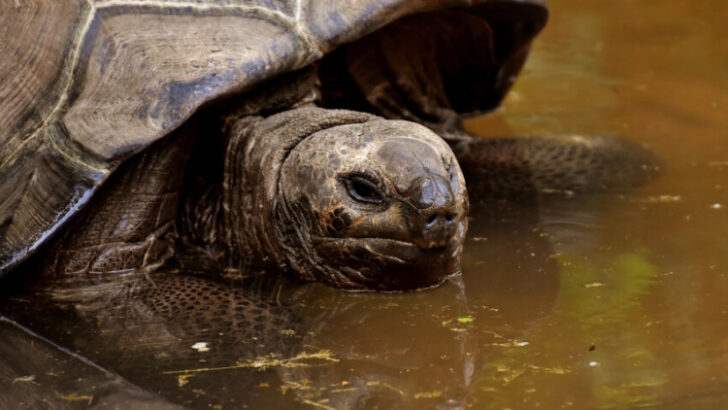
Galápagos giant tortoises are threatened, but they do not all share one conservation status. The name covers a complex of island lineages in the genus Chelonoidis. Living lineages are assessed from Vulnerable to Critically Endangered, while several historic taxa are extinct. Some populations are recovering after decades of protection, captive breeding, invasive-species control, and reintroduction.
Direct answer: Yes. Galápagos giant tortoises are endangered in the everyday sense of the word because every living lineage remains a conservation concern. However, “Vulnerable” is not an accurate blanket label for the entire group.
Current population estimates also differ. The Charles Darwin Foundation estimates 30,000–35,000 tortoises, while Galápagos Conservancy reported approximately 45,000 in late 2025. Because those figures combine separate island populations and may use different survey dates and methods, the most responsible archipelago-wide estimate is roughly 30,000–45,000 individuals, last checked in August 2026.
| Scientific group | Chelonoidis species complex |
|---|---|
| Native range | Galápagos Islands, Ecuador |
| Conservation status | Living lineages range from Vulnerable to Critically Endangered; several historic taxa are extinct |
| Estimated population | Approximately 30,000–45,000 across the archipelago, depending on source and survey method |
| Living diversity | 12 commonly recognized named forms; a 2025 genomic analysis evaluated 13 extant taxa |
| Diet | Herbivorous: grasses, leaves, herbs, flowers, fruit, shrubs, and cacti |
| Lifespan | Often more than 100 years; some individuals live beyond 150 |
| Ecological role | Ecosystem engineer and major seed disperser |
Are Galápagos giant tortoises endangered?
Yes, although the precise answer depends on the island lineage. The International Union for Conservation of Nature treats Critically Endangered, Endangered, and Vulnerable taxa as threatened. Galápagos tortoise assessments span all three categories, and the Charles Darwin Foundation states that all living forms are of conservation concern.
This distinction matters because the popular phrase “the Galápagos giant tortoise” can sound like one animal with one Red List status. In reality, populations evolved in isolation on different islands and volcanoes. Their numbers, threats, genetics, and recovery trajectories vary sharply. A large recovering population on Wolf Volcano does not make a tiny or highly restricted lineage safe.
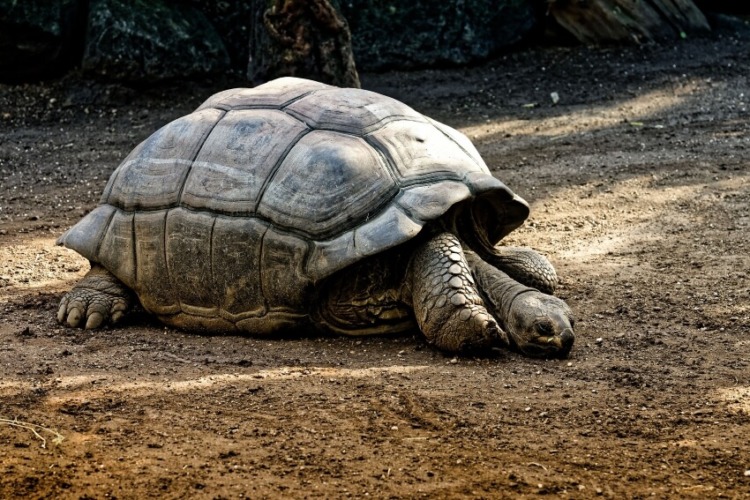
Why population estimates differ
There is no single synchronized census of every tortoise across the archipelago. Many animals live in remote volcanic terrain, and conservation organizations may report different survey years, age classes, modeled estimates, or taxonomic groupings. That is why a dated range is more honest than repeating a single number as if it were exact.
- Charles Darwin Foundation: 30,000–35,000 individuals.
- Galápagos Conservancy: approximately 45,000 individuals reported in its Fall/Winter 2025 publication.
- Practical interpretation: the total population has increased substantially from its twentieth-century low, but the recovery is uneven and several lineages remain at high risk.
What is a Galápagos giant tortoise?
A Galápagos giant tortoise is a large, long-lived land reptile in the genus Chelonoidis. Tortoises are a terrestrial branch of the broader turtle group; this overview of the different types of turtles explains the basic distinction between land tortoises, freshwater turtles, and sea turtles.
The ancestors of Galápagos tortoises likely reached the archipelago from mainland South America by floating or rafting across the ocean. Once established, populations became isolated on separate islands and, on Isabela, on separate volcanoes. Over evolutionary time, they developed differences in shell shape, body proportions, behavior, and genetics.
How many Galápagos giant tortoise species are there?
The answer depends on the taxonomic framework. Conservation organizations commonly refer to 12 living named species. A peer-reviewed whole-genome study published in Evolution analyzed 13 extant taxa, rejected the idea that all Galápagos tortoises belong to one species, and found a conservative minimum of nine species, with most analyses supporting 13.
The apparent mismatch is not simply an error. The genomic study treated two genetically differentiated Wolf Volcano populations as separate taxa, while public conservation pages often use 12 named living forms. It is therefore safest to describe Galápagos tortoises as a species complex with 12 commonly recognized living names and 13 extant genetic taxa in the 2025 analysis. Readers interested in why classifications change can see how scientists use DNA, anatomy, ecology, and geography to decide what counts as a species.
| Island or volcano | Common name | Scientific name commonly used | Conservation context |
|---|---|---|---|
| Española | Española giant tortoise | Chelonoidis hoodensis | Saddleback form restored from 15 breeding founders |
| Fernandina | Fernandina giant tortoise | Chelonoidis phantasticus | Known publicly from one genetically confirmed living female; searches continue |
| Pinzón | Pinzón giant tortoise | Chelonoidis duncanensis | Recovery supported by rat control and head-starting |
| San Cristóbal | San Cristóbal giant tortoise | Chelonoidis chathamensis | Restricted to San Cristóbal |
| Santiago | Santiago giant tortoise | Chelonoidis darwini | Restoration includes invasive-species control and juvenile releases |
| Western Santa Cruz | Western Santa Cruz giant tortoise | Chelonoidis porteri | Migrates through protected land, farms, roads, and tourism areas |
| Eastern Santa Cruz | Eastern Santa Cruz giant tortoise | Chelonoidis donfaustoi | Recognized as distinct from the western Santa Cruz lineage |
| Wolf Volcano, Isabela | Wolf Volcano giant tortoise | Chelonoidis becki | Large but genetically and geographically complex population |
| Darwin Volcano, Isabela | Darwin Volcano giant tortoise | Chelonoidis microphyes | Restricted to Darwin Volcano |
| Alcedo Volcano, Isabela | Alcedo giant tortoise | Chelonoidis vandenburghi | One of the archipelago’s larger populations |
| Sierra Negra, Isabela | Sierra Negra giant tortoise | Chelonoidis guntheri | Southern Isabela lineage under active management |
| Cerro Azul, Isabela | Cerro Azul giant tortoise | Chelonoidis vicina | Southern Isabela lineage affected by historic exploitation and introduced species |
Taxonomic note: Some authorities place these names as species within Chelonoidis; others treat several as subspecies of Chelonoidis niger. The table follows names commonly used in conservation communication and should not be read as a final resolution of an active scientific debate.
Extinct and restored lineages
- Pinta: Chelonoidis abingdonii is considered extinct. Lonesome George, the last known pure Pinta tortoise, died in 2012.
- Floreana: the original wild population disappeared in the nineteenth century. Descendants carrying substantial Floreana ancestry were identified on Wolf Volcano and used in a managed breeding program. In February 2026, 158 juveniles of Floreana lineage were released on Floreana for the first time in more than 180 years.
- Santa Fé: the island’s original, unnamed tortoise taxon is extinct. Española tortoises have been introduced as ecological replacements because they are the closest suitable living analogue.
These cases show why “extinct” and “restored” need careful wording. A reintroduced population may recover lost ecological functions without being genetically identical to the vanished population. See more examples of animals that have become extinct and the different evidence used to document extinction.
Appearance and survival adaptations
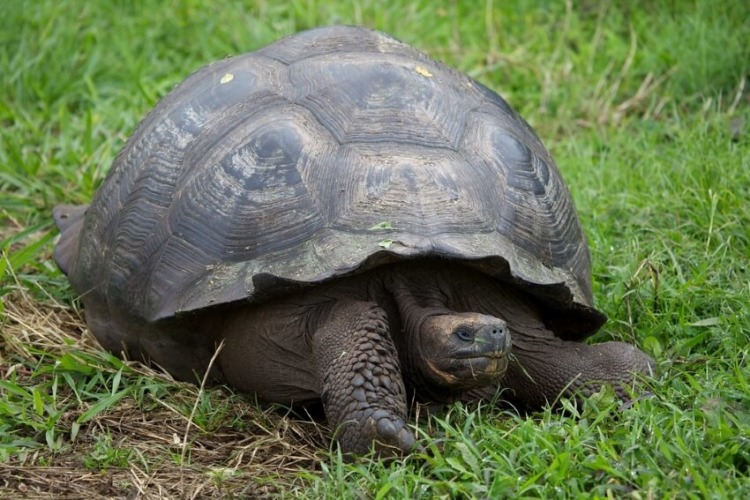
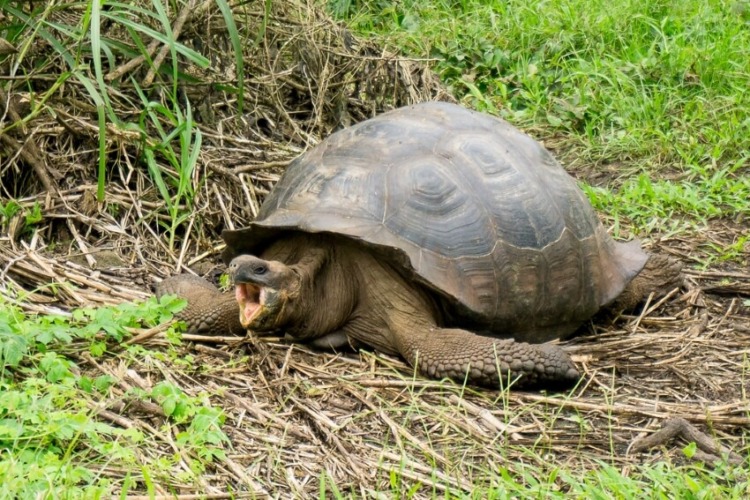
Galápagos giant tortoises have thick, column-like legs, long necks, small heads, and heavy shells. Adult males are generally larger than females and have longer, thicker tails. The largest males can exceed 250 kilograms (550 pounds), although body size varies substantially among lineages and habitats.
Domed, saddleback, and intermediate shells
Shell shape is the most visible difference among populations:
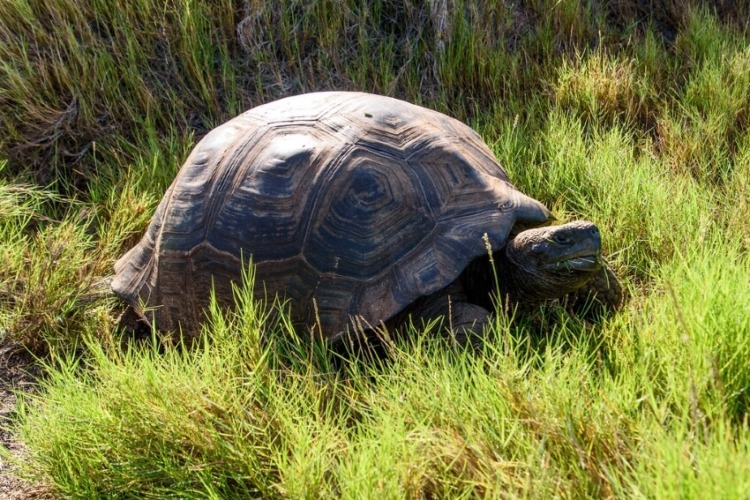
- Domed shells have a rounded profile and a lower front opening. They are often associated with more humid areas where grasses and low plants are readily available.
- Saddleback shells rise sharply above the neck, giving the tortoise more vertical reach. They are common in arid habitats where cactus pads, shrubs, and other food may grow above ground level.
- Intermediate shells combine features of both forms.
The habitat pattern is useful, but it is not an absolute rule. Genomic and developmental research indicates that shell shape has a heritable basis, while local ecology and evolutionary history also matter.
Habitat, diet, and daily movement
Galápagos giant tortoises live in environments ranging from arid cactus scrub to humid highland forest and volcanic grassland. The exact habitat depends on the island, elevation, rainfall, and season. Understanding the difference between a species’ immediate habitat, its ecosystem, and the broader biome helps explain why protecting a nesting site alone is not enough.
What do they eat?
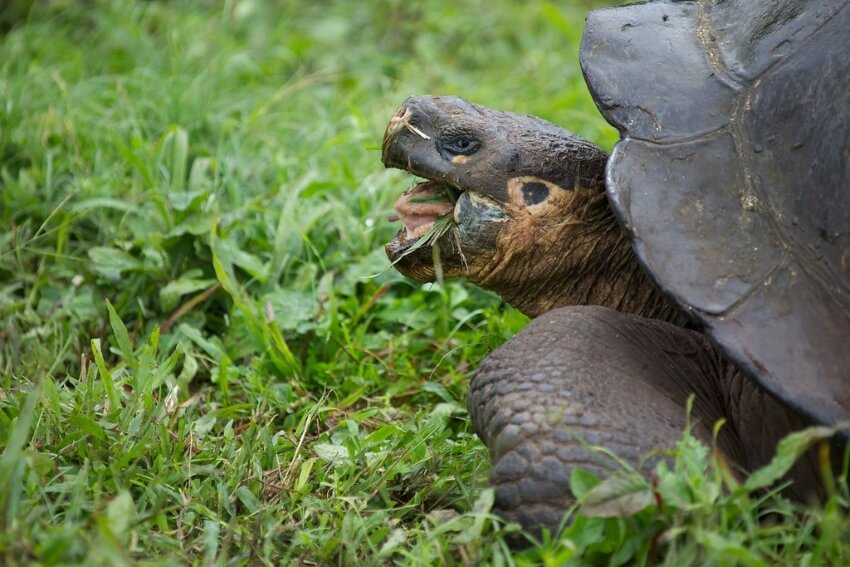
They are herbivores. Their diet can include grasses, sedges, leaves, herbs, flowers, berries, guava, shrubs, cactus pads, and cactus fruit. Food availability changes with rainfall and elevation. Tortoises obtain much of their moisture from plants and can tolerate long periods without regular access to fresh water.
Do Galápagos tortoises migrate?
Some do. On Santa Cruz, adults may move between warmer lowlands used for nesting and cooler, wetter highlands with abundant forage. These seasonal routes can cross farms, fences, roads, and visitor areas. That creates a conservation problem different from the challenges on remote uninhabited islands: the animals must share working landscapes with people.
Giant tortoises are most active during daylight. They forage, bask, rest in shade, soak in muddy wallows, and travel slowly but persistently across large home ranges. During dominance encounters, males may stretch their necks to appear taller; the individual that holds its head highest often gains priority without a prolonged fight.
Reproduction and lifespan
Breeding timing varies by island and climate. Females travel to suitable nesting ground, dig flask-shaped holes with their hind legs, lay a clutch of hard-shelled eggs, cover the nest, and leave. Depending on the lineage, a clutch may contain a few eggs or more than 20.
Incubation commonly lasts several months. Nest temperature influences the sex of hatchlings, a biological feature that conservation breeding programs must manage carefully. Young tortoises are far more vulnerable than adults: introduced rats, pigs, cats, and dogs can eat eggs or kill hatchlings before their shells harden.
Galápagos giant tortoises mature slowly, commonly taking two decades or more to reproduce. They often live beyond 100 years, and some documented individuals have exceeded 150. Long life can buffer a population for a time, but slow maturity also means recovery takes decades. Losing breeding adults or repeatedly losing nests cannot be reversed quickly.
Why giant tortoises matter to Galápagos ecosystems
Giant tortoises are ecosystem engineers: their ordinary movement and feeding change the physical environment in ways that affect other species. They:
- graze grasses and browse shrubs, changing plant height and density;
- carry seeds through their digestive systems and deposit them with nutrient-rich dung;
- open paths and clearings through dense vegetation;
- create wallows and small disturbed patches used by other organisms; and
- move nutrients between feeding, resting, and nesting areas.
On Española, reintroduced tortoises help keep areas open for waved albatrosses to approach nesting grounds and take flight. That is a more accurate description of their ecological relationship than treating tortoises as a major food source for Galápagos predators. Their value comes mainly from shaping habitat and moving seeds and nutrients. These links between tortoises, vegetation, and other wildlife show why conservation must protect ecological relationships, not only individual animals.
Main threats to Galápagos giant tortoises
| Threat | How it causes harm | Current response |
|---|---|---|
| Introduced predators | Rats, pigs, cats, and dogs eat eggs or kill hatchlings and juveniles | Eradication, control, nest protection, and head-starting |
| Introduced herbivores and invasive plants | Goats and other animals compete for food or transform vegetation; invasive plants can obstruct movement and replace native forage | Island restoration, vegetation management, and biosecurity |
| Habitat fragmentation | Roads, fences, farms, and development interrupt migration routes and increase collision or conflict risk | Movement research, wildlife-friendly fencing, landowner cooperation, and road management |
| Historic hunting and modern illegal removal | Sailors removed enormous numbers for food; poaching and wildlife trafficking can still harm small populations | Legal protection, enforcement, monitoring, and traceable captive management |
| Climate variability and disease | Rainfall, drought, nesting temperatures, and emerging pathogens can affect food, reproduction, sex ratios, and survival | Long-term monitoring, health screening, and adaptive management |
Historic exploitation
From the seventeenth through nineteenth centuries, pirates, whalers, fur sealers, and other sailors collected tortoises for meat. Because the animals could survive for long periods aboard ships, crews stored them alive as a source of fresh food. Estimates of the number removed vary, but at least one conservation account places the toll at about 100,000 between 1774 and 1860. Several island populations collapsed before modern conservation began.
Invasive species
Introduced mammals caused a second wave of damage. Goats stripped vegetation and competed for food. Pigs dug up nests. Rats consumed eggs and hatchlings. Cats and dogs attacked young animals. Removing or controlling invasive species can be ethically and operationally difficult, but on islands it may be the only way to prevent repeated losses of native wildlife. This analysis of the tradeoffs involved in culling invasive animals explains why conservation programs must weigh animal welfare, ecological necessity, feasibility, and long-term monitoring.
Human–tortoise conflict
On inhabited islands, tortoises may cross roads, enter farms, become blocked by fences, or encounter domestic animals and waste. Effective habitat-loss solutions therefore include migration corridors, compatible fencing, speed management, landowner partnerships, and careful development—not only protected-area boundaries.
Conservation progress: what is working?
The recovery of several populations is one of the strongest examples of long-term wildlife conservation producing measurable results. The core strategy combines protection of wild adults, captive breeding, head-starting, genetic management, invasive-species control, habitat restoration, and long-term monitoring.
Breeding and head-starting
At breeding centers on Santa Cruz, Isabela, and San Cristóbal, eggs or hatchlings from vulnerable populations are protected during their most dangerous years. Young tortoises are generally raised until about five years old, when their larger size and harder shells improve their chances of surviving introduced predators. Galápagos Conservancy reports that more than 10,000 tortoises have been reared and returned to the wild through these programs.
The Española recovery
By the 1960s, only 15 known Española tortoises remained: 12 females and three males. A carefully managed breeding program produced thousands of descendants. More than 2,300 have been reintroduced, and the island now supports a naturally reproducing population. The program is a major success, but its narrow founder base means genetic diversity still requires attention.
The 2026 return to Floreana
On February 20, 2026, conservation partners released 158 juvenile tortoises of Floreana lineage into their ancestral habitat. Their breeding stock descended from Wolf Volcano animals carrying Floreana ancestry, probably because sailors moved tortoises among islands. The release does not erase the extinction of the original wild population, but it restores close descendants and the ecological functions tortoises had performed on Floreana.
The search for Fernandina tortoises
For more than a century, the Fernandina giant tortoise was known only from a specimen collected in 1906. In 2019, researchers found an elderly female later named Fernanda. A 2022 genetic study confirmed that she belongs to the same lineage as the historic specimen. She remains the only publicly confirmed living individual, so field teams continue searching the island for more.
Restoring whole islands
Breeding more tortoises is not enough if their habitat remains degraded. Conservation teams also remove invasive mammals, restore native vegetation, maintain biosecurity, study migration, and monitor released animals. This is where conservation and preservation differ in practice: recovery often requires active intervention rather than leaving a damaged ecosystem untouched.
How visitors can protect giant tortoises
Wildlife tourism can support local livelihoods and conservation, but close contact can alter animal behavior and damage habitat. Follow the Galápagos National Park visitor rules:
- Stay at least 2 meters (6 feet) from tortoises and other wildlife.
- Never touch, feed, chase, surround, or reposition an animal for a photograph.
- Remain on marked trails and follow the instructions of authorized naturalist guides.
- Do not use flash photography near wildlife.
- Do not remove shells, bones, plants, rocks, sand, or other natural material.
- Follow all biosecurity rules so seeds, insects, soil, and pathogens are not moved between islands.
- Choose operators that enforce wildlife-distance rules rather than promising unusually close encounters.
Key takeaways
- “Galápagos giant tortoise” describes multiple island lineages, not one uniformly assessed species.
- Living lineages range from Vulnerable to Critically Endangered, and all remain conservation concerns.
- Current public estimates place the archipelago-wide population at roughly 30,000–45,000, but the total is not a synchronized census.
- A 2025 genome study supports at least nine and probably 13 species-level lineages, while conservation organizations commonly use 12 living named forms.
- Invasive species, habitat fragmentation, slow reproduction, illegal removal, climate variability, and disease remain important risks.
- Breeding, head-starting, invasive-species control, and habitat restoration have produced real recoveries, including the 2026 return of Floreana-lineage tortoises.
Galápagos giant tortoises show both the limits and the promise of conservation. Their recovery is not complete, and success on one island should not hide the vulnerability of another. Still, decades of patient work have rebuilt populations and restored ecological processes that once appeared lost. That is why the importance of wildlife conservation is measured not only by preventing extinction, but by returning species to functioning landscapes.
Frequently asked questions
Are Galápagos giant tortoises endangered?
Yes, in the broad sense. The name covers multiple island lineages whose IUCN assessments range from Vulnerable to Critically Endangered, while several historic taxa are extinct. It is more accurate to report the status of a specific lineage than to assign one label to every Galápagos giant tortoise.
How many Galápagos giant tortoises are left?
Current conservation sources do not publish one harmonized archipelago-wide total. The Charles Darwin Foundation estimates 30,000–35,000 individuals, while Galápagos Conservancy reported approximately 45,000 in late 2025. This article therefore uses a dated range of roughly 30,000–45,000.
How many species of Galápagos giant tortoise are there?
Conservation organizations commonly refer to 12 living named species. A 2025 whole-genome study analyzed 13 extant taxa—including two genetically distinct Wolf Volcano populations—and found that the complex contains at least nine species, with most analyses supporting 13. The taxonomy remains under scientific review.
How long do Galápagos giant tortoises live?
They commonly live for more than 100 years, and some documented individuals have lived well past 150. Exact lifespan varies among individuals and is difficult to measure in wild tortoises that may have hatched before long-term records began.
What do Galápagos giant tortoises eat?
They are herbivores that eat grasses, leaves, herbs, flowers, fruit, shrubs, and cactus pads or fruit. The mix changes with the island, elevation, season, and available rainfall.
Why are Galápagos giant tortoises important?
They are ecosystem engineers. By grazing, trampling vegetation, opening paths, creating wallows, moving nutrients, and dispersing seeds, tortoises help shape habitats used by native plants and other animals.
Related species profiles
See Related: Giant Armadillo: Is This Species Endangered?
See Related: Top 10 Interesting Facts About Giant Pandas