
For most adults, the best sustainable toothpaste is a fluoride formula in the lowest-waste package they will use correctly twice a day. Toothpaste tablets can reduce packaging and travel well, but a recyclable tube may be the better choice if it makes consistent brushing easier.
Sustainable toothpaste is not defined by one ingredient or package. A useful comparison has to consider cavity protection, the amount and type of packaging, refill availability, local recycling or composting rules, and how practical the product is for daily use.
This guide compares current fluoride tablets, refillable jars, aluminum tubes, recyclable plastic tubes, and fluoride-free hydroxyapatite options. Product specifications and availability were checked on July 22, 2026. Prices are not listed because they change frequently and differ by country, retailer, and subscription plan.
Disclosure: Some links on Our Endangered World may be affiliate links. We may earn a commission from eligible purchases at no additional cost to you. The rankings below are based on manufacturer documentation, oral-health guidance, packaging information, and independent desk research. We did not hands-on test every product.
This article provides general information and does not replace advice from a dentist. People with a high cavity risk, sensitive teeth, gum disease, braces, recurring mouth irritation, or prescription-fluoride needs should seek individualized guidance before changing toothpaste.
Key Takeaways
- Oral health comes first. The American Dental Association and Centers for Disease Control and Prevention recommend fluoride toothpaste for cavity prevention.
- Tablets are a format, not an active ingredient. Some contain fluoride, some contain hydroxyapatite, and others contain neither recognized fluoride anticaries active nor a clearly stated alternative.
- Refillable packaging usually has the clearest waste-reduction advantage when refills remain available and the original container is reused many times.
- “Recyclable” does not mean locally accepted. Check the package and your municipal recycling program before placing a tube, cap, pouch, or aluminum container in curbside recycling.
- Fluoride-free does not automatically mean safer or more sustainable. Formula suitability depends on cavity risk, age, dental history, and professional advice.
- The most practical option may be better than the theoretically lowest-waste one. A product only works when it is used correctly and consistently.
What Makes Toothpaste Sustainable?

A more sustainable toothpaste should reduce unnecessary material without compromising its main job: helping you clean your teeth and prevent oral disease. Useful criteria include a refill system, lightweight packaging, reusable containers, credible recycling instructions, transparent active ingredients, and a formula you can use consistently.
No toothpaste is literally zero-impact. Glass, aluminum, plastic, paper, ingredients, manufacturing, and shipping all use resources. Terms such as “zero waste,” “natural,” and “plastic-free” describe selected product attributes; they do not constitute a complete environmental assessment.
Toothpaste changes are also only one part of a lower-waste bathroom routine. Broader ways to reduce household waste include buying fewer disposable items, using products fully, reusing durable containers, and following local disposal rules.
Best Sustainable Toothpaste: Quick Picks

- Best overall for U.S. readers: Bite Toothpaste Bits with Fluoride
- Best lower-plastic conventional paste: Georganics Fresh Mint Fluoride Toothpaste with Hydroxyapatite
- Best refillable fluoride tablet for U.K. readers: PÄRLA Original Toothpaste Tabs
- Best fluoride and nano-hydroxyapatite tablet: Tidalove Cool Mint Toothpaste Tablets
- Best tablet flavor selection: Kaylaan Fluoride Toothpaste Tablets
- Best economical U.K. and European tablet: Denttabs Mint with Fluoride
- Best familiar natural-positioned paste: Tom’s of Maine Whiten+ Deep Clean
- Best widely available budget benchmark: Colgate Cavity Protection
- Best fluoride-free metal-tube option: Davids Hydroxi Sensitive+Whitening
- Best fluoride-free refillable glass-jar tablet: Georganics Mineral Toothtablets
Sustainable Toothpaste Comparison

| Product | Formula and format | Packaging | Best for | Main tradeoff |
|---|---|---|---|---|
| Bite Toothpaste Bits | Sodium monofluorophosphate tablets | Reusable jar and refill pouch | U.S. refill system | Premium, subscription-oriented model |
| Georganics Fresh Mint Fluoride | 1,350 ppm fluoride, hydroxyapatite paste | Aluminum tube, HDPE cap, cardboard box | People who prefer regular paste | Regional availability and local metal-recycling rules |
| PÄRLA Original | 1,450 ppm fluoride tablets | Reusable jar with refill options | U.K. fluoride-tablet users | Limited availability in some countries |
| Tidalove Cool Mint | Fluoride and nano-hydroxyapatite tablets | Eco refill or reusable tin | People seeking both listed actives | Confirm the current fluoride concentration on the label |
| Kaylaan Fluoride Tablets | 1,000 ppm sodium fluoride tablets | Reusable aluminum tin and refill formats | Flavor variety and travel | Formula details differ by flavor and SKU |
| Denttabs Mint with Fluoride | Fluoride tablets | Compact refill packaging | Lower-cost U.K. and European option | Low-foam texture requires adjustment |
| Tom’s of Maine Whiten+ Deep Clean | Fluoride paste | Recyclable full-size tube | A familiar paste with clearer tube disposal | Local programs may not accept toothpaste tubes |
| Colgate Cavity Protection | Sodium monofluorophosphate paste | Tube; check for the recyclable-tube symbol | Budget and broad availability | Less packaging reduction than a refill system |
| Davids Hydroxi Sensitive+Whitening | Fluoride-free nano-hydroxyapatite paste | Recyclable metal tube and FSC-certified box | People intentionally choosing fluoride-free paste | Does not contain an FDA-monograph fluoride anticaries active |
| Georganics Mineral Toothtablets | Fluoride-free mineral tablets | Refillable glass jar and aluminum lid | Fluoride-free, plastic-light routines | Non-foaming and no fluoride anticaries active |
How We Ranked These Products

This is an editorial comparison based on published information, not a laboratory test or a claim that every product has a lower total carbon footprint than conventional toothpaste. Products were assessed using five criteria:
- Anticavity active and label clarity: Does the manufacturer clearly state whether the formula contains fluoride, hydroxyapatite, or neither?
- Packaging reduction: Can the container be reused, refilled, recycled, or materially reduced compared with a conventional laminated tube?
- Realistic end of life: Are disposal instructions credible, and do they acknowledge that local recycling or composting acceptance can vary?
- Availability and daily usability: Is the product reasonably accessible in its main market, and is its format practical enough for consistent brushing?
- Claim transparency: Does the manufacturer provide specific ingredient and packaging information rather than relying mainly on terms such as “clean,” “natural,” or “zero waste”?
We did not assign numerical sustainability scores because comparable life-cycle data was not available for every product. A precise-looking score without consistent data would create false confidence.
Oral Health Comes Before Packaging
Fluoride remains the evidence-based default
The American Dental Association’s toothpaste guidance states that fluoride helps prevent tooth decay by strengthening and remineralizing enamel. Toothpastes making an ADA-accepted cavity-protection claim must contain fluoride. The CDC also recommends brushing twice daily with fluoride toothpaste.
In the United States, the FDA OTC anticaries monograph recognizes sodium fluoride, sodium monofluorophosphate, and stannous fluoride as active ingredients within specified formulations and concentrations.
Hydroxyapatite evidence is promising but still developing

Hydroxyapatite is a mineral related to the structure of teeth. An 18-month randomized clinical trial in adults reported promising caries-prevention results for a hydroxyapatite toothpaste. That evidence makes hydroxyapatite relevant, particularly for people who intentionally avoid fluoride, but it does not place every hydroxyapatite product on equal footing with a properly formulated fluoride toothpaste.
Hydroxyapatite is not currently listed as an OTC anticaries active in the FDA monograph. People with frequent cavities, dry mouth, exposed roots, braces, or other elevated-risk conditions should not assume that an unverified fluoride-free formula is an interchangeable substitute.
Be cautious with charcoal whitening claims

Charcoal can make a product appear environmentally simple or “detoxifying,” but those terms do not establish dental benefit. The ADA reports insufficient evidence to support the whitening effectiveness of charcoal-based dental products and notes concerns about safety and abrasivity. A conventional fluoride toothpaste is generally a more defensible daily default than an aggressive charcoal formula.
Keep products containing xylitol away from dogs

Xylitol appears in many tablet and fluoride-free formulas. It may be suitable for human oral-care products, but it is dangerous to dogs. The FDA advises keeping xylitol-containing products away from pets and seeking veterinary help immediately after suspected ingestion.
The Best Sustainable Toothpaste Options
1. Bite Toothpaste Bits with Fluoride: Best Overall for U.S. Readers

Best for: Adults who want a clearly labeled fluoride tablet and an established refill system.
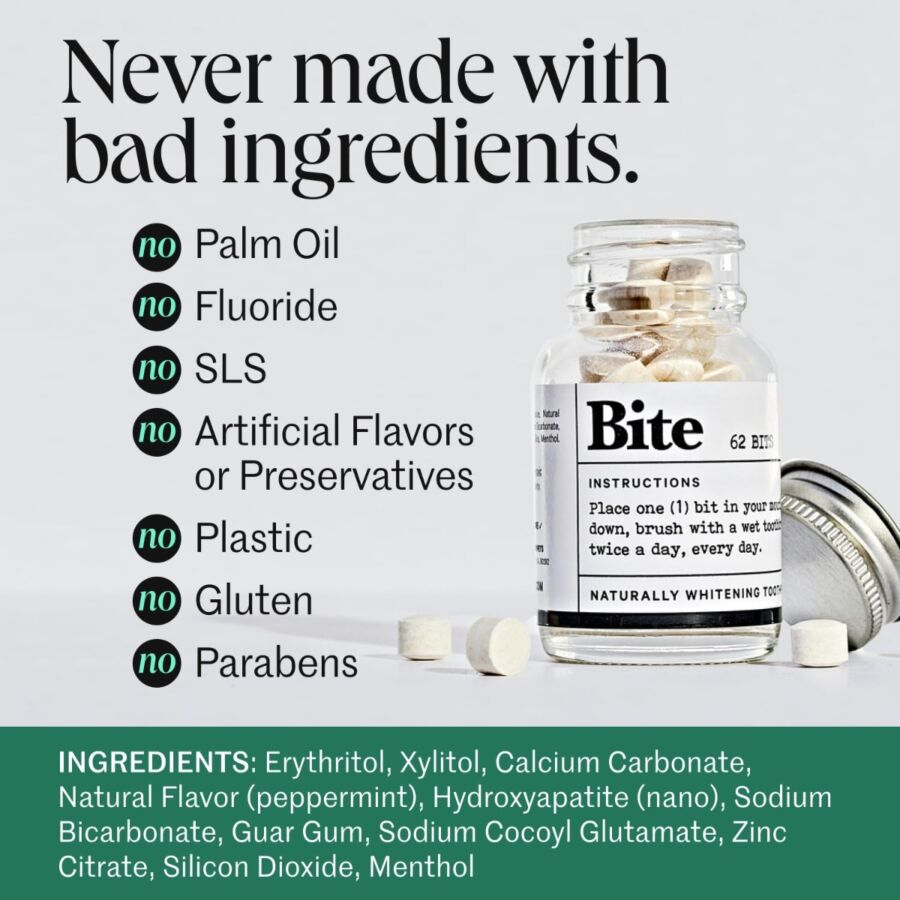
Bite’s fluoride subscription contains 248 toothpaste bits, described by the company as a four-month supply, with a refillable jar and refill pouch. The active ingredient is sodium monofluorophosphate 0.76%, providing 0.14% fluoride ion by weight.
It ranks first because it combines a recognized fluoride active with a practical tablet format and a container designed for repeated use. The pre-portioned bits are also convenient for travel and avoid the mess associated with loose tooth powder.
Main tradeoff: Bite is positioned as a premium subscription product. It may cost more than basic fluoride paste, and international availability can be less practical. A refill system only reduces waste when the jar is kept and reused rather than repeatedly replaced.
2. Georganics Fresh Mint Fluoride Toothpaste: Best Aluminum-Tube Paste

Best for: People who want the texture and routine of regular toothpaste with less conventional plastic packaging.
Georganics Fresh Mint contains 1,350 ppm sodium fluoride alongside hydroxyapatite. It comes in an aluminum tube with an HDPE lid and cardboard box. The manufacturer describes the aluminum as recyclable and made from recycled material.
This is one of the strongest options for readers who dislike chewing tablets or prefer a familiar paste. It does not require a new brushing technique, and the fluoride concentration is disclosed directly on the product page.
Main tradeoff: Aluminum-tube acceptance varies. Residual toothpaste, mixed components, and local collection rules can affect whether the tube is actually recycled. Separate the cap when local instructions require it, and do not assume that “widely recyclable” applies to every municipality.
3. PÄRLA Original Toothpaste Tabs: Best U.K. Refillable Fluoride Tablet

Best for: U.K. readers who want a dentist-founded fluoride tablet with jar and refill options.
PÄRLA Original 62 contains 62 tablets and lists 1,450 ppm fluoride. The instructions follow the usual tablet process: chew the tab briefly, wet the toothbrush, and brush normally.
The disclosed fluoride concentration, compact format, and refill model make PÄRLA a strong alternative to conventional paste for adults who are comfortable with tablets. Larger subscription quantities are also available through the manufacturer.
Main tradeoff: This is primarily a U.K.-market recommendation. Shipping cost and product availability can reduce its practical advantage elsewhere. Readers should also verify the exact packaging supplied with one-time purchases and subscriptions, because package configurations can change.
4. Tidalove Cool Mint Toothpaste Tablets: Best Fluoride and Nano-Hydroxyapatite Tablet

Best for: Adults interested in a tablet that lists both fluoride and nano-hydroxyapatite.
Tidalove’s Cool Mint tablets combine fluoride with nano-hydroxyapatite and are offered as an eco refill or tin starter. This gives new users a durable container while allowing returning customers to choose the refill format.
The combined formula is notable because many tablet brands use either fluoride or hydroxyapatite rather than listing both. The manufacturer also provides a full ingredient-list link, which is useful for readers checking flavoring agents, allergens, or personal ingredient preferences.
Main tradeoff: The visible product copy reviewed for this update did not clearly state the fluoride concentration. Confirm the current package label before ordering, particularly when comparing it with a product that explicitly lists 1,000, 1,350, or 1,450 ppm.
5. Kaylaan Fluoride Toothpaste Tablets: Best Flavor Selection

Best for: Tablet users who need more flavor choice than standard peppermint.
Kaylaan’s fluoride tablets list 1,000 ppm sodium fluoride. A standard tin contains 90 tablets, which equals approximately 45 days for one person brushing twice daily. The collection includes multiple flavors and both reusable-tin and refill formats.
Flavor variety matters more than it may seem. Strong mint and essential oils can be unpleasant or irritating for some people, while an acceptable flavor can make twice-daily use easier. The aluminum tin is also compact and less likely to leak during travel.
Main tradeoff: Kaylaan sells several flavors and both fluoride and fluoride-free formulas. Confirm that the selected SKU contains the active and concentration you intend to buy. People with elevated cavity risk should also ask a dentist whether a 1,000 ppm product fits their needs.
6. Denttabs Mint with Fluoride: Best Economical U.K. and European Tablet

Best for: Readers seeking a simple fluoride tablet with a relatively large tablet count.
The current Denttabs Mint listing contains 125 fluoride toothpaste tablets. The compact, dry format is convenient for travel, shared bathrooms, and people who dislike throwing away partly empty tubes.
Denttabs is a practical choice rather than a luxury presentation. That makes it relevant for readers who want to test a lower-waste format without buying a large starter set or elaborate container.
Main tradeoff: Denttabs has a low-foam texture that can feel unfamiliar. Foam is not the same as cleaning performance, but a person who strongly dislikes the experience may return to conventional paste. Check the current label for the fluoride concentration and age instructions supplied in your market.
7. Tom’s of Maine Whiten+ Deep Clean: Best Familiar Natural-Positioned Paste

Best for: People who want fluoride paste in a familiar tube and prefer a brand positioned around naturally sourced ingredients.
Tom’s of Maine Whiten+ Deep Clean is a fluoride toothpaste in the company’s full-size recyclable-tube format. It offers a more conventional brushing experience than tablets and may be easier to find in U.S. stores.
This is a sensible transition product for someone who is not ready for tablets or jars. Choosing a tube designed for recycling can be an improvement over a traditional multilayer tube, provided the local collection system accepts it.
Main tradeoff: It remains a single-use tube, and Tom’s acknowledges that recycling availability differs by community. Confirm that the product is full size, look for the recycling instructions on the package, and check local acceptance before placing it in curbside recycling.
8. Colgate Cavity Protection: Best Widely Available Budget Benchmark

Best for: Readers who prioritize an affordable, ADA-Accepted fluoride toothpaste and need broad retail availability.
Colgate Cavity Protection is ADA Accepted and lists sodium monofluorophosphate 0.76%, equivalent to 0.15% fluoride ion by volume on the U.S. product page. It is included because sustainability decisions should account for affordability and access, not only premium refill systems.
A basic toothpaste that a household can obtain locally and use fully may be more realistic than a specialty product requiring repeated individual shipments. Colgate has introduced recyclable tube technology, but package implementation can differ by product and market.
Main tradeoff: This is not the lowest-packaging option in the list. Check the specific tube for the recyclable-tube symbol and verify local acceptance. Do not infer that every Colgate package uses the same tube construction.
9. Davids Hydroxi Sensitive+Whitening: Best Fluoride-Free Metal-Tube Option

Best for: Adults intentionally choosing a fluoride-free nano-hydroxyapatite paste after considering their cavity risk.
Davids Hydroxi Sensitive+Whitening is a fluoride-free, SLS-free paste made with the company’s nano-hydroxyapatite formula. It comes in a recyclable metal tube with FSC-certified paper packaging and includes a metal tube key to help use the contents fully.
This is a useful option for readers who want regular paste rather than tablets but are specifically seeking a fluoride-free formula. The metal tube and clear formula description make its tradeoffs easier to evaluate than products relying on broad “toxin-free” language.
Main tradeoff: It does not contain one of the fluoride anticaries actives listed in the FDA monograph. Hydroxyapatite research is promising, but people with recurring cavities should not switch solely because the package looks more sustainable. The formula also contains xylitol and must be kept away from dogs.
10. Georganics Mineral Toothtablets: Best Fluoride-Free Refillable Glass-Jar Tablet

Best for: Adults who intentionally prefer a fluoride-free, non-foaming tablet in a reusable glass container.
Georganics Mineral Toothtablets contain 120 tablets in a refillable glass jar with an aluminum lid. The peppermint formula is fluoride-free, SLS-free, glycerin-free, and non-foaming.
The reusable jar is durable and easy to clean, while the dry tablets are convenient for travel and reduce the need for a conventional tube. This product also provides unusually clear information about the sensory difference: people should expect little or no foam.
Main tradeoff: These tablets do not contain fluoride. They should not be assumed to provide the same anticavity benefit as a fluoride toothpaste. Glass also has production and shipping impacts, so the environmental value depends on keeping the jar and purchasing refills rather than repeatedly replacing it.
How to Choose Sustainable Toothpaste
1. Start with the anticavity active

Read the Drug Facts or active-ingredient panel, not just the front-of-package claims. For most people, a fluoride toothpaste is the most evidence-supported starting point. When selecting a fluoride-free formula, identify what it contains, what evidence supports it, and whether it suits your personal cavity risk.
2. Choose a format you will use consistently

Tablets are compact and pre-portioned, but the chewing step and lower foam can take adjustment. Aluminum tubes preserve a familiar paste texture. Glass jars are reusable but heavier and breakable. A lighter recyclable tube may be more practical for families and people with limited dexterity.
3. Examine the full packaging system

A reusable jar is only useful when refills are available. A compostable pouch needs the correct composting conditions. An aluminum tube may include a plastic cap. A recyclable plastic tube still depends on local collection and processing. Review every component rather than judging the package by its most favorable material.
4. Be skeptical of vague environmental language

Terms such as “eco-friendly,” “clean,” “chemical-free,” and “all natural” do not tell you how well a toothpaste prevents cavities or what happens to the package after use. Prefer specific disclosures: fluoride concentration, tablet count, refill material, recycling resin, take-back instructions, or third-party certifications.
5. Check flavors and potential irritants

Mint, cinnamon, essential oils, detergents, and other ingredients can irritate some mouths. SLS-free formulas may be more comfortable for certain users, but SLS-free is not automatically more effective or more sustainable. Stop using a product that causes persistent burning, peeling, ulcers, or swelling and consult a dental or medical professional.
6. Verify palm-oil claims rather than inferring them

An ingredient name does not always disclose its agricultural feedstock. A brand that claims to be palm-oil-free or responsibly sourced should provide a sourcing statement or certification. Our overview of palm oil in consumer products explains why supply-chain details are more useful than treating one surfactant name as proof of palm content.
7. Use extra care when choosing toothpaste for children

Young children need an age-appropriate amount of fluoride toothpaste and adult supervision. The ADA recommends a rice-grain-sized smear from the eruption of the first tooth until age three, followed by a pea-sized amount from ages three through six. Children should be supervised so they spit rather than swallow toothpaste.
Do not give toothpaste tablets to a child who cannot safely chew, brush, spit, and follow the product’s age directions. Never assume that a candy-like flavor makes a tablet appropriate for unsupervised use.
How to Recycle or Dispose of Toothpaste Packaging

A recycling symbol is a starting point, not a guarantee. The Association of Plastic Recyclers notes that practical recyclability depends on package design, consumer access to collection, processor acceptance, and a viable end market for the recovered material.
- Read the package instructions. Look for the material, recycling symbol, cap instructions, and any take-back details.
- Use the toothpaste fully. Flatten or roll a tube where appropriate. Do not use excessive water or cut into a package unless the manufacturer or local program advises it.
- Check local rules. Search your municipality’s accepted-material list for toothpaste tubes, aluminum tubes, glass jars, caps, and flexible refill pouches.
- Separate components when instructed. A metal tube, plastic cap, paper box, and internal seal may have different disposal routes.
- Use specialist collection for excluded packaging. Programs such as TerraCycle’s oral-care recycling program may accept qualifying toothpaste tubes, toothbrushes, and related packaging that local curbside systems reject.
- Compost only as directed. “Biodegradable” and “compostable” do not mean the same thing. Follow the product’s certification and facility requirements. Our explanation of biodegradable and compostable packaging covers the distinction.
- Do not wish-cycle. Placing an unaccepted tube or pouch in curbside recycling can contaminate the stream rather than improve recovery.
Frequently Asked Questions

What is the most sustainable toothpaste?
A refillable fluoride tablet is often the strongest lower-waste option for adults, provided the active ingredient suits their oral-health needs and the refill packaging can be composted or recycled as directed. A recyclable tube may be more practical for people who will not use tablets consistently.
Are toothpaste tablets as effective as regular toothpaste?
They can be, but effectiveness depends on the active ingredient, formulation, brushing technique, and brushing time. Check the fluoride amount or discuss a fluoride-free formula with your dentist. The tablet format alone does not establish cavity protection.
Should sustainable toothpaste contain fluoride?
For most adults and children, the ADA and CDC recommend fluoride toothpaste because fluoride helps prevent cavities and supports enamel remineralization. People considering fluoride-free toothpaste should account for their personal cavity risk and seek professional advice when needed.
Are toothpaste tubes recyclable?
Many newer tubes are designed with recyclable plastic or metal, but local acceptance varies. Check the package and your local collection program. A specialist oral-care recycling program may be an alternative when curbside collection does not accept the tube.
Is charcoal toothpaste safe for daily use?
Charcoal formulas vary. Some may be abrasive, many are fluoride-free, and the ADA reports insufficient evidence for charcoal-based whitening claims. An evidence-based fluoride toothpaste is usually the more defensible everyday default unless a dentist recommends otherwise.
Can children use toothpaste tablets?
Only use tablets when the child can safely chew, brush, spit, and follow the product’s age label. Young children need supervision and an age-appropriate amount of fluoride toothpaste. Ask a pediatric dentist when the child’s cavity risk or ability to use tablets is uncertain.
Which Sustainable Toothpaste Should You Choose?

For most U.S. adults interested in toothpaste tablets, Bite offers the clearest combination of a recognized fluoride active and a reusable-container system. People who prefer regular paste should consider Georganics Fresh Mint Fluoride, Tom’s of Maine, or a locally available fluoride toothpaste in a tube their recycling program accepts.
PÄRLA and Denttabs are stronger options for U.K. and European tablet shoppers. Davids and Georganics Mineral Toothtablets serve people intentionally seeking fluoride-free hydroxyapatite or mineral formulas, but neither should be treated as the automatic choice simply because its packaging appears more sustainable.
The most defensible decision is neither perfection nor the package with the strongest environmental slogan. Choose a suitable formula, use it fully, brush correctly twice a day, reuse durable packaging, and follow the disposal rules where you live.