
The spoon-billed sandpiper (Calidris pygmaea, formerly Eurynorhynchus pygmeus) is a tiny, Critically Endangered wading bird famous for its unique spatula-shaped bill, which it sweeps through shallow water to sift out small crustaceans and mollusks. It breeds in the Arctic tundra of north-eastern Russia and winters in South and Southeast Asia, with only around 490 mature individuals left in the wild.
- Status: Critically endangered
- Known as: Spoon-Billed Sandpiper (Calidris pygmaea).
- Estimated numbers left in the wild: ~490 mature individuals (roughly 470–920 of all ages), and declining.
They are one of the rarest birds in the world, with a global population estimated at only around 490 mature individuals (roughly 470–920 of all ages) and declining by about 8% a year.
The main threat they face is loss of habitat as wetlands dry up or become degraded due to development and climate change. This bird also faces threats from hunting, collisions with manmade objects such as power lines, fishing nets, and oil spills.

The spoon-billed sandpiper has been a focus of international conservation concern for decades. It was uplisted to Critically Endangered on the IUCN Red List in 2008, meaning it faces an extremely high risk of extinction in the wild in the near future.
They are threatened with extinction because they breed only on a narrow strip of Arctic coastal tundra in north-eastern Russia and depend on a handful of tidal-flat staging sites along the Yellow Sea during migration, making them highly vulnerable to habitat loss, pollution, and hunting.
Description
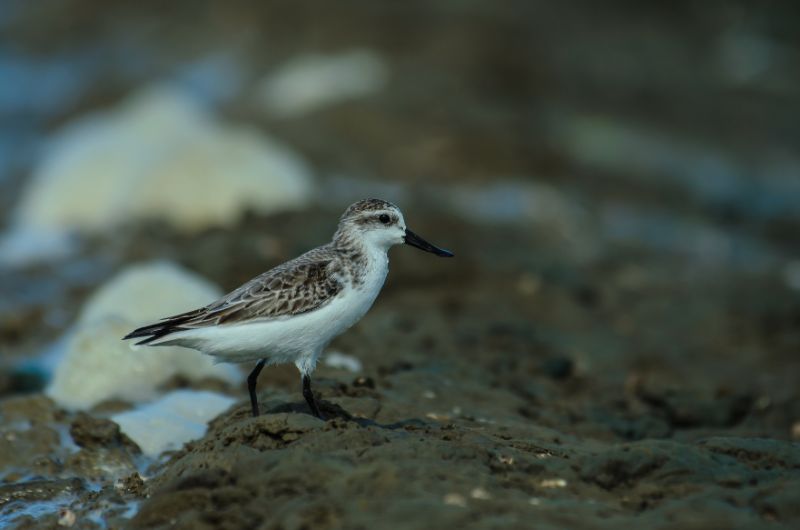
Spoon-Billed Sandpipers are small birds, 14 to 16 centimeters long, with the usual sandpiper “look” – plump body, long black legs, and a rounded, alert-looking head.
Their feathers are ginger-colored on the head with darker brown streaks, while the back is darker. Their most distinctive feature is their beak. The tip is flared out into a “spatula” shape to be much wider at the end than at the base.
See Related: Amsterdam Albatross
Anatomy and Appearance
They are one of the rarest and most endangered birds on the planet. The bill of this bird is shaped like a spoon and is used to filter through shallow water for tiny crustaceans and mollusks.
Spoon-billed sandpiper plumage is brown with longitudinal white stripes on its wings, back, head, neck, breast, tail coverts, flanks, and underwing coverts.
They are small, slender wading birds that measure about 14–16 cm (5.5–6 in) in length and weigh only around 30–34 g (about 1 oz). Their plumage ranges from light to dark brown, with a pale grey, spatula-tipped bill and a reddish head and breast in the breeding season.
Location
The spoon-billed sandpiper nests in north-eastern Russia, mostly on the Kamchatka and Chukotsk peninsulas. It winters in Myanmar and Bangladesh.
A few individuals winter in Vietnam, India, China, Sri Lanka, Thailand, Singapore, and Malaysia. The summer range is tundra with freshwater pools, while the winter-favored habitat is mostly tidal flats.
See Related: Environmental Organization in Europe
Spoon-billed Sandpipers Habitat
Their breeding home is the Arctic coastal tundra of north-eastern Russia. On migration and in winter they depend on tidal mudflats along the East Asian–Australasian Flyway, especially the Yellow Sea coasts of China and the Koreas and wintering sites in Myanmar, Bangladesh, and southern China, where they feed by sifting through shallow water for small crustaceans and mollusks.
The spoon-billed sandpiper is a long-distance migrant along the East Asian–Australasian Flyway, travelling south each winter to the coasts of Myanmar, Bangladesh, Thailand, Vietnam, and southern China — it does not reach Australia or New Zealand.
Every year, however, a large number die during their migration. It is estimated that only around 490 mature individuals of this species now remain.
Spoon-billed Sandpipers Diet and Nutrition
These bird species are wading birds that feed on insects, small invertebrates, and a variety of larval and adult invertebrates such as worms.
They walk through the shallows, wet meadows, and similar areas, moving their red-brown head left and right to forage. Mudflats and saltpans are the areas favored by these birds in the winter, where invertebrate prey is plentiful.
See Related: Yellow-Eared Parrot
Spoon-billed Sandpipers Mating Habits

It is a bird species that are extremely territorial birds and almost breeding adults always return to precisely the same spot to breed each year.
These sites are defended vigorously by the males, who are the first to migrate north in the spring. These sandpipers are monogamous, with both parents tending the nest during the two to three weeks it takes the eggs to hatch. The species is very particular about the areas where it will nest, making it especially vulnerable to habitat destruction.
They will not nest further than 5 kilometers from the shore, prefer lagoon spits, and are typically the only nest where crowberry lichen, dwarf birch, and willow sedge are present, as well as freshwater pools.
The chicks follow their parents and forage alongside them for two weeks until they fledge and can join the southward migration at summer’s end.
Conservation Status
The Spoon-billed Sandpiper is classified as Critically Endangered on the IUCN Red List. Birdlife International and Wildlife conservation groups aim to lift the bird from the list.
Threats
Their single biggest threat is the bird trappers in Myanmar, where these waterfowl overwinter. Mist nets are often used to capture the birds alive to keep them fresh longer without refrigeration. Poisoned fish are also used to kill waterfowl for human consumption.
At least half of the Spoon-Billed Sandpipers winter in the Bay of Martaban, where the most intensive and successful subsistence hunting occurs.
The loss of intertidal staging habitat along the Yellow Sea, together with hunting on the wintering grounds, drives the species’ sharp and accelerating decline. Without sustained conservation these unusual sandpipers remain at real risk of extinction, though intensive efforts have so far helped slow the loss.
Conservation efforts
Conservation efforts are underway to try to save the spoon-billed sandpiper, though these may be too little, too late. Some areas in the summer range are now protected, but it is urgently necessary for more to be done and for protection to be given and enforced in Myanmar.
One initiative supplies Myanmar bird trappers with the equipment needed for a different occupation since bird trapping is a highly undesirable way to make money. Most hunters would prefer to do something else.
See Related: Best Conservation Posters
Organizations
Wildfowl & Wetlands Trust

The Wildfowl & Wetlands Trust protects wetlands in the UK and around the world, and the wildlife found in these habitats like the Spoon-billed Sandpiper.
Final Thoughts
Spoon-billed Sandpipers are a rare species found in the wild. Spoon-bills get their name from their distinctive bill which is shaped like a spoon and is used to feed by sifting through shallow water for small crustaceans and mollusks. Habitat destruction has also been cited as being one of the major factors contributing to this bird’s endangerment status.
Spoonbill sandpiper conservation programs include supplying hunters with equipment that will allow them to find other work since trapping birds is not a desirable income generation for these people.
FAQ
Is the Spoon-Billed Sandpiper endangered?
Spoon-Billed Sandpipers (Calidris pygmaea, formerly Eurynorhynchus pygmeus) are classified as Critically Endangered by the IUCN and their numbers are still declining. They feed on small crustaceans and mollusks with their long bill, which is shaped like a spoon.
Their only breeding grounds are on the Arctic coastal tundra of north-eastern Russia (Chukotka and the Kamchatka isthmus); the global population is now estimated at only around 490 mature individuals.
How many Spoon-Billed Sandpipers are left?
They are among the most endangered wading birds in the world. From several thousand pairs in the 1970s, the population has crashed to roughly 490 mature individuals today, and it continues to decline by about 8% a year.
Other Species Profile
Related Resources