Solar lead-acid batteries remain a practical choice for off-grid cabins, backup systems, and cost-sensitive installations where weight and daily cycle count are not the main constraints. Flooded batteries usually have the lowest purchase cost but need watering and ventilation. AGM models remove routine watering. Gel batteries can work in selected applications but require a compatible charging profile. For a compact system that will cycle deeply every day, lithium iron phosphate deserves a lifetime-cost comparison.
This guide explains how lead-acid storage works, how to size a battery bank, what changes between flooded, AGM, and gel designs, and which charging, maintenance, and safety mistakes shorten service life. The U.S. Department of Energy’s lead-battery assessment describes the chemistry as mature and relatively inexpensive, but also notes its lower energy density and the strong relationship between depth of discharge and cycle life.
Key takeaways
- Choose a deep-cycle battery, not an automotive starting battery. Solar storage requires repeated energy delivery rather than short engine-starting bursts.
- Size the bank for usable watt-hours, not nameplate amp-hours alone. Allow for depth of discharge, system losses, discharge rate, temperature, aging, and days without adequate solar production.
- Match the charge controller to the exact battery type and model. Flooded, AGM, and gel batteries can require different absorption, float, equalization, and temperature-compensation settings.
- Treat 50% depth of discharge as a common design reference, not a universal rule. The applicable manufacturer cycle-life chart and warranty terms should determine the operating limit.
- Do not mix battery models, capacities, chemistries, or ages. Unequal batteries charge and discharge unevenly, allowing the weakest unit to limit the bank.
- “Sealed” does not mean gas-free or inspection-free. Valve-regulated batteries can vent during abnormal charging, high temperature, or failure.
- Plan for proper end-of-life handling. Return lead-acid batteries to a battery retailer or approved hazardous-waste collection program.
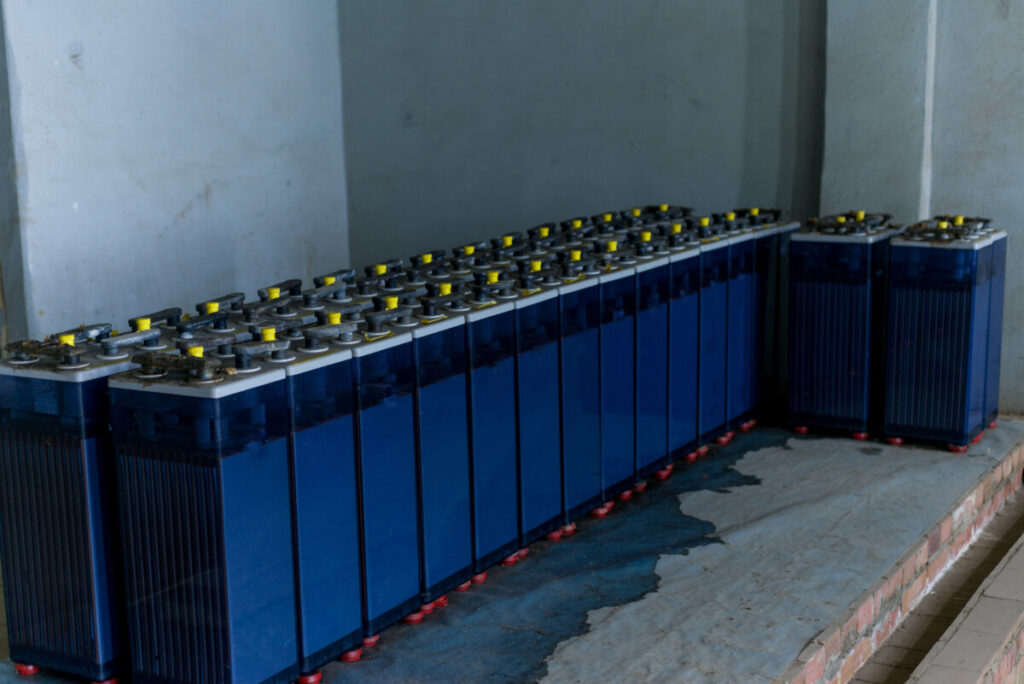
What is a solar lead-acid battery?
A lead-acid battery stores electrical energy through reactions between lead dioxide at the positive plate, metallic lead at the negative plate, and a sulfuric-acid electrolyte. During discharge, material on both plates converts toward lead sulfate. Charging reverses the process.
One lead-acid cell has a nominal voltage of about 2 volts. A 6-volt battery normally contains three cells, while a 12-volt battery contains six. Larger battery banks combine matched batteries in series, parallel, or a series-parallel arrangement.
For solar storage, look for a battery explicitly designed for deep-cycle service. Starting batteries are optimized to release a large current for a few seconds and then recharge. Repeatedly drawing a large share of their capacity causes rapid deterioration.
How a battery fits into a solar energy system
Solar panels generate direct-current electricity. In a common DC-coupled off-grid system, the charge controller regulates the panel output and applies the battery manufacturer’s charging profile. The battery stores DC energy. DC loads can use that energy through an appropriate DC distribution system, while an inverter converts battery DC into AC for household appliances.
Some residential systems are AC-coupled and use bidirectional inverters, so the exact energy path differs. The essential point remains the same: the inverter performs DC-to-AC or AC-to-DC conversion, while the battery itself stores direct-current energy.
Are lead-acid batteries a good choice for solar?
Lead-acid can still be a rational choice when low initial cost, broad availability, and local serviceability matter more than weight, space, or maximum cycle life. It is less attractive when the battery will be discharged deeply every day or installed where replacement labor is expensive.
| Use case or constraint | Lead-acid fit | Reason |
|---|---|---|
| Low upfront budget | Strong | Lead-acid commonly costs less to purchase than a comparable lithium bank. |
| Backup or occasional cycling | Strong | Standby and shallow-cycle use can suit the chemistry when charging is maintained correctly. |
| Daily deep cycling | Conditional | Deeper discharge generally reduces lead-acid cycle life, so lifetime cost may favor LiFePO4. |
| Tight weight or space limit | Weak | Lead-acid has lower energy density and is substantially heavier for the same usable energy. |
| Owner can inspect and service the bank | Strong for flooded batteries | Accessible flooded cells allow watering and specific-gravity testing. |
| No routine watering desired | Strong for AGM or gel | Valve-regulated designs do not require the user to add water. |
| Occupied or poorly ventilated enclosure | Poor without an engineered installation | Charging can release gas, and the installation must follow manufacturer and local ventilation requirements. |
The purchase price is only one part of the decision. Compare the cost per usable kilowatt-hour over the expected duty cycle, including replacement frequency, maintenance, charging efficiency, ventilation, structural support, and labor.
Types of solar lead-acid batteries
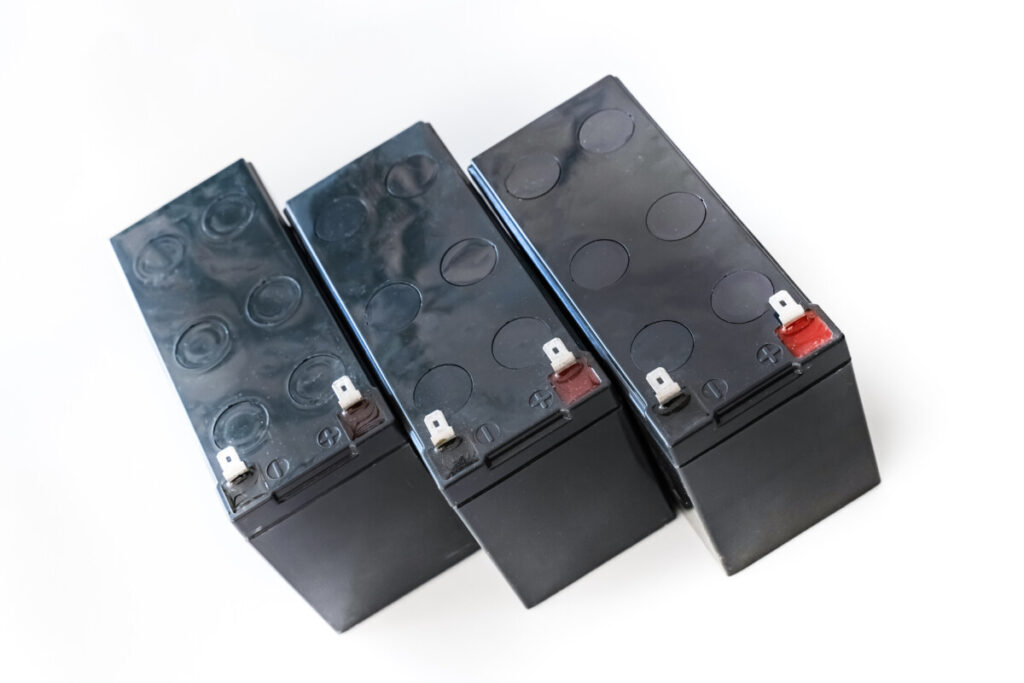
The three useful design categories are flooded, AGM, and gel. “Sealed lead-acid” and “valve-regulated lead-acid” are broader labels rather than a separate fourth chemistry.
| Type | Electrolyte and venting | Routine maintenance | Charging considerations | Typical fit |
|---|---|---|---|---|
| Flooded lead-acid | Free liquid electrolyte with vented cell caps | Watering, inspections, terminal care, and possible specific-gravity testing | May permit controlled equalization when the manufacturer prescribes it | Accessible, ventilated, budget-sensitive stationary banks |
| AGM | Electrolyte absorbed in fiberglass separators; pressure-regulated valves | No watering, but still requires inspection and monitoring | Sensitive to sustained overcharge; use the specified AGM profile and temperature compensation | Cabins, backup systems, RVs, and installations where watering is undesirable |
| Gel | Electrolyte immobilized with a gelling agent; pressure-regulated valves | No watering, but still requires inspection and monitoring | Requires a compatible gel profile and may be damaged by excessive charging voltage | Selected low-maintenance systems using gel-compatible charging equipment |
| SLA or VRLA | Umbrella terms commonly covering AGM and gel designs | Depends on the underlying design | Follow the specific AGM or gel datasheet rather than a generic “sealed” setting | Classification term, not a separate electrochemical type |
Flooded lead-acid batteries
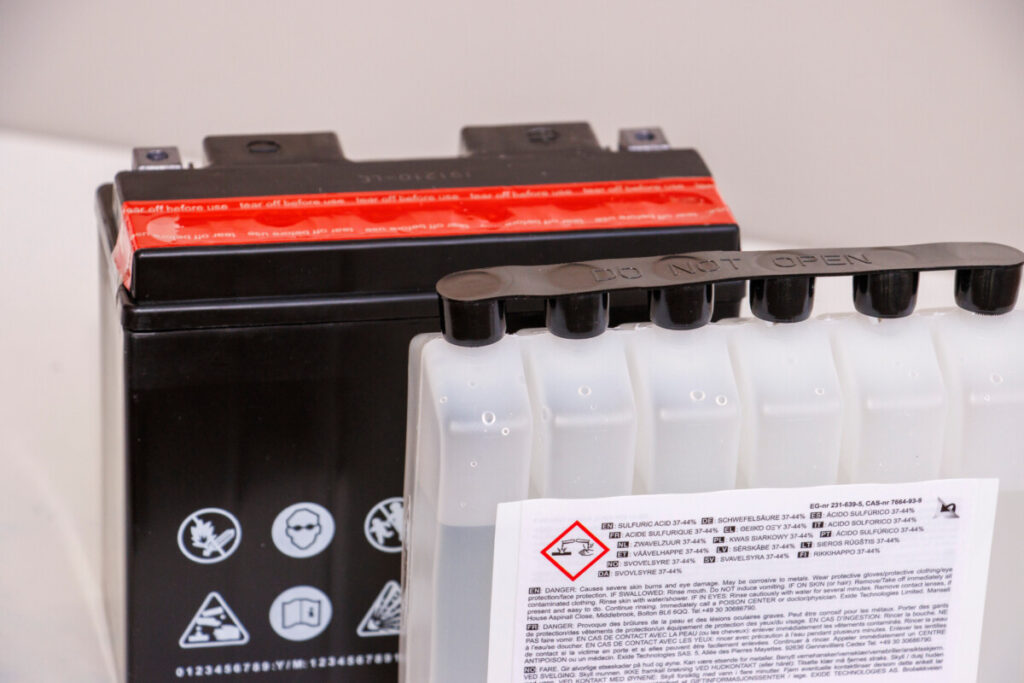
Flooded lead-acid batteries contain free liquid electrolyte and removable vent caps. They are often the least expensive deep-cycle option and make it possible to measure individual-cell specific gravity, which can reveal state-of-charge differences and failing cells.
The tradeoff is maintenance. The bank must be accessible for inspection and watering, installed upright, protected against spills, and ventilated. Water consumption varies with temperature, charging voltage, usage, and battery condition, so a fixed watering interval should not be assumed.
Best fit: A stationary off-grid system where the owner can inspect the bank, perform maintenance, and provide a properly designed battery enclosure.
AGM lead-acid batteries
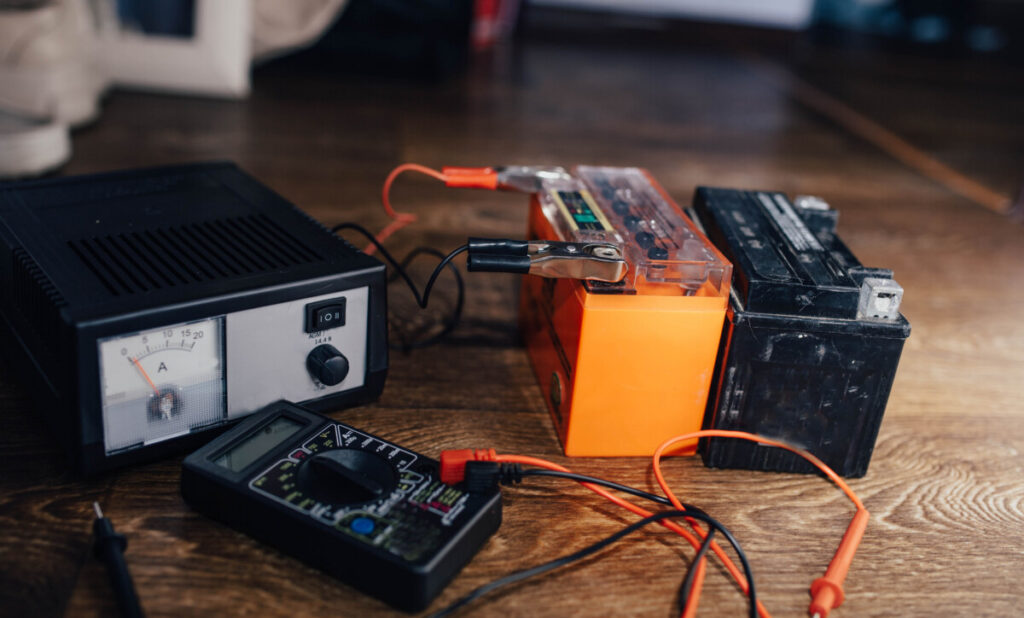
Absorbent glass mat batteries hold the electrolyte in fiberglass separators between the plates. Their valve-regulated construction recombines much of the generated gas internally during normal operation, so users do not add water.
AGM batteries can deliver high current, tolerate vibration better than many flooded designs, and simplify maintenance. They are not immune to damage. Sustained overvoltage, excessive heat, chronic undercharging, or an unsuitable equalization program can dry out the cells or accelerate deterioration.
Best fit: A lower-maintenance solar, backup, RV, or cabin installation where the charger has a verified AGM profile and the added purchase cost is acceptable.
Gel lead-acid batteries
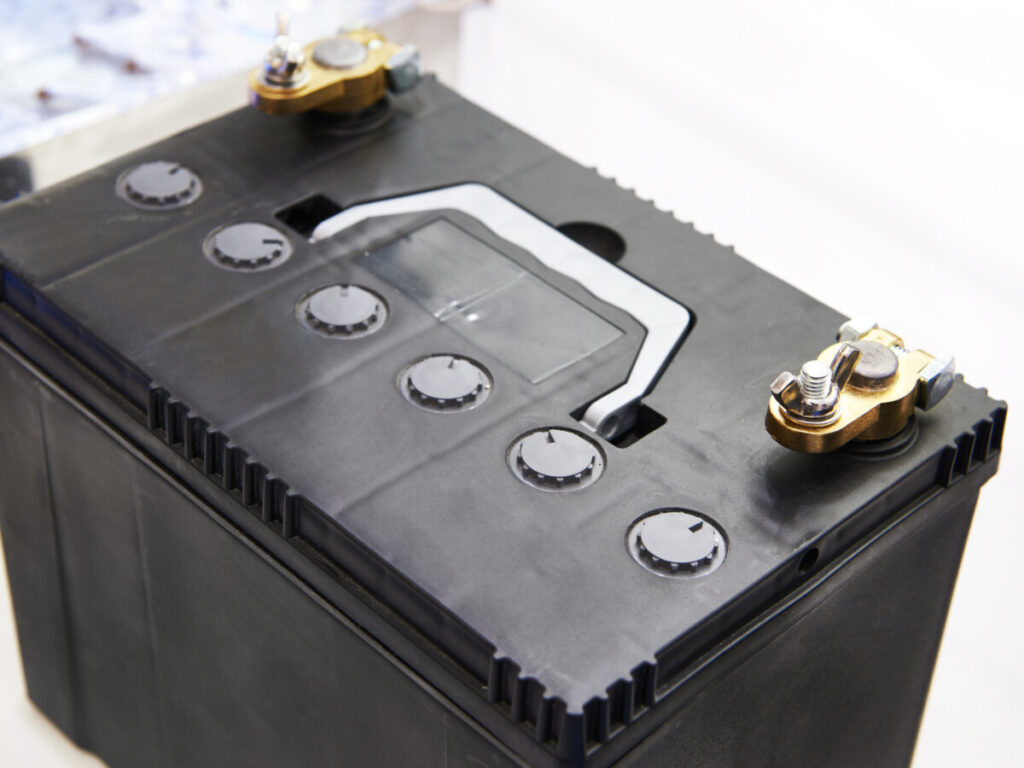
Gel batteries mix a gelling agent into the electrolyte so it does not flow freely. Like AGM, they are valve-regulated and do not require watering. They can provide low self-discharge and useful deep-cycle performance when operated within their specified limits.
Gel charging requirements are particularly important. A controller set for flooded or some AGM batteries may apply too much voltage. Gas pockets created by overcharging can reduce plate contact and cause permanent capacity loss.
Best fit: A system deliberately designed around a gel battery and a charger whose documented voltage profile matches that model. Gel should not be selected merely because the word “sealed” sounds safer.
What “sealed lead-acid” actually means
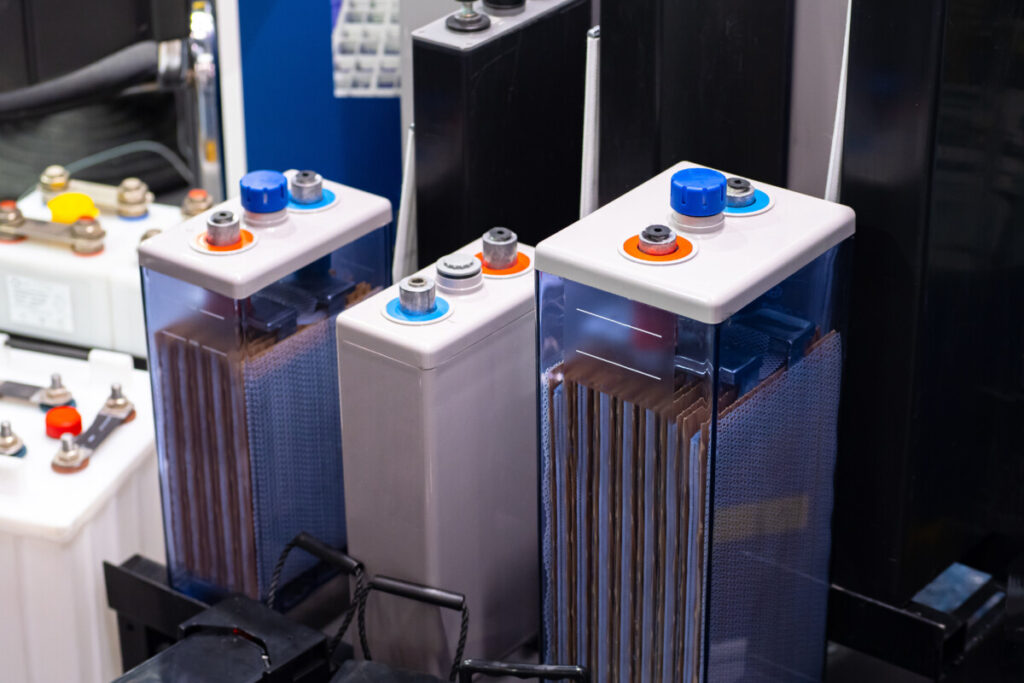
Most batteries marketed as sealed lead-acid are valve-regulated lead-acid batteries. A pressure-relief valve allows gas to escape if internal pressure rises. The battery is therefore not hermetically sealed and should not be installed on the assumption that it can never vent.
“Maintenance-free” normally means that users do not replenish water. Owners still need to inspect the case, terminals, cables, temperature, charging behavior, and physical condition.
How to choose a lead-acid battery for solar storage
1. Confirm that it is a true deep-cycle battery
Look for renewable-energy, motive-power, floor-machine, golf-cart, or deep-cycle service in the manufacturer’s documentation. A label such as “marine,” “dual purpose,” or “heavy duty” does not automatically establish that a battery is suitable for repeated solar cycling.
2. Match the bank voltage to the inverter and charge controller
Small systems may use 12 volts, while larger systems commonly use 24 or 48 volts to reduce current for the same amount of power. The battery voltage, inverter DC-input range, charge-controller output, monitoring equipment, disconnects, and DC loads must be compatible.
For example, a 2,400-watt inverter draws about 200 amps from a 12-volt bank before accounting for losses, but roughly 50 amps from a 48-volt bank. Lower current can make voltage drop and cable sizing more manageable, although higher-voltage DC brings its own equipment and safety requirements.
3. Compare usable capacity, not amp-hours alone
A 12-volt 100Ah battery has about 1,200 nominal watt-hours at its stated test rate. That does not mean all 1,200Wh should be treated as routinely usable. The operating depth-of-discharge limit, discharge rate, temperature, battery age, wiring losses, and inverter efficiency reduce the energy available to the loads.
Also check the test rate attached to the capacity. A battery rated at 100Ah over 20 hours may deliver less effective capacity when discharged rapidly. This behavior is commonly described by the Peukert effect.
4. Read the cycle-life chart at the intended depth of discharge
Do not compare a cycle number from one battery at 50% depth of discharge with another battery tested at 20%, 80%, or a different end-of-life threshold. Test temperature, discharge rate, charging procedure, and the capacity-retention threshold can materially change the published figure.
A higher nameplate cycle count is useful only when the underlying test conditions match the way the bank will operate.
5. Verify the complete charging profile
- Bulk or maximum charging current
- Absorption or cycle-use voltage
- Absorption duration or termination rule
- Float voltage
- Temperature-compensation requirement
- Equalization permission and procedure
- Minimum and maximum charging temperature
Do not rely on a generic controller preset if the preset values conflict with the battery datasheet. High battery temperature normally requires a lower charging-voltage target, making a correctly installed temperature sensor especially valuable.
6. Account for maintenance, weight, warranty, and replacement logistics
Review the battery’s installed weight, terminal type, lifting method, orientation limits, ventilation requirements, warranty exclusions, shipping restrictions, and local replacement availability. A low-cost battery can become expensive when installation access or freight makes replacement difficult.
How to size a solar lead-acid battery bank
Start with the energy your loads consume, not the number of panels or a convenient battery package. A simplified sizing process is:
- Calculate daily load energy. Multiply each appliance’s watts by its hours of use and add the results to obtain watt-hours per day.
- Choose the required autonomy. Decide how many low-solar days the bank should cover before a generator, grid charger, or load reduction is needed.
- Choose the permitted depth of discharge. Use the battery manufacturer’s cycle-life and warranty data.
- Allow for system losses. Include inverter, wiring, controller, and battery losses. A preliminary design may use a conservative combined-efficiency assumption and then replace it with equipment-specific values.
- Convert watt-hours to amp-hours. Divide the required nominal watt-hours by the bank’s nominal voltage.
- Check power and surge requirements separately. A bank that stores enough energy can still be unable to supply the inverter’s continuous or starting current.
Nominal bank watt-hours = daily watt-hours × days of autonomy ÷ allowed depth of discharge ÷ system efficiency
Required amp-hours = nominal bank watt-hours ÷ nominal bank voltage
Worked sizing example
| Input | Example value |
|---|---|
| Daily load | 2,000Wh |
| Autonomy | 2 days |
| Planned depth of discharge | 50%, expressed as 0.50 |
| Estimated system efficiency | 85%, expressed as 0.85 |
| Bank voltage | 24V |
The preliminary nominal-energy requirement is:
2,000Wh × 2 ÷ 0.50 ÷ 0.85 = approximately 9,412Wh
At 24 volts:
9,412Wh ÷ 24V = approximately 392Ah
A preliminary design would therefore look for a compatible bank near or above 400Ah at 24 volts, then verify available battery sizes, discharge-rate performance, temperature derating, aging reserve, maximum current, charging time, and manufacturer limits.
Four matched 12V 200Ah batteries could theoretically form a 24V 400Ah bank as two series strings connected in parallel, provided the manufacturer permits that configuration. This is a sizing illustration, not a final electrical design. Parallel strings require careful balancing, fusing, disconnects, and cable selection.
Series and parallel battery-bank wiring
| Configuration | What increases | What stays the same | Example |
|---|---|---|---|
| Series | Voltage | Amp-hour capacity | Two 12V 100Ah batteries become 24V 100Ah |
| Parallel | Amp-hour capacity and current capability | Voltage | Two 12V 100Ah batteries become 12V 200Ah |
| Series-parallel | Voltage and total capacity | Depends on string design | Four 12V 100Ah batteries can form 24V 200Ah as two matched series strings |
Follow these bank-design rules:
- Use the same manufacturer, model, voltage, capacity, chemistry, and age throughout the bank.
- Confirm the manufacturer permits the intended number of series and parallel connections.
- Use busbars or another balanced connection method so parallel batteries have equal-resistance current paths.
- Keep corresponding interconnect cables equal in length and conductor size.
- Size conductors for ampacity, acceptable voltage drop, insulation rating, ambient temperature, bundling, and terminal compatibility.
- Install code-compliant overcurrent protection, disconnects, strain relief, terminal covers, and enclosure barriers.
- Do not add a new battery to an old bank without manufacturer or qualified-system-designer approval.
Victron’s battery-bank wiring guidance illustrates busbar and equal-cable approaches that help prevent one parallel battery from carrying a disproportionate share of the current.
Current lead-acid battery examples
Affiliate disclosure: Some product links below are affiliate links. Our Endangered World may earn a commission from qualifying purchases at no additional cost to you. The products are specification examples rather than rankings, and no hands-on testing is claimed.
Specification check: Model information was reviewed on August 14, 2026. Verify the current datasheet, terminal configuration, charging profile, warranty, seller, shipping restrictions, and availability before designing a bank around any product.
| Model | Type | Published rating | Maintenance | Reasonable use case | Main caveat |
|---|---|---|---|---|---|
| Trojan T-105 / T-105 Plus | Flooded | 6V, 225Ah at the 20-hour rate | Watering and flooded-cell inspections | Serviceable 24V or 48V stationary banks assembled from matched units | Requires series connections, upright installation, ventilation, and ongoing maintenance |
| VMAX SLR125 | AGM | 12V, 125Ah | No watering | Lower-maintenance cabin, RV, backup, or off-grid bank | Heavy and dependent on correct AGM charging settings |
| Renogy AGM12-100 | AGM | 12V, 100Ah at the 10-hour rate | No watering | Smaller 12V systems or matched multi-battery banks | Manufacturer-listed cycle life and availability should be rechecked before purchase |
| UPG UB121000 | AGM/VRLA | 12V, 100Ah | No watering | Backup, replacement, and modest renewable-energy banks | Seller availability and warranty terms can vary |
Trojan T-105 Plus flooded battery

The Trojan T-105 family uses a 6-volt flooded format with a 225Ah rating at the 20-hour rate. Two matched batteries in series produce a nominal 12-volt string; four produce 24 volts.
This format suits owners who are comfortable maintaining flooded cells and want a modular stationary bank. It is not a convenient choice for a sealed living-space installation, an inaccessible compartment, or anyone unwilling to monitor water levels and charging behavior.
VMAX SLR125 AGM battery
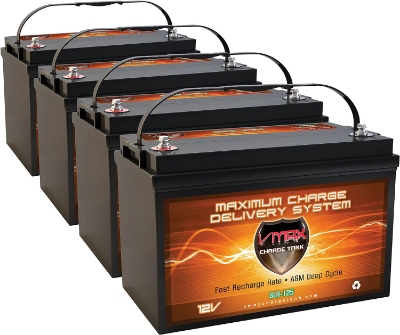
The VMAX SLR125 is a 12-volt, 125Ah AGM battery marketed for solar, off-grid, RV, and backup applications. Its valve-regulated construction removes routine watering and can simplify an installation that still has enough space and structural capacity for a heavy lead-acid bank.
Verify the controller’s AGM absorption and float settings before use. “Sealed” should not be interpreted as permission to use an arbitrary charging profile or omit enclosure planning.
Renogy 12V 100Ah AGM battery
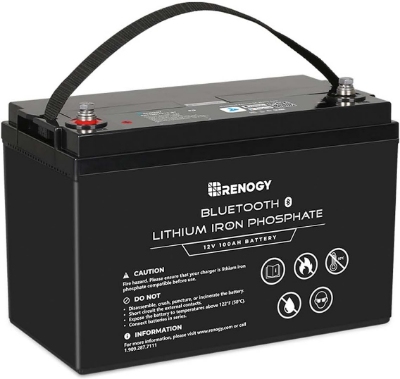
Renogy lists its 12V 100Ah AGM battery at 100Ah using a 10-hour test rate. Its published specifications include model-specific cycle-use, float-voltage, charging-current, and temperature limits that should be entered into a compatible controller.
This is a reasonable reference model for a modest 12-volt bank or matched series/parallel system. Availability has varied, so confirm the current seller and warranty rather than assuming the listing is continuously stocked.
Universal Power Group UB121000 AGM battery
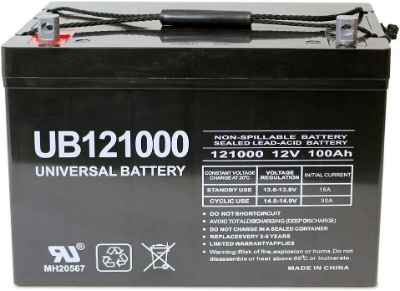
The UPG UB121000 is retailer-listed as a 12-volt, 100Ah AGM/VRLA battery. Its familiar form factor can make it relevant for replacement, backup, and modest renewable-energy applications where the system’s charging settings and physical compartment already suit a 100Ah AGM unit.
Retailer availability has not been consistent. Confirm that the seller is supplying the exact UB121000 model, review the current warranty, and obtain the applicable charging datasheet before combining multiple batteries into a bank.
Installation and charging guidance
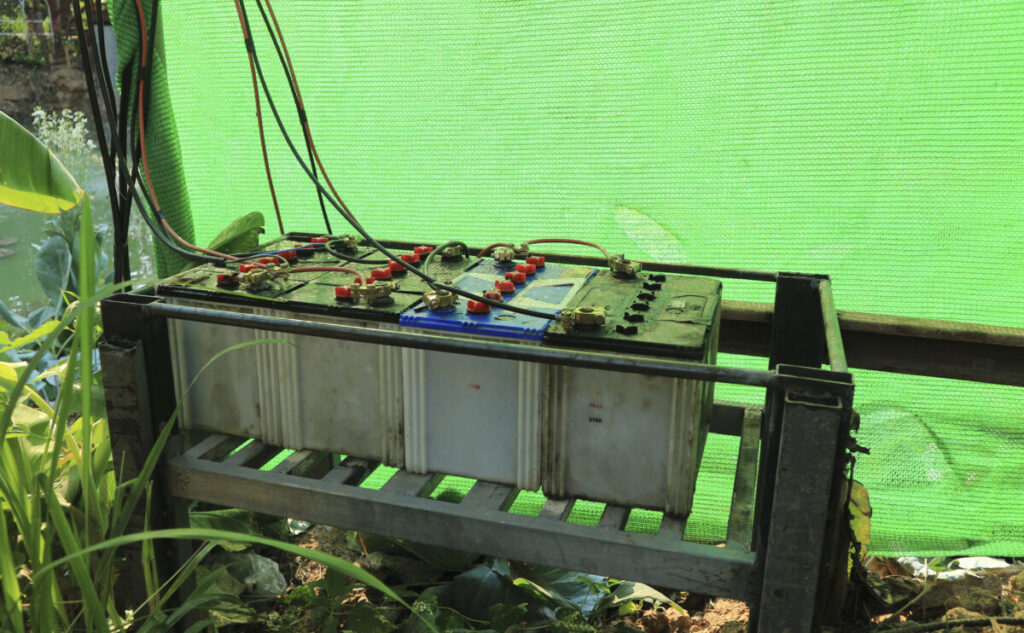
A lead-acid bank can release enough current to melt tools, damage conductors, ignite nearby material, or cause severe burns. A permanent installation should be designed and inspected by a qualified professional familiar with battery systems and the electrical rules applicable in the project’s jurisdiction.
Before installation
- Confirm that the battery, inverter, charger, controller, monitor, disconnects, and overcurrent devices are compatible.
- Choose a dry, secure, temperature-controlled location protected from direct sunlight, flooding, rain, children, pets, impact, and ignition sources.
- Provide the enclosure and ventilation required by the battery manufacturer and local code.
- Verify that floors, shelves, trays, and restraints can support the total installed weight.
- Provide enough working clearance for inspection, watering where applicable, cable service, and battery replacement.
- Cover exposed terminals and prevent conductive objects from falling across them.
Configure charging for the exact battery
- Select the battery-specific flooded, AGM, or gel profile.
- Enter manufacturer-specified absorption, float, maximum-current, and temperature values rather than assuming the controller preset is correct.
- Install the battery-temperature sensor where the equipment manufacturer directs.
- Disable automatic equalization for AGM and gel unless the battery manufacturer explicitly permits a defined procedure.
- Confirm that available solar and backup charging sources can return the bank to full charge after the planned discharge.
A properly selected compatible solar charge controller is central to battery life. An undersized array or poorly configured controller can leave the bank chronically partly charged, encouraging sulfation and capacity loss.
Commission and document the bank
- Confirm polarity before making the final connection.
- Torque terminals to the manufacturer’s specification using the correct hardware.
- Record installation date, battery model, serial numbers, open-circuit voltage, individual-battery voltage, and flooded-cell specific gravity where applicable.
- Confirm controller, inverter, monitor, and low-voltage-disconnect settings.
- Test disconnects and verify that protective devices are correctly rated and labeled.
- Observe the first full charging cycle for abnormal heat, odor, swelling, noise, leakage, or unequal battery voltage.
Lead-acid battery maintenance
Flooded-battery maintenance
- Inspect regularly. Look for cracked cases, leakage, loose hardware, damaged vents, corrosion, hot connections, and unusual water consumption.
- Recharge promptly. Avoid leaving the bank partly discharged for extended periods.
- Use distilled water. Add water rather than acid during normal service.
- Water at the correct point in the charge cycle. The manufacturer will normally direct final topping-up after a full charge. If plates are exposed, follow its emergency pre-charge instructions before charging.
- Do not overfill. Electrolyte expands during charging, so excess water can lead to overflow and acid contamination.
- Record specific gravity where supported. A persistent difference between cells can identify imbalance, undercharging, or a failing cell.
- Equalize only when prescribed. Equalization is a controlled overcharge for flooded batteries, not routine treatment for every lead-acid design.
Trojan’s flooded-battery maintenance instructions are a useful example of how watering, specific-gravity testing, discharge limits, and equalization remain model-specific. Always follow the manual supplied for the installed battery.
AGM and gel maintenance
- Do not remove valves or attempt to add water.
- Inspect cases for swelling, distortion, leakage, cracks, heat damage, or recessed terminals.
- Verify that charging voltage and temperature compensation still match the datasheet.
- Check terminal torque and cable condition without overtightening the inserts.
- Investigate persistent differences in individual-battery voltage.
- Do not apply a flooded-battery equalization program unless the VRLA manufacturer explicitly authorizes it.
- Keep the bank charged during storage according to the manufacturer’s stated interval and float procedure.
Use a shunt-based monitor for daily state-of-charge tracking
Voltage alone gives only a rough state-of-charge indication because readings change with current, temperature, recent charging, and battery condition. A properly configured shunt monitor measures current entering and leaving the bank and provides more useful daily tracking.
The monitor still requires correct settings for battery capacity, charge efficiency, Peukert exponent, charged voltage, tail current, and synchronization. Periodically compare its estimate with battery-specific tests rather than assuming the displayed percentage is permanently accurate.
Lead-acid battery safety
Safety note: Sulfuric acid, hydrogen gas, heavy battery cases, and extremely high fault current can all cause serious injury or property damage. Follow the battery safety data sheet, manufacturer instructions, equipment manuals, local electrical requirements, and qualified-installer guidance.
- Ventilate charging areas. Prevent hydrogen from accumulating into an explosive concentration.
- Keep away flames, smoking, sparks, and electrical arcs. Use appropriate insulated or non-sparking tools where required.
- Wear suitable PPE. Acid-resistant gloves, eye protection, a face shield, and protective clothing may be required when handling flooded batteries or electrolyte.
- Remove conductive jewelry. Rings, watches, and tools can create a severe short circuit.
- Provide emergency washing access. Charging and service areas should have a rapid means to flush the eyes and body.
- Use correct lifting equipment. Many deep-cycle batteries weigh 25 to 35 kilograms or more.
- Isolate all energy sources before service. Follow the documented shutdown and reconnection sequence for the array, controller, inverter, generator, grid charger, and battery bank.
- Protect against accidental short circuits. Use terminal covers, enclosures, cable supports, overcurrent devices, and disconnects appropriate to the available fault current.
- Stop if a battery is hot, swollen, leaking, hissing, or emitting an unusual odor. Isolate the area and follow the manufacturer’s emergency instructions rather than continuing to charge it.
OSHA’s battery-charging requirements provide useful baseline guidance on ventilation, PPE, electrolyte handling, and emergency washing facilities. Local residential and electrical requirements may impose additional rules.
Lead-acid versus LiFePO4 solar batteries
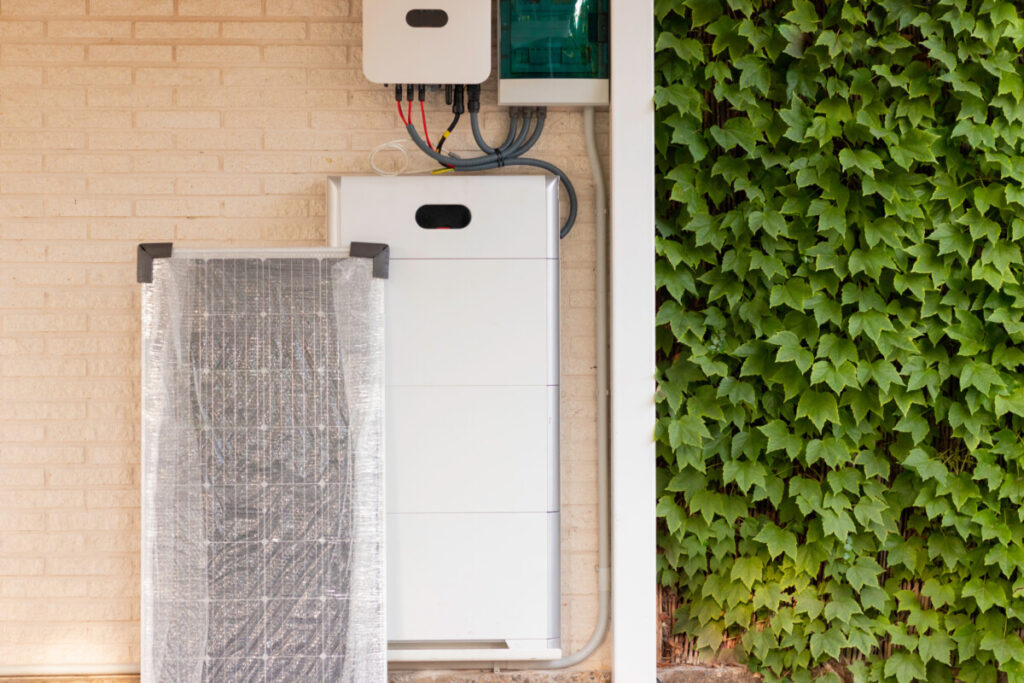
| Decision factor | Lead-acid | LiFePO4 |
|---|---|---|
| Initial purchase cost | Usually lower | Usually higher |
| Routine usable capacity | Often sized around shallower cycling to preserve life | Many models permit deeper routine discharge; use the specific BMS and warranty limits |
| Daily deep-cycle use | Cycle life is highly sensitive to depth of discharge and charging quality | Generally better suited to frequent deep cycling |
| Energy efficiency | Lower, with longer absorption charging near full state of charge | Generally higher with less extended absorption behavior |
| Weight and space | Heavy and bulky for the same usable energy | Lighter and more compact |
| Maintenance | Flooded batteries require watering; AGM and gel still need inspections | No watering; monitoring and BMS-compatible operation still required |
| Charging controls | Chemistry-specific voltage profile and temperature compensation are important | Requires a compatible charger and functioning BMS; temperature limits are model-specific |
| High-current fault risk | Present | Present |
| U.S. end-of-life collection | Mature retailer and core-charge network | Developing and dependent on installer, manufacturer, and local programs |
| Strongest use case | Lower-cost backup, occasional cycling, and owner-serviceable stationary systems | Daily cycling, tight spaces, mobile systems, and projects optimizing lifetime delivered energy |
For a bank cycled every day, compare cost per delivered kilowatt-hour rather than sticker price. A PNNL analysis of selected small-scale storage systems found that LiFePO4 could produce a lower levelized storage cost under its modeled assumptions. That result is not universal: local product prices, cycle depth, temperature, financing, maintenance, replacement labor, and system design can change the outcome.
Lead-acid remains defensible when the bank cycles infrequently, replacement products are locally available, maintenance is manageable, and the lower purchase cost solves a real budget constraint. LiFePO4 becomes more compelling as cycle frequency, usable-capacity requirements, space constraints, and replacement labor increase.
Recycling and environmental responsibility
Lead-acid batteries contain lead and corrosive sulfuric acid. Do not open, drain, burn, abandon, or place them in household trash or a municipal recycling bin.
In the United States, the EPA recommends returning used lead-acid batteries to a battery retailer or a local household hazardous-waste collection program. Retailer core charges and state disposal rules support a mature collection network, but responsible recycling still depends on controlled handling and processing.
Outside the United States, use the battery manufacturer’s take-back program or the hazardous-waste pathway designated by the relevant national or municipal authority. Transport the battery upright, protect its terminals, contain potential leakage, and follow carrier rules for hazardous materials.
Frequently asked questions
Are lead-acid batteries good for solar?
Yes, when low purchase cost, broad availability, and serviceability matter more than weight or maximum cycle life. For daily deep cycling in a tight space, compare lifetime cost with LiFePO4.
How long do solar lead-acid batteries last?
There is no reliable single year figure. Service life depends on depth of discharge, temperature, charging accuracy, time spent partly charged, maintenance, and the model’s cycle-life curve.
What depth of discharge is safe for a lead-acid solar battery?
Use the manufacturer’s limit. A 50% depth of discharge is a common design target for many deep-cycle lead-acid batteries, but some models allow different limits and occasional deeper discharge.
Can I use a car battery for solar storage?
No. Automotive starting batteries are built for short, high-current engine starts, not repeated deep cycling. Use a battery explicitly rated for deep-cycle or renewable-energy service.
How many lead-acid batteries do I need for a solar system?
Calculate daily watt-hours, multiply by days of autonomy, divide by the allowed depth of discharge and system efficiency, then divide by bank voltage. Also check inverter surge current and the battery’s discharge-rate rating.
Is AGM or gel better for solar?
AGM is usually the easier general-purpose choice when you want no watering and relatively high charge or discharge currents. Gel can suit specific low-maintenance applications, but it needs a charge controller with the correct gel profile.
Can I mix old and new lead-acid batteries?
Avoid it. Mixing ages, capacities, chemistries, or models causes unequal charging and discharging, so the weakest battery can limit or damage the whole bank.
Do sealed lead-acid batteries need ventilation?
Yes. Valve-regulated batteries recombine much of their gas internally, but they can still vent during overcharge, high temperature, or failure. Follow the manufacturer’s enclosure and ventilation instructions.
Bottom line
A lead-acid battery bank is most defensible when purchase cost, serviceability, and established local availability outweigh weight, space, and high daily cycle requirements. Flooded batteries suit owners prepared to perform maintenance. AGM offers a simpler no-watering option. Gel should be used only with a compatible charging profile and a clear application-specific reason.
Whichever type you choose, size the bank from daily watt-hours and usable depth of discharge, verify the discharge-rate rating, use matched batteries, balance parallel wiring, configure charging from the current datasheet, and prevent the bank from remaining chronically undercharged.
Next steps for your solar system
- Match the bank to one of the best solar charge controllers for the required voltage and charging profile.
- Review the optimal solar panel direction so the array can replenish the bank reliably.
- For portable USB charging rather than a stationary battery bank, compare portable solar power banks.