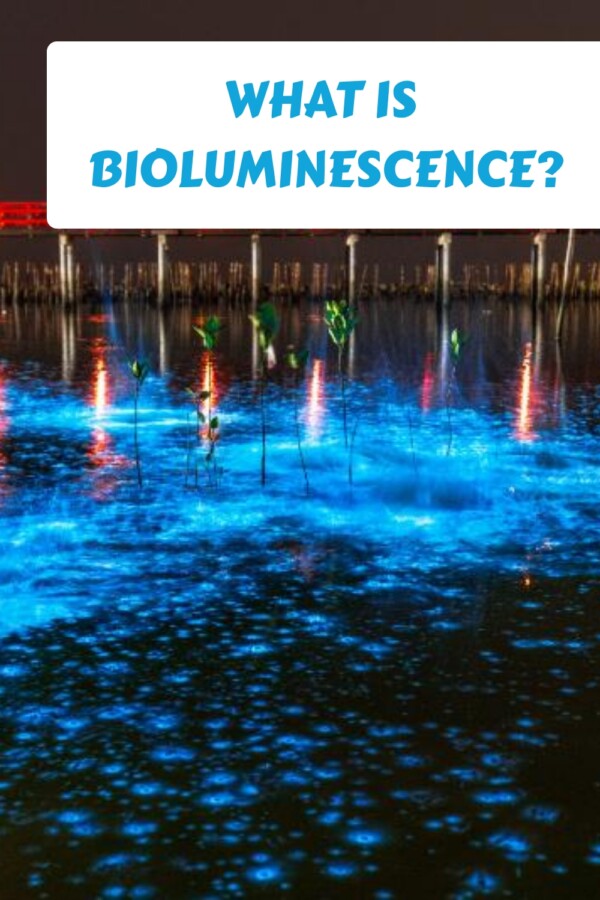
Bioluminescence is light produced by a living organism through a chemical reaction. Instead of reflecting sunlight or absorbing outside light, a bioluminescent organism makes its own glow inside its body, in specialized cells, or with help from symbiotic bacteria. Fireflies, glowing fungi, jellyfish, dinoflagellates, squid, lanternfish, and anglerfish are all examples of organisms that can produce this “living light.”
Most people notice bioluminescence in two places: summer fields where fireflies flash, and dark coastlines where disturbed waves glow blue. In the ocean, it is far more than a spectacle. NOAA Ocean Exploration notes that bioluminescence is especially common in the pelagic water column, where many animals between 200 and 1,000 meters deep can produce light.
Key Takeaways
- Bioluminescence is chemical light. It happens when a light-emitting molecule reacts with oxygen, usually helped by an enzyme or photoprotein.
- Luciferin and luciferase are the best-known terms. Luciferin is the light-producing molecule; luciferase is an enzyme that helps the reaction happen.
- The ocean is the main stage. Bioluminescence is found in bacteria, dinoflagellates, jellyfish, comb jellies, crustaceans, squid, fish, and sharks.
- Animals use light for survival. Common uses include attracting prey, confusing predators, finding mates, communicating, and camouflage.
- Not every natural glow is bioluminescence. Fluorescence and phosphorescence need an outside light source first; bioluminescence does not.
- Glowing water is not automatically safe. Some glowing plankton blooms are harmless to observe from shore, but harmful algal blooms can sicken people and animals.
What Bioluminescence Means
Bioluminescence means “living light.” More precisely, it is a form of chemiluminescence, which means light created by a chemical reaction. In living organisms, that reaction happens inside cells, in light-producing organs called photophores, in mucus or secreted fluids, or in symbiotic bacteria living inside the animal.
The word applies across many species, from single-celled plankton to complex deep-sea fish. It does not describe ordinary color, reflection, or the way a coral may glow under ultraviolet light. Those effects can look similar to the human eye, but they work differently.
How Bioluminescence Works
Most bioluminescent systems involve three basic ingredients: a molecule that can emit light, oxygen, and a catalyst that speeds the reaction. In many organisms, the light-emitting molecule is called luciferin, and the catalyst is an enzyme called luciferase. When luciferin reacts with oxygen, the reaction releases energy as visible light.
That simple explanation is useful, but real bioluminescence is more varied. Different organisms use different luciferins, luciferases, cofactors, or photoproteins. Some systems need ATP, the cell’s energy-carrying molecule. Others are triggered by calcium ions. Smithsonian Ocean describes this diversity as one reason bioluminescence appears to have evolved many times.
| Term | Role in bioluminescence | Simple explanation |
|---|---|---|
| Luciferin | Light-emitting molecule | The molecule that releases light energy after reacting with oxygen. |
| Luciferase | Enzyme | The protein that helps the reaction happen quickly and efficiently. |
| Oxygen | Reactant | Needed in many known bioluminescent reactions. |
| ATP | Energy molecule | Required in some systems, including firefly bioluminescence, but not all systems. |
| Photoprotein | Pre-loaded light system | A protein-luciferin complex that can emit light when triggered, often by calcium. |
| Photophore | Light organ | A specialized body part that produces, controls, filters, or directs light. |
Why bioluminescence is called “cold light”
Bioluminescence is often called cold light because it produces visible light without the intense heat of a flame or incandescent bulb. The organism is not burning. It is using controlled chemistry to release photons. That efficiency is one reason bioluminescence is so valuable in dark environments, where a small flash can carry a powerful signal.
Bioluminescence vs. Fluorescence vs. Phosphorescence
Bioluminescence is easy to confuse with other natural glows. The difference comes down to whether the organism creates light internally or first needs outside light.
| Type of glow | Needs outside light first? | How it works | Example |
|---|---|---|---|
| Bioluminescence | No | A chemical reaction inside or associated with a living organism produces light. | Fireflies, anglerfish lures, glowing dinoflagellates. |
| Fluorescence | Yes | A material absorbs light at one wavelength and quickly emits it at another. | Some corals glowing under blue or ultraviolet light. |
| Phosphorescence | Yes | A material absorbs light and continues glowing after the light source is removed. | Glow-in-the-dark materials; not the same as living light. |
This distinction matters because many marine animals are fluorescent, bioluminescent, or both. The crystal jelly Aequorea victoria, for example, is famous for green fluorescent protein, or GFP. GFP is fluorescent, but its scientific story is tied to jellyfish bioluminescence and became so important that the 2008 Nobel Prize in Chemistry recognized the discovery and development of GFP as a research tool.
Where Is Bioluminescence Found?
Bioluminescence is found on land and in water, but it is especially common in the ocean. Marine examples include bacteria, dinoflagellates, jellyfish, comb jellies, worms, crustaceans, squid, octopuses, fish, and some sharks. Many of these are invertebrates, which helps explain why bioluminescence appears across so many body plans and lifestyles.
Marine bioluminescence
In the open ocean, darkness creates a strong evolutionary incentive to make or detect light. Deep-sea animals use bioluminescence to lure prey, hide their silhouette, startle predators, identify mates, or communicate with their own kind. This is why bioluminescence appears so often in animals from twilight-zone and midnight-zone habitats.
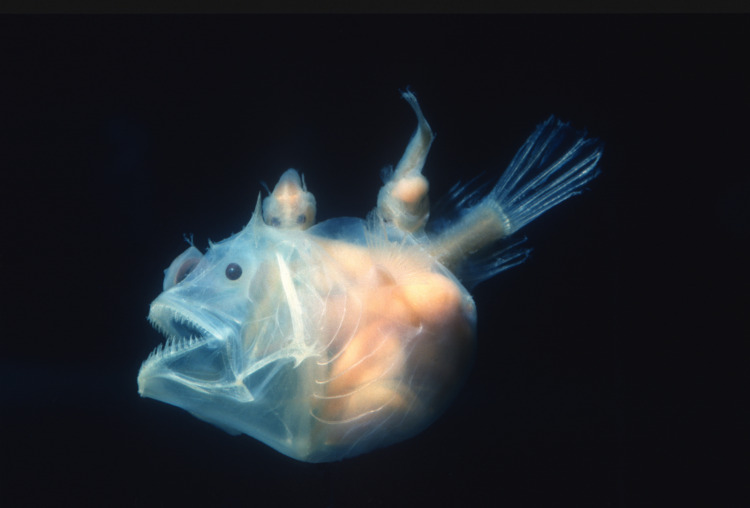
Examples include lanternfish with rows of photophores, anglerfish with glowing lures, squid that release glowing fluid, and plankton that flash when disturbed. Many Mariana Trench animals and other deep-sea species rely on darkness, pressure, and visual signals in ways that surface animals do not.
Terrestrial bioluminescence
On land, bioluminescence is less common but still remarkable. Fireflies and glow-worms use light for mating signals and, in some life stages, defense. Some fungi glow faintly on decaying wood, a phenomenon sometimes called foxfire. A few other land organisms, including some millipedes and beetle larvae, also produce light.
Fireflies are beetles, not flies. Their flashes can be species-specific, meaning the timing, rhythm, and color help potential mates recognize each other. That makes artificial light at night a real conservation concern because it can interfere with the signals fireflies use to find mates.
Why Do Living Organisms Glow?
Bioluminescence is not decorative from the organism’s point of view. Light costs energy, so it usually serves a biological purpose. The exact function can be hard to prove in wild deep-sea animals, but the major patterns are well documented.
| Function | How the glow helps | Example |
|---|---|---|
| Attract prey | A light acts like bait in dark water. | Anglerfish use a glowing lure near the mouth. |
| Avoid predators | A flash can startle, confuse, or distract an attacker. | Some squid and shrimp release glowing fluid. |
| Camouflage | Light on the underside matches faint light from above, hiding the animal’s silhouette. | Lanternfish and bobtail squid use counterillumination. |
| Find mates | Flashes or glowing patterns signal species, sex, or readiness to mate. | Fireflies and some marine worms use light signals. |
| Communicate | Light patterns can help animals recognize rivals, partners, or group members. | Some deep-sea fish and squid use controlled light displays. |
| Symbiosis | An animal hosts glowing bacteria; both partners benefit. | The Hawaiian bobtail squid houses bioluminescent bacteria in a light organ. |
Camouflage through counterillumination
Counterillumination is one of the most elegant uses of bioluminescence. In open water, predators looking upward may see prey as a dark silhouette against faint light from the surface. Some animals solve that problem by producing light on their underside, matching the brightness above them and making their outline harder to see.
The Hawaiian bobtail squid is a classic example. It provides a safe habitat for bioluminescent bacteria, while the bacteria help the squid reduce its shadow during nighttime activity. This kind of relationship shows how bioluminescence can shape behavior, anatomy, and microbial partnerships at once.
Why Is Ocean Bioluminescence Usually Blue or Green?
Most marine bioluminescence is blue or blue-green because those wavelengths travel best through seawater. Red and orange wavelengths disappear quickly as depth increases, while blue-green light can travel farther and be detected by more marine eyes.
That does not mean all bioluminescence is blue. Some organisms emit green, yellow, violet, or red light. Red bioluminescence is rare in the deep sea, but some dragonfish can use red light like a private spotlight because many deep-sea animals cannot detect it well.
What Makes Ocean Waves Glow at Night?
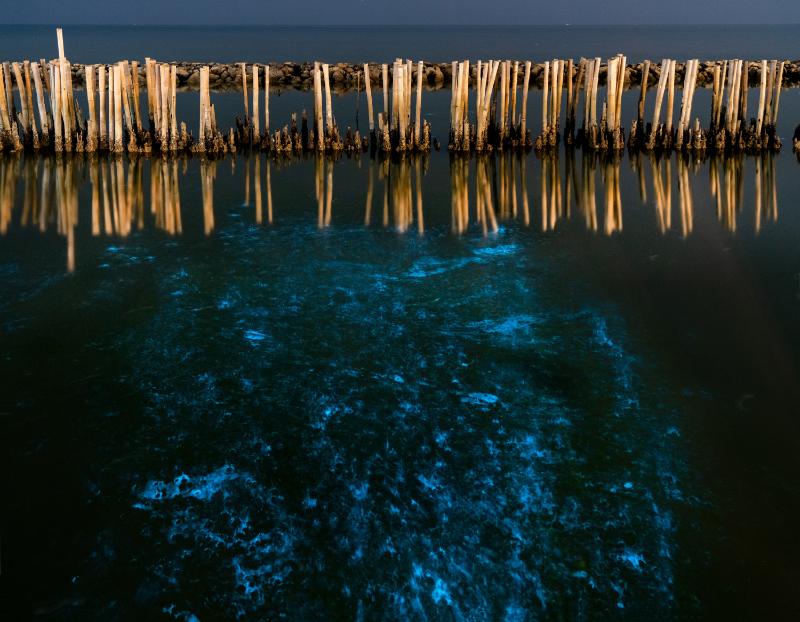
Glowing waves are usually caused by microscopic plankton, especially bioluminescent dinoflagellates. When waves break, a boat moves, or a person steps through shallow water, the physical disturbance can trigger tiny flashes. With enough organisms in the water, those flashes merge into a blue shimmer along the shore.
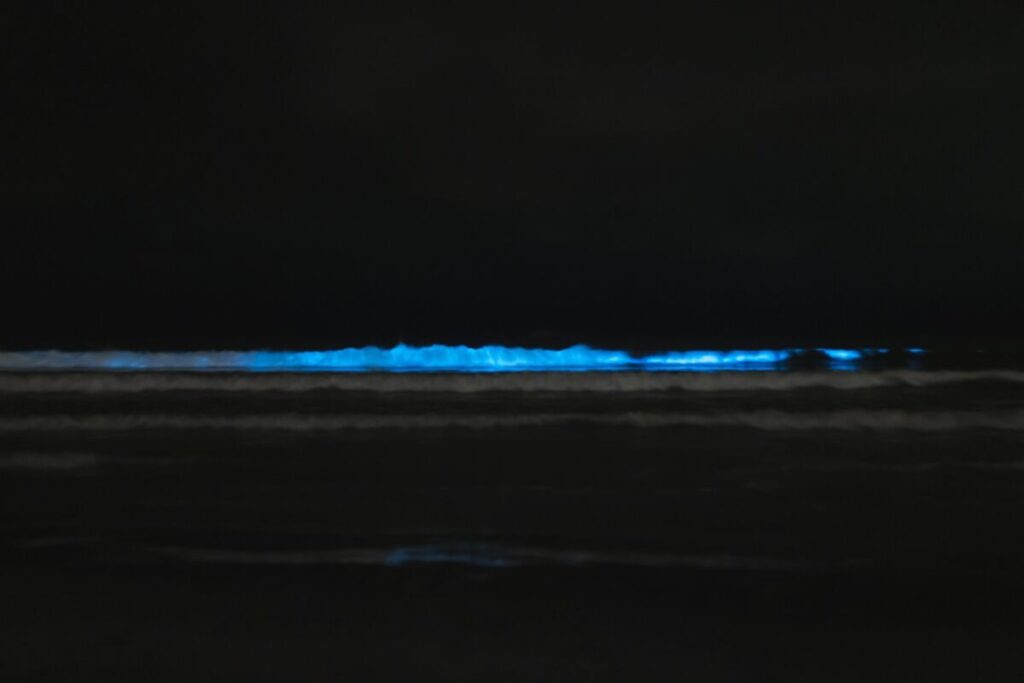
These glowing displays can be beautiful, but they are not a guarantee that the water is safe. Some algal blooms are harmless; others can produce toxins, reduce oxygen, or irritate skin and eyes. The CDC advises staying out of water that looks discolored, scummy, foamy, paint-like, or smells bad, and following local swimming, fishing, and shellfish advisories.
Examples of Bioluminescent Organisms
| Organism | Where it lives | How it uses bioluminescence |
|---|---|---|
| Fireflies | Fields, forests, wetlands, and gardens | Adults flash to attract mates; larvae may glow as a warning signal. |
| Dinoflagellates | Surface waters and coastal blooms | Flash when disturbed by waves, boats, or predators. |
| Anglerfish | Deep sea | Use a glowing lure to attract prey in dark water. |
| Lanternfish | Mesopelagic ocean zones | Use photophores for camouflage and signaling. |
| Hawaiian bobtail squid | Shallow Hawaiian waters | Uses symbiotic bacteria for counterillumination. |
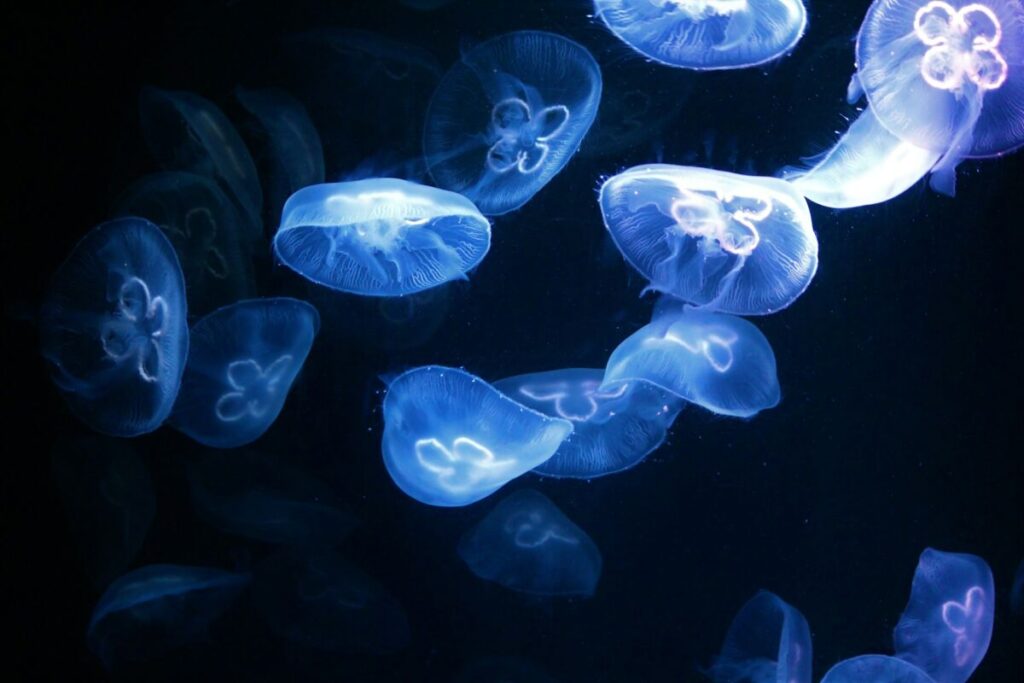
| Jellyfish | Coastal and open ocean waters | Some use light flashes, photoproteins, or fluorescent proteins as part of their light system. |
| Bioluminescent bacteria | Seawater, sediments, and animal light organs | Glow independently or in symbiosis with fish and squid. |
| Glowing fungi | Decaying wood and damp forests | Produce faint greenish light; possible functions include spore dispersal or defense, depending on species. |
Bioluminescence in Science and Technology
Bioluminescence is not only an ecological adaptation. It has become a major scientific tool. Researchers use luciferase reactions, fluorescent proteins, and related light-based markers to observe processes that would otherwise be invisible.

Green fluorescent protein, first observed in Aequorea victoria, helped transform cell biology because researchers can attach GFP to proteins or cells and watch where they move. The Nobel Prize in Chemistry 2008 recognized Osamu Shimomura, Martin Chalfie, and Roger Y. Tsien for the discovery and development of GFP.
Bioluminescent reporter systems are also used in gene expression studies, drug discovery, infection research, environmental monitoring, and ATP-based hygiene testing. The point is not to copy nature’s glow for decoration; it is to turn light into a measurable signal.
Conservation: Why Living Light Needs Darkness
Bioluminescence depends on darkness. For many species, especially fireflies, artificial light can make natural signals harder to see. Habitat loss, pesticide use, poor water quality, climate change, and light pollution all affect firefly populations. The Xerces Society reports that one in three assessed North American firefly species may be at risk of extinction, with many species still lacking enough data for confident assessment.
Simple actions can help: reduce unnecessary outdoor lighting, use motion sensors or shielded warm lights, avoid pesticides when possible, protect damp leaf litter and native vegetation, and observe fireflies without collecting them. These same habits support broader ecosystem health, not just the insects that glow.
Common Misconceptions About Bioluminescence
- Misconception: All glowing animals are bioluminescent. Some are fluorescent, meaning they need outside light first.
- Misconception: Bioluminescence is always blue. Blue-green is common in the ocean, but other colors exist.
- Misconception: Glowing beaches are always safe to swim in. Some glowing plankton displays are harmless to view, but harmful algal blooms require caution.
- Misconception: Fireflies are flies. Fireflies are beetles in the family Lampyridae.
- Misconception: Bioluminescence works the same way in every organism. The chemistry varies widely across bacteria, insects, fungi, jellyfish, fish, and plankton.
Frequently Asked Questions About Bioluminescence
What is bioluminescence in simple terms?
Bioluminescence is light made by a living organism. It happens when chemicals inside the organism, or inside bacteria living with the organism, react and release visible light.
What chemicals cause bioluminescence?
The best-known chemicals are luciferin and luciferase. Luciferin is the molecule that emits light after reacting with oxygen, and luciferase is an enzyme that speeds the reaction. Some organisms use photoproteins or different cofactors instead.
Why is most ocean bioluminescence blue?
Blue and blue-green light travel farther through seawater than red or orange light. That makes blue-green light more useful for communication, camouflage, and predation in many marine environments.
Are bioluminescent waves dangerous?
Not always. Many glowing wave displays come from plankton that flash when disturbed. Still, some algal blooms can be harmful, so avoid water that is discolored, scummy, foamy, smells bad, or is under a local advisory.
Is bioluminescence the same as fluorescence?
No. Bioluminescence creates light through a chemical reaction. Fluorescence requires outside light first; the organism or material absorbs that light and re-emits it at another wavelength.
Which animals are bioluminescent?
Bioluminescent animals include fireflies, glow-worms, jellyfish, comb jellies, some worms, crustaceans, squid, octopuses, anglerfish, lanternfish, dragonfish, and some sharks. Many bioluminescent systems also involve bacteria.
Why do fireflies glow?
Adult fireflies usually glow to find mates. Different species can have different flash patterns. In larvae, glowing may also warn predators that the insect is not a good meal.
Can humans use bioluminescence for lighting?
Bioluminescence is useful in science, but it is not a practical replacement for electric lighting at city or household scale. Its strongest applications are as precise biological signals in research, imaging, testing, and environmental monitoring.
The Bottom Line
Bioluminescence is one of nature’s clearest examples of chemistry becoming behavior. A glow can lure prey, hide a body, warn a predator, attract a mate, or help a scientist watch a living cell. It is most common in the ocean, but the same idea makes summer fireflies flash and forest fungi glow.
The next time you see blue waves or a firefly flicker, you are not just seeing beauty. You are seeing an organism use light as information.
Related Resources
- Mariana Trench: Exploring the Deepest Oceanic Abyss
- Incredibly Cool Sea Creatures to Know
- Sea Turtle Conservancy
Further reading: This page may include affiliate links. For a visual introduction to the topic, Glow: The Wonders of Bioluminescence is a reader-friendly book option for families, students, and nature lovers.