A stranded dolphin may survive for many hours with trained supportive care, but there is no safe fixed limit. Overheating, skin damage, stress, and pressure from its own weight can become life-threatening quickly.
This is different from asking how long a dolphin can hold its breath underwater. A dolphin on land can still breathe air through its blowhole, but it loses the physical support and cooling that water provides.
Found a stranded dolphin? Do not push, drag, roll, or return it to the water. Keep people and pets away, record the exact location, and contact an authorized marine mammal stranding network immediately.
Fact-checked against NOAA Fisheries, marine mammal stranding research, and specialist rescue guidance. Last reviewed July 14, 2026.
Key facts at a glance
- There is no universal survival countdown for a dolphin out of water.
- With proper care from trained responders, some stranded dolphins can remain alive for many hours.
- Dolphins breathe air through a blowhole, but being able to breathe does not make land safe for them.
- The main immediate threats include overheating, loss of body support, skin damage, stress, and the illness or injury that caused the stranding.
- A stranded dolphin should not be refloated until qualified responders have assessed it.
How long can a dolphin survive out of water?
A dolphin can sometimes survive for many hours out of water when trained responders provide cooling, physical support, monitoring, and veterinary care. The International Fund for Animal Welfare uses “many hours” rather than a fixed maximum because conditions vary widely.
That figure is not a safe waiting period or a guarantee. A dolphin can deteriorate well before several hours have passed, especially in direct sun, warm air, an unsupported position, or poor health. A dolphin that appears alert may also have an internal injury, infection, entanglement injury, toxin exposure, or another condition that caused it to strand.
The practical answer is therefore simple: treat every live dolphin stranding as an immediate wildlife emergency. The animal’s condition, not a stopwatch, determines its chance of survival.
Why can’t dolphins live on land?
Dolphins are marine mammals whose bodies are specialized for an aquatic environment. Water provides buoyancy, distributes pressure across the body, removes heat, protects sensitive skin, and allows movement. On land, those advantages disappear.
A published overview of cetacean strandings explains that a stranded cetacean cannot properly support its own weight. The resulting pressure can damage internal organs, while the animal may also overheat and develop dry, damaged, or sunburned skin.
| Risk | Why it happens on land | Possible result |
|---|---|---|
| Loss of buoyancy | The dolphin’s full mass presses against the ground instead of being supported by water. | Pressure on muscles and organs, impaired circulation, restricted breathing, and tissue damage. |
| Overheating | Blubber retains heat, while air and direct sunlight do not cool the body as effectively as water. | Dangerous rise in body temperature and worsening physiological stress. |
| Skin drying | Dolphin skin is adapted to constant contact with water. | Drying, cracking, abrasion, blistering, and sun damage. |
| Stress and struggling | Noise, crowds, handling, an unfamiliar position, and repeated attempts to move can intensify distress. | Exhaustion, muscle injury, shock, and reduced likelihood of successful release. |
| Loss of mobility | Flippers and tail flukes are built for swimming rather than supporting or moving the body across land. | The dolphin cannot safely walk or return to deep water without appropriate equipment and assistance. |
Can dolphins breathe on land?
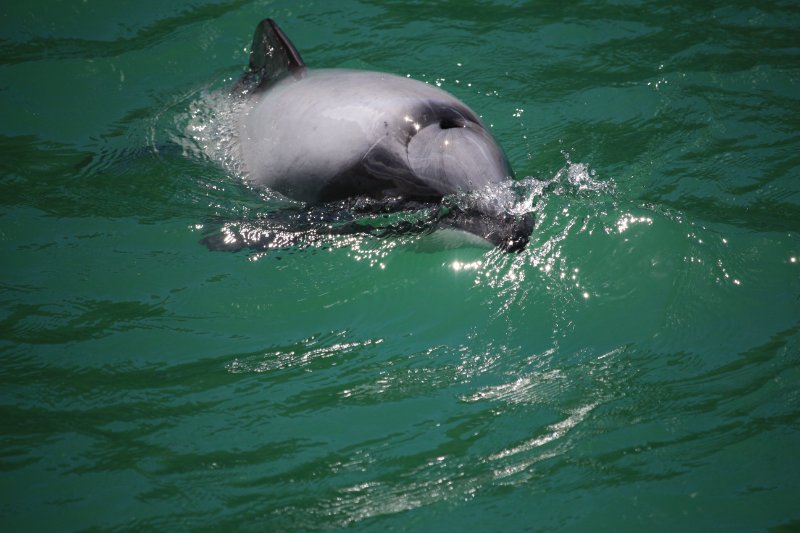
Yes. Dolphins breathe air through a blowhole connected to their respiratory system. They are mammals with lungs, not fish with gills. NOAA’s dolphin anatomy guidance confirms that dolphins must breathe atmospheric air.
A dolphin on land can therefore breathe as long as its blowhole remains clear and its body position does not severely compromise respiration. No water, cloth, sand, seaweed, or other material should cover or enter the blowhole.
Breathing air is only one requirement for survival. A stranded dolphin can still die from overheating, pressure-related injury, skin damage, stress, or an underlying medical condition even while it continues to take breaths.
What affects a dolphin’s survival time out of water?
No responsible source can calculate an exact survival time from species alone. Responders consider several interacting conditions:
- Air temperature and sunlight: Warm weather and direct sun accelerate overheating and skin damage.
- Body size and species: Size affects heat retention, handling requirements, and the amount of pressure placed on unsupported tissues.
- Health before stranding: Infection, trauma, starvation, toxin exposure, pregnancy complications, or entanglement can sharply reduce resilience.
- Body position and surface: Uneven rocks, hard sand, mud, surf, or an obstructed blowhole can create additional injury or respiratory risk.
- Length of exposure: Damage generally becomes more likely as the stranding continues, even when the animal initially appears stable.
- Speed and quality of the response: Rapid assessment and appropriate support from an authorized team can improve the available options.
What should you do if you find a stranded dolphin?
Do not begin hands-on treatment independently. Instructions can vary with the species, terrain, weather, tide, animal position, local law, and response team’s estimated arrival time.
- Call the appropriate stranding authority immediately. In the United States, use the NOAA regional stranding contacts. Outside the United States, use the Global Stranding Network guidance or contact the relevant wildlife or environmental agency.
- Give an exact location. Provide a dropped map pin, beach access point, nearby landmark, tide conditions, number of animals, and any visible injuries or entanglement.
- Keep people and pets back. NOAA recommends a distance of at least 50 yards, or 150 feet, in the United States. Follow any stricter local instruction.
- Observe from a safe distance. Note whether the animal is breathing, moving, bleeding, entangled, or repeatedly attempting to roll. Take photographs or a short video only if this can be done without approaching.
- Follow the responder’s instructions exactly. Do not touch, shade, wet, reposition, or move the dolphin unless an authorized responder specifically directs you to do so.
What not to do
- Do not push or tow the dolphin back into the ocean.
- Do not drag it by the tail, flippers, dorsal fin, or head.
- Do not roll or reposition it without professional direction.
- Do not cover the blowhole or pour water into it.
- Do not give the dolphin food, drinking water, medication, or other substances.
- Do not crowd the animal, make loud noises, pose for photographs, or allow dogs nearby.
- Do not assume that reaching the water automatically means the animal is safe.
NOAA specifically warns against moving stranded dolphins. Premature refloating may worsen an injury, prevent a medical assessment, cause the animal to strand again elsewhere, and put rescuers or bystanders at risk.
How do marine biologists rescue beached dolphins?
Marine mammal responders do more than return an animal to the sea. They first determine why it may have stranded, whether it can safely withstand transport or release, and which outcome is most humane.
- Secure the scene: Responders limit crowds, establish a safe working area, identify the species, and assess environmental hazards.
- Perform a health assessment: The team may monitor breathing, responsiveness, temperature, body condition, wounds, entanglement, posture, and other clinical signs.
- Provide supportive care: Depending on the approved protocol, trained personnel may use padding, wet coverings, cooling equipment, stretchers, slings, fluids, or other veterinary treatment while keeping the blowhole clear.
- Choose the safest outcome: Options may include immediate release, relocation to deeper water, disentanglement, short-term rehabilitation, longer veterinary care, or humane euthanasia when recovery is not realistic.
- Document and monitor: Teams collect measurements, samples, photographs, and health data. Released dolphins may be tagged or otherwise monitored when resources and permits allow.
According to NOAA’s stranding-response overview, professional teams may release, relocate, disentangle, rehabilitate, or humanely euthanize an animal depending on its condition. Immediate refloating is only one possible response.
Why do dolphins strand?
A stranding may involve one dolphin, a mother and calf, or a larger group. In many cases, the exact cause is not obvious at the scene and may remain uncertain even after examination.
Known or suspected causes include:
- Illness caused by viruses, bacteria, parasites, or other disease
- Injury from a vessel strike
- Entanglement or entrapment in fishing gear
- Exposure to harmful algal blooms or other environmental toxins
- Starvation, weakness, or poor body condition
- Unusual weather, tides, currents, or coastal geography
- Navigation errors in shallow water or complex bays
- Social behavior that causes healthy group members to follow a distressed dolphin
Stranding data also help researchers monitor disease, pollution, population health, fisheries interactions, and broader changes in marine ecosystems.
Can a stranded dolphin recover?
Yes, some stranded dolphins recover and return to the wild. The outcome depends on the cause of the stranding, the injuries sustained on land, environmental conditions, and how quickly qualified responders can assess and support the animal.
Other dolphins re-strand after release because the original illness, disorientation, injury, or local hazard remains. Some are too sick or badly injured to survive. In those cases, veterinary teams may determine that humane euthanasia is the least harmful outcome.
This uncertainty is another reason members of the public should not push a dolphin into the water. A professional examination is necessary to distinguish an animal that can be safely released from one that needs treatment or cannot recover.
Related dolphin guides
- Explore the different types of dolphins found in oceans and rivers.
- Learn why Hector’s dolphin faces severe conservation pressure.
- Read about the endangered South Asian river dolphin.
- See how the Hebridean Whale and Dolphin Trust supports cetacean research and conservation.
Frequently asked questions
How long can a dolphin survive out of water?
There is no safe universal limit. With trained supportive care, a stranded dolphin may survive many hours, but serious harm can develop quickly. Survival depends on temperature, health, body size, position, and response time.
Do dolphins breathe air or water?
Dolphins breathe air through a blowhole connected to their respiratory system. They have lungs rather than gills and must surface regularly to breathe.
Will a dolphin die if it stays out of water?
Yes. Prolonged stranding can become fatal. Major threats include overheating, pressure from unsupported body weight, skin damage, stress, and the illness or injury that caused the stranding. Breathing may also become compromised if the blowhole is obstructed or body compression becomes severe.
Should you push a stranded dolphin back into the ocean?
No. Immediate refloating can worsen injuries, delay medical assessment, and cause the dolphin to strand again. Keep your distance and contact an authorized marine mammal stranding network.
Can dolphins breathe on land?
Yes, a dolphin can breathe air on land if its blowhole remains clear. However, its body is adapted to water, so breathing ability does not protect it from overheating, body compression, skin damage, or stress.
The bottom line
A dolphin may remain alive out of water for many hours when trained responders provide effective supportive care, but there is no safe universal limit. A stranded dolphin can suffer serious harm from overheating, skin exposure, stress, and unsupported body weight even though it can still breathe air. Report the animal immediately, keep people and pets away, and leave handling or refloating to authorized professionals.
See Related: Hairy Long-Nosed Armadillo: Is This Species Endangered?
See Related: The Science of Frog Starvation: How Long Can They Go Without Eating