
California’s forests, deserts, coastline, and Central Valley wetlands hold one of the most biologically diverse — and most imperiled — collections of wildlife in the United States. Endangered species here range from the iconic California condor and the nearly vanished delta smelt (Hypomesus transpacificus) to little-known animals such as the Amargosa vole and Lange’s metalmark butterfly. Below are some of the state’s most notable endangered species and why they are at risk.
The idea of endangered species in California or elsewhere is not an old one.
In fact, during the Age of Enlightenment when people were inventing the printing press, marveling at astronomy, and increasing trade, they also thought that God would take care of the animals and would never let any of his creatures die unnecessarily.
As the scriptures had pointed out, so the logic went, the Creator had placed the animals on earth to serve mankind. A couple of centuries later, Charles Darwin made it clear that animal species did and could in fact expire and go completely extinct, as he documented so carefully in his writings.
As a result, today’s definition of “endangered” is literally those species, plant and animal, whose population is so small, they very well could be wiped out of existence in the modern day. For California that ranges from mammals to birds to plants in a biodiverse environment that ranges from deep, rich forests in the north to the arid desert of the Southern California valleys.
And it’s through awareness and protection, as well as conservation, that these species might still have a fighting chance to last versus becoming another statistic in the history books.
A Lot of Diversity in One Territory
California as a natural environment is big. With roughly 840 miles of Pacific coastline and habitats ranging from redwood forests to deserts, the state packs in more environmental variety than most states put together.
That said, development has taken a toll, and good number of species are on the brink in the state, either pushed to the edge by growing expansion of population interfaces or simply running out of natural territory that is critical for their survival.
Pollution is also charging a heavy price as chemicals, trash and ground-poisoning make once-expansive areas that given species thrived in inhabitable.
In short, protecting California’s endangered species is more than just making sure not to kill any more of their numbers. It’s also about protecting the landscape and environment that these species depend on to survive, which is a far more complicated affair.
See Related: Spectacled Bear
Notable Entries in the State’s Endangered List
Below is a list of what are some endangered species in California and the most notable as a state and territory. They include both mundane-looking animals and plants as well as some of the most iconic species that call California home.
Kings Gold
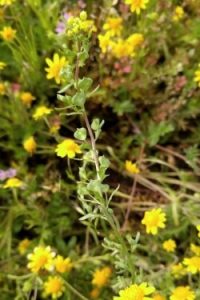
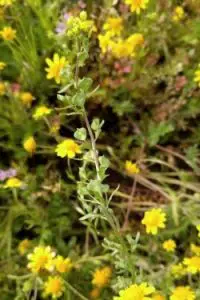
Scientifically known as Tropidocarpum californicum, this plant could be easily mistaken for a weed. However, it is a naturally-growing plant in California that has been in the state for centuries well before human beings showed up and started landscaping everything.
King’s gold (Tropidocarpum californicum) belongs to the mustard family (Brassicaceae) and produces small yellow flowers. It is endemic to Kern and Kings counties in the southern San Joaquin Valley, where it grows in moist, alkaline, sandy-clay soils. It carries a California Rare Plant Rank of 1B.1 and is considered critically imperiled, with only a few known occurrences remaining.
In fact, the rarer aspect of the plant is finding anyone that actually likes it as a species to begin with.
The greatest amount of Kings Gold grew near Tulare Lake, at least in terms of documented presence, much of that due to the fact that the soil in the particular area had a high level of alkaline in it, a key ingredient for the given plant. The last of the Tulare specimens died out sometime in the 1940s and haven’t been seen since.
Other areas and locations were rearranged by farming, irrigation or wiped out by localized climate change due to the variations created by human presence and development. Many specimens needed proximity to rivers, and these were swamped or flooded over as dams were built.
Its few surviving populations sit in alkaline flats of the Tulare Basin, where farm conversion, irrigation, and water diversion have destroyed most of its former habitat. Because the plant is an annual that depends on specific soil chemistry and seasonal moisture, even small changes to the land can wipe out an entire stand.
As more and more towns keep growing along I-5, and the corridor increases with traffic, eventually this singular patch could be affected as well.
See Related: Pygmy Three-Toed Sloth
The Delta Smelt
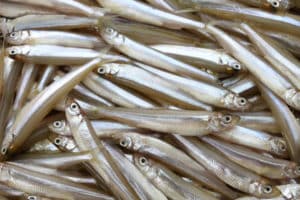
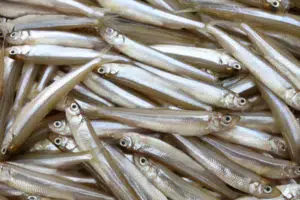
The delta smelt (Hypomesus transpacificus) is a small, translucent fish — tinier than an anchovy — found only in the Sacramento–San Joaquin Delta. It was listed as threatened under the federal Endangered Species Act in 1993 and is listed as endangered under California law. Decades of water diversions, invasive species, and habitat loss killed off the smelt in large numbers, and it is now considered functionally extinct in the wild.
For years it was one of the most famous creatures on the endangered species in California list. Part of the problem working against the Smelt is that it sits in the very water ways the state needed for irrigation of farmland as well as drinking water re-distributed to the southern areas. The Smelt have a bad habit of getting sucked into the various culverts and diversions, which in turn kill them off considerably.
Naturally, the Delta Smelt are a classic species that found a niche in the natural difference of California and were fine until people showed up. The waters of California range from the snowmelt to the watersheds that capture the runoff to the Delta and then eventually the salty ocean in the Bay Area.
The Smelt are a species of fish that found a way to thrive in the very thin barrier between the snowmelt waters and the ocean tidal waters full of salt. This diluted mix only exists in certain parts of the Delta, and it can be considerably changed as freshwater is diverted away upstream.
Once development started pulling freshwater out of the rivers prior to this mixing barrier, saltwater was able to move further and further up the Delta. The result essentially destroyed the habitat where the Smelt live, forcing them further up and closer to the diversions.
Suddenly, the remaining Smelt were either being eaten by freshwater animals, sucked into the diversion pumps, or being starved by newly-invading saltwater sea life like clams eating up their food source.
Recent monitoring surveys now catch almost no wild delta smelt, and since December 2021 the U.S. Fish and Wildlife Service and its partners have released hatchery-raised smelt into the Delta in an attempt to keep the species from disappearing entirely.
Again, however, the extinction won’t be mourned by some; the Smelt have been the source of a number of obstacles for development and would be better off gone in the minds of many.
See Related: Hawksbill Sea Turtle
The Amargosa Vole
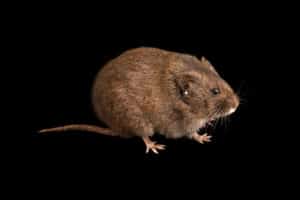
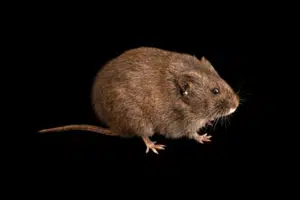
The Amargosa vole (Microtus californicus scirpensis), a mouse-faced rodent listed as federally endangered in 1984, survives only in a handful of spring-fed bulrush marshes near Tecopa, in the lower Amargosa River basin at the edge of the Mojave Desert. Only a few hundred remain in the wild. It handles the desert climate well, but only as long as its narrow marsh habitat stays intact.
When a number of biologists tried to re-plant this vole back in its area from captive specimens in 2015, they stressed out so much, the animals stopped drinking water and died in their cages before arriving. It’s indicative of how sensitive the species is to changes in its surroundings.
Naturally, the Amargosa vole could be found in a marsh that fostered and grew the plant known as a three-square bulrush. This plant is indigenous to the Death Valley region, and it grows very well when the ecosystem is in balance.
Unfortunately, farming reconstituted the ground water. That coupled with a drought basically spelled a death-knell for the plant, and the local marshland dried up. The vole started dying off just as much because its primary food source was disappearing. The species was saved in captivity by a combination of university and government experts who figured out how to sustain them.
The grand plan is to reintroduce the species back once the bulrush die-off conundrum can be solved. In the meantime, it’s a population in captivity at UC Davis that represents the remaining numbers of the Amargosa vole.
By 2015 a new colony was successfully started again outside of the lab, but the survival in the wild has been stop and go with extremely delicate protection. No surprise, the vole has a very high position on the endangered species in California category.
See Related: West African Manatee
The Tricolored Blackbird
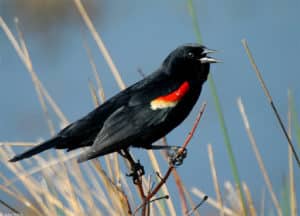
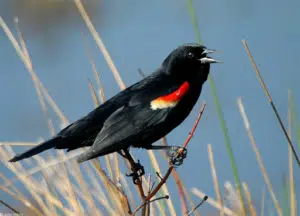
Some long-standing Californians might remember the tricolored blackbird (Agelaius tricolor) being far more plentiful decades ago. In April 2018 California listed it as threatened under the state Endangered Species Act, and the IUCN classifies it as endangered worldwide.
Nearly the entire global population nests in California — with only small numbers reaching Oregon, Washington, Nevada, and Baja California. The birds gather in dense colonies in spring to nest, then spread out the rest of the year, often toward grain fields. The combination of grain harvest time and the birds oftentimes ends with a lot of birds being killed by the harvesting equipment.
Statewide surveys recorded a roughly 44% drop between 2011 and 2014, and the 2017 survey still estimated only about 177,000 birds statewide. Farming, again, has been the primary mortality source of most of the birds, which doesn’t seem to be solvable anytime soon.
See Related: Asian Lion
The Buena Vista Lake Ornate Shrew
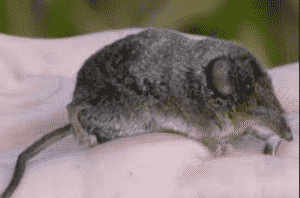
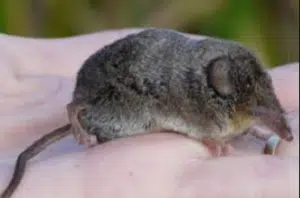
Another of the furry, mundane-looking mammals unique to the state, the Buena Vista Lake Ornate Shrew is a particularly hard creature to find now. Native to the wetlands of the southern Tulare Basin, the Buena Vista Lake ornate shrew (Sorex ornatus relictus) was listed as federally endangered in 2002; at the time, fewer than 30 individuals were believed to survive, and it is now known from only a handful of sites in Kern County. Again, another victim of development, the shrew was quite happy in the runoff with the Tulare Basin, the same waters that fed the Tulare Lake repository.
However, changes, development, and drought dried up the basin, and much of the wetland that the shrew called home disappeared. About 95% of its historic Tulare Basin wetland and riverine habitat has been lost to agriculture and water diversion, leaving roughly 5% of the original range. Scientists aren’t really sure if any of the shrew still survive today has it has been almost impossible to find signs of them, but it is unlikely they will last long as water continues to be diverted to farm, the main source of their wetlands even existing.
See Related: Great Hammerhead Shark
The Desert Slender Salamander
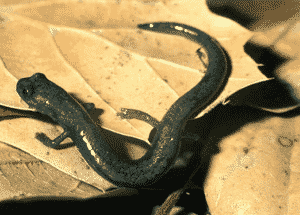
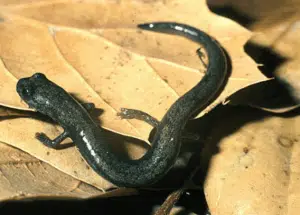
Among the endangered species in Southern California no one is quite sure whether the Desert Slender Salamander still exists, mainly because there hasn’t been a documented sighting of it for at least two decades. The desert slender salamander (Batrachoseps aridus) — listed as federally endangered in 1973 — was known from just two canyons, Hidden Palm and Guadalupe, in the Santa Rosa Mountains of Riverside County.
Unfortunately, the region has continued to keep drying out, and the recent extreme drought in the last ten years probably wiped out anything that was left of the species.
The desert slender salamander was discovered in 1969 and formally described in 1970, near Palm Desert. It survives on water seeping through canyon rock, relying on constant moisture to breathe through its skin. If the animal dries out, it can no longer breathe through its skin and dies. The last sighting of the creature was documented in 1996.
It’s possible a few might still exist in the area where they were first found, but biologists have stopped actively looking for it, officially signing it off as very likely extinct.
See Related: Great White Shark
The Lange Metalmark Butterfly
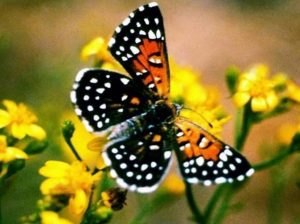
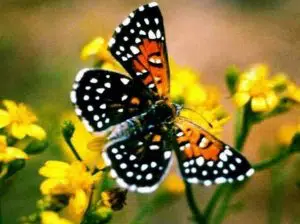
No one at first blush would ever expect a location like Antioch, California to be home to an endangered species. The East Bay city has been a blue color town known for a gritty existence, sprawling, unplanned development and strip malls.
That said, somehow biology has found a way to keep surviving in the area, and that’s the case with the Lange Metalmark Butterfly. The small orange, brown, and black Lange’s metalmark butterfly (Apodemia mormo langei) is found nowhere on Earth except the Antioch Dunes in Contra Costa County, and its caterpillars feed on a single plant — Antioch Dunes buckwheat, a form of naked buckwheat.
The Antioch Dunes sits right on the south shore of the nearby San Joaquin River, but the area has been ravaged as supply for brickmakers going as far back as 1906. The remaining habitat, protected as the Antioch Dunes National Wildlife Refuge, spans only about 55 acres, and invading plants keep crowding out the buckwheat the caterpillars need. The population collapsed from tens of thousands historically to just 45 adults in 2006; a captive-rearing program ran from 2007 to 2019 but could not reverse the decline. The last confirmed sighting was a single male in 2022, and none were found in the 2023 survey, leaving the butterfly likely extinct in the wild.
There are plenty of other contenders on the California endangered list, including the Sacramento River Chinook Salmon, the famous California Condor, and most notably the return of the gray wolf: a lone wolf known as OR-7 crossed into California from Oregon in 2011 — the first confirmed wild wolf in the state since 1924 — and the first breeding pack, the Shasta Pack, formed in 2015. Several packs now roam northern California.
All of these species and many more, however, share the same issue: human development and encroachment continue to keep pushing them into oblivion. Until humans can find a way to grow without continue to keep damaging the environment, the state will continue to see casualties added to the list of endangered species in California, increasing even faster with modern activity.
Related Articles